Below is the English translation of the text you provided.
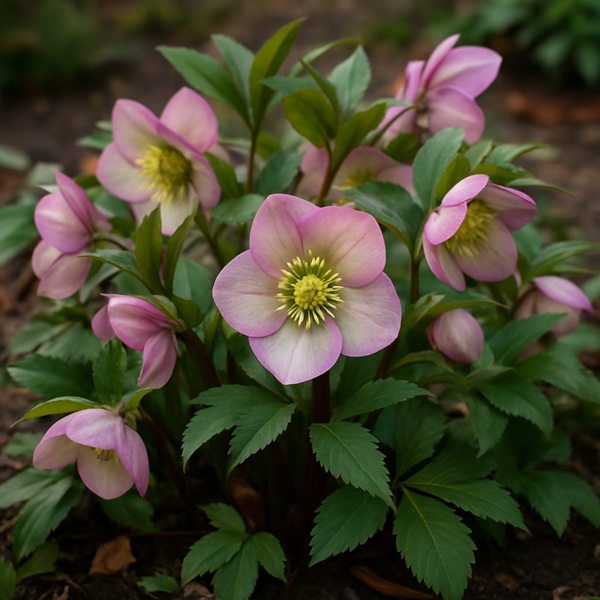
Hellebore, also known as Helleborus, is one of the most striking perennial plants, especially valued for its ability to bloom in early spring, often emerging straight from beneath the snow. In Ukraine’s conditions, hellebore establishes itself very well in open ground thanks to its hardiness and ability to withstand frosts down to -25 °C without additional cover. The key factor in successfully growing this plant is choosing the right planting site. Semi-shaded areas or places with diffused light are best, such as under tree canopies, near shrubs, or on the north-eastern side of a building. In deep shade, the plant will grow slowly, while in full sun the leaves will quickly wilt, especially during hot summer days.
Hellebore prefers neutral or slightly alkaline soil rich in organic matter. The plant does not tolerate standing water, so it is important to choose locations with good drainage. If the soil is heavy or clayey, it is advisable to add sand, compost, humus, and a small amount of lime. Before planting, the soil should be dug to a depth of 25–30 cm, removing weeds and the rhizomes of perennial plants. If planting a group of hellebores, leave at least 30–40 cm between planting holes. Although hellebore grows slowly, it forms powerful rosettes that need space.
The best time for planting is late August or early September, when the air temperature has already dropped, but the soil remains warm enough for rooting. Spring planting is also possible, although in that case the plant will need more time to adapt. After placing the plant in the hole, it should be carefully covered with soil, lightly firmed, and watered generously. It is recommended to mulch the root zone with rotted leaves or peat, as this helps retain moisture and protects the roots from temperature fluctuations. Within 2–3 years, in a well-chosen place, hellebore will begin to bloom steadily, bringing the joy of spring.
Hellebore is a long-lived plant capable of growing in one place for 10–15 years without transplanting, which makes it ideal for low-maintenance gardens. However, if desired, hellebore can be propagated in two main ways: by dividing the clump or by seed. Division is carried out in spring immediately after flowering has finished or in autumn, in September. For this, the plant is carefully dug up, trying not to damage the root system, and then divided with a sharp knife into 2–3 parts, each of which should have several growing points. After division, the sections are planted immediately in a new place, following the same rules as for the initial planting.
Seed propagation is a longer but fascinating process. Hellebore seeds quickly lose viability, so they should be sown immediately after harvesting, in June–July, into prepared beds or containers. The sowing depth is 1–1.5 cm. Seedlings usually appear the following spring, while full flowering occurs only in the third or fourth year. It should be remembered that seedlings may not retain the varietal characteristics of the mother plant, especially if these are hybrids. Therefore, this method is more often used to obtain new forms or for decorative experiments.
As for transplanting, hellebore tolerates it poorly. Even if all conditions are met, the plant may remain weak for a long time and fail to bloom for 1–2 seasons. That is why hellebore should be transplanted only when absolutely necessary, for example in cases of excessive overcrowding or worsening growing conditions. During transplanting, it is important to preserve the root ball as much as possible and avoid injuring the roots. After the procedure, the plant should be watered generously and mulched. It is best to transplant on a cloudy day or in the evening, and young plants up to three years old tolerate it much more easily.
Hellebore does not require complicated care, but there are several important horticultural practices that encourage active growth and regular flowering. In spring, when the snow melts, old leaves should be removed, especially if they have darkened or have spots. This helps prevent fungal infections and allows sunlight to reach the new shoots. At the same time, the first feeding can be carried out using a balanced mineral fertilizer with an emphasis on phosphorus and potassium, which stimulates bud formation.
In summer, the main attention is given to watering, especially during periods of drought. Hellebore does not like excessive moisture, but it also reacts poorly to prolonged dryness. Watering should be infrequent but deep, preferably early in the morning or in the evening. After watering, the soil should be loosened to ensure oxygen reaches the roots. Mulching around the base of the plant is also beneficial, as it preserves moisture, suppresses weed growth, and protects against overheating. Suitable mulching materials include bark, wood chips, and humus.
In the second half of summer, when active vegetation slows down, hellebore care comes down to keeping the area clean, preventing diseases, and removing faded flower stalks in time. In autumn, it is advisable to apply organic fertilizers such as humus or compost, or wood ash. This strengthens the plant before wintering. In regions of Ukraine with harsher climates, young plantings are better covered with spruce branches or dry leaves, especially during snowless periods. At the same time, mature plants generally do not require protection thanks to their high frost resistance.
Despite hellebore’s high resistance to most diseases, under unfavorable conditions the plant may suffer from pests and fungal infections. Most often, gardeners encounter leaf spot, powdery mildew, and black rot. These diseases are triggered by excessive moisture, overcrowded plantings, and lack of light. To reduce the risks, it is advisable to prune old leaves in spring and treat the plants with biofungicides. If spots appear, the affected leaves should be removed immediately and burned.
Among pests, the greatest danger comes from slugs, aphids, cockchafer larvae, and other soil-dwelling insects. Slugs actively feed on young leaves, especially in wet weather. To control them, traps, hand collection, or granular products based on iron phosphate are used. Aphids usually appear on buds and young shoots, causing distortion and stunted growth. Effective remedies include infusions of garlic, tobacco, or pepper, as well as specialized insecticides. In cases of severe infestation, treatments are carried out several times at intervals of 7–10 days.
Hellebore contains poisonous substances—alkaloids and cardiac glycosides—which naturally protect it from most pests. But for this same reason, care should be taken when handling the plant: all work such as transplanting, pruning, or dividing the clump should preferably be done while wearing gloves, especially if there are scratches or cracks on the hands. After finishing the work, hands should be washed thoroughly. Hellebore is not recommended for planting near children’s playgrounds or places accessible to pets because of its toxicity.
Hellebore is not only hardy and beautiful, but also combines wonderfully with other ornamental plants in shaded or semi-shaded flower beds. Thanks to its early flowering, it becomes a bright accent in the garden even before most plants awaken. Ideal companions for hellebore are spring primroses such as crocuses, squills, and snowdrops. The contrast between the large flowers of hellebore and the small spring plants creates a picturesque scene that brings the garden to life after winter.
After flowering has finished, hellebore remains decorative thanks to its carved dark green leaves. They can serve as a background for summer shade-loving plants such as hostas, astilbes, lungworts, ferns, and Solomon’s seal. These plants have similar growing requirements: moist, well-drained soil and moderate light. Such compositions look natural, harmonious, and do not require intensive care, making them ideal for decorative gardens in a natural style.
Hellebore also looks good in plantings along garden paths, around trees, or near shrubs, where it creates a green framing outline. Its frost resistance, endurance, and long life cycle allow it to be used as the basis for permanent compositions. It does not require annual replanting, does not need winter cover, and at the same time gives the garden spring flowering every year—the first and long-awaited one.
Hellebore has been known to humanity since ancient times. In medieval Europe, the plant was considered magical: protective amulets were made from it, and its roots were placed near the entrance to a house to drive away evil forces. Hellebore was also widely used in folk medicine as a remedy for heart ailments, skin diseases, and even epilepsy. However, because of its high toxicity, modern medicine limits its use, while gardeners value it for its ornamental qualities and hardiness.
Breeders are actively working on the creation of new hellebore varieties. The most popular are hybrids with dark burgundy, violet, or almost black flowers, as well as varieties with double or bicolored petals. Some varieties are capable of flowering for up to two months in a row, gradually changing shades. In Ukraine, not only the classic white-green forms but also exotic colored hybrids are becoming increasingly popular, suitable for flower beds, borders, and rock gardens.
Hellebore is not just an ornamental plant, but a true symbol of spring renewal, endurance, and natural beauty. Its flowers appear in the very first warm days, when snow may still be lying on the ground. With proper care, hellebore can decorate a garden for decades without demanding much attention. It is the perfect plant for those who want to make their garden come alive from the very first rays of the spring sun, giving it depth, texture, and unmistakable character.