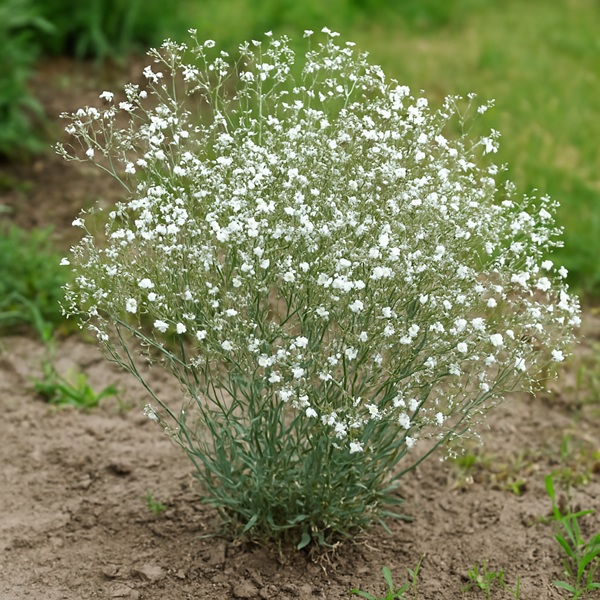
Gypsophila (Gypsophila) is an annual or perennial plant from the carnation family, valued for its light, airy appearance. It is popularly known as tumbleweed or “breathing grass,” and in floristry it is called the bride’s veil, since it is often added to wedding bouquets to create softness and volume. In the conditions of Ukraine, gypsophila grows very well both in open ground and in containers — it all depends on the selected species and the region.
Among more than 100 species of gypsophila, two are used most often in gardening: panicled gypsophila (Gypsophila paniculata) and creeping gypsophila (Gypsophila repens). The first is a perennial plant with strong stems that reaches up to 1 meter in height and blooms abundantly in mid-summer. It is ideal for cultivation in the central and southern regions of Ukraine, where the summer is long and warm. The second is a compact ground-cover form that forms dense cushions of miniature flowers and is suitable for rock gardens, borders, and alpine plantings. Annual varieties are also often available for sale (for example, Gypsophila elegans), which are grown through seedlings or by direct sowing into the soil. They are especially valued for their rapid growth and abundant flowering already in the first year.
Ukraine’s climate supports successful gypsophila cultivation in almost all regions — from the west and north to the south. But it is important to take the winter hardiness of the variety into account: perennial forms require good drainage and light winter cover, especially in the northern and western regions (Volyn, Chernihiv, Sumy). In the southern regions (Odesa, Kherson, Mykolaiv), gypsophila often overwinters without cover. Regardless of the region, it prefers open sunny areas with light, slightly alkaline or neutral soils, which are especially typical of the steppe and forest-steppe zones.
Tip: gypsophila combines beautifully with roses, irises, lavender, and echinacea — this highlights its transparent texture in flowerbed compositions.
Proper planting is the key to successful gypsophila development. This is a light-loving plant with a deep root system that tolerates transplanting very poorly. That is why it is important to determine a permanent place in the garden right away. In the conditions of Ukraine, especially on chernozem soils, attention should be paid to drainage and soil acidity — the main factors that affect growth and flowering. Planting can be done both in spring and autumn, depending on the species (annual or perennial) and the region.
Planting times and methods:
Annual varieties are sown in open ground in April–May, when the soil temperature reaches +10 to +12 °C. Winter sowing in October is also possible.
Perennial forms are better grown through seedlings (sowing in February–March) or by dividing the bush in spring (in April), but only if the plant is more than 3 years old.
Seedlings are planted into open ground in May, keeping a distance of 30–50 cm between plants.
Site selection: gypsophila needs at least 6–8 hours of direct sunlight per day. The best sites are southern or southwestern slopes, elevated places, or flowerbeds where moisture does not stagnate. It is ideal for rockeries, alpine slides, and even dry mixed borders.
Soil: the main requirement is good air permeability and drainage. Sandy loam or light loamy substrate with a pH of 6.5–7.5 is best. If the soil is acidic, it should be limed — in autumn or 2–3 weeks before planting. On heavy clay soils, it is advisable to create drainage layers or raised beds with added sand and compost.
Please note: perennial gypsophila is best not transplanted after planting — its root system is very sensitive to damage.
Caring for gypsophila is simple, but it requires consistency. It is an undemanding plant, but it is sensitive to standing water, shade, and soil compaction. The main period of active growth and flowering in Ukraine falls in June–August for perennial forms and June–September for annuals.
Watering: gypsophila is a drought-tolerant plant. Young seedlings need regular moderate moisture — 1–2 times a week during hot periods. Mature plants are watered less often, according to climate conditions. Water stagnation leads to rot, so it is better to underwater than overwater.
Feeding: 2–3 fertilizer applications per season are enough. In spring, use a complex fertilizer with an emphasis on nitrogen and potassium; before flowering, a phosphorus-potassium fertilizer is preferable. Organic infusions also work well (grass infusion or diluted manure at 1:10). Mineral fertilizers are applied in the evening to moist soil. Excess nitrogen stimulates greenery but suppresses flowering.
Pruning and shaping: after the first wave of flowering (July), faded inflorescences should be cut off — this stimulates repeat flowering. This is especially effective for perennial panicled gypsophila. Light shaping of the bush is also advisable. In autumn, the above-ground part is cut back almost to the root, leaving 2–3 cm of stems.
Tip: cut gypsophila branches can last up to two weeks in a bouquet. To extend their freshness, add sugar and citric acid to the water.
Gypsophila is not just a decorative crop for one season. With proper care, perennial species can grow in one place for up to 20–25 years, almost without needing transplanting. To achieve this, especially in the climate of Ukraine with uneven winters, the plant’s wintering should be organized properly.
Wintering features by region:
South (Odesa, Mykolaiv, Zaporizhzhia regions): usually no cover is needed. Pruning the above-ground part and mulching the soil with dry leaves or straw is enough.
Center and east (Kyiv, Poltava, Dnipropetrovsk regions): it is advisable to use light cover made of agrofabric or spruce branches, especially for young bushes.
North and west (Lviv, Sumy, Chernihiv regions): excessive moisture must be avoided. Plastic film is not recommended; it is better to use breathable cover and ensure good drainage.
One of the main factors is avoiding excessive moisture in autumn. Too much moisture often causes root rot, especially if there is a lot of rain or thawing periods occur. That is why in autumn it is worth checking the drainage capacity of the site and, if necessary, adding sand or creating a raised bed. It is also advisable to carry out preventive spraying with a fungicide after pruning — this reduces the risk of disease during dormancy.
Tip: do not mound up the root collar — it should remain at soil level. Excessive deepening can lead to rotting and the death of the plant.
Although gypsophila does not like transplanting, sometimes transplanting or dividing the bush is necessary. This should only be done in spring. Autumn transplanting almost always results in the loss of the plant. After transplanting, be sure to water delicately and treat with a root formation stimulant.
Gypsophila can be propagated both vegetatively and generatively (by seed). Each method has its own advantages and is appropriate in different cases. In Ukraine, seed sowing, cuttings, and division of mature bushes are used most often. Experienced gardeners sometimes also practice grafting, especially for rare decorative forms.
1. Seed method
Suitable for annuals and most perennial species:
Direct sowing: in April–May into open ground. Depth — 0.5 cm. Sow in furrows, then thin out. Flowering begins in 2–2.5 months.
Through seedlings: sowing in March. Pricking out after 2 leaves appear. Transplanting in May.
Before winter: in October, on beds with marked rows. In spring, the seedlings are hardened and vigorous.
2. Division of the bush
Used for panicled gypsophila that has been growing for more than 3 years. In spring, the bush is dug up and divided with a sharp knife into parts with 2–3 buds each. They are planted immediately, without allowing the roots to dry out. The cut surfaces are treated with ash or charcoal.
3. Cuttings
Done in June–July. Young shoots 5–8 cm long are planted in light sand under film. Roots appear in 2–3 weeks. This method is especially effective for varieties that do not produce seeds or when it is necessary to preserve the parent characteristics.
Tip: use root formation stimulants to improve the survival rate of cuttings (“Kornevin,” “Heteroauxin”). The ideal temperature for rooting is +20 to +22 °C.
Sometimes, for especially valuable varieties, grafting onto the roots of wild gypsophila is used. This is a complex but effective way to improve winter hardiness or adapt a variety to difficult soil conditions.
Gypsophila has natural resistance to many pests and diseases, but if agricultural practices are not followed, even it can become sick. Cultivation in shaded or waterlogged areas, as well as dense plantings without regular thinning, is especially dangerous.
Most common diseases:
Gray mold (botrytis): occurs in wet weather. A brown coating appears on stems and leaves. Remove the affected areas and treat with a fungicide (“Topaz,” “Fundazol”).
Fusarium: the leaves turn yellow and the plant wilts. Most often it affects the roots. It is difficult to save the plant — it is usually removed.
Rust: reddish-orange spots on the underside of the leaves. It is treated with “Hom” or Bordeaux mixture.
Pests:
Aphids: clusters of small insects on buds and young shoots. Control with “Fitoverm,” “Aktara,” or a soap solution.
Spider mite: thin webbing and pale spots on the leaves. Becomes active in drought. Regular moisture and insecticides help.
Thrips: cause silvery streaks on leaves and deform inflorescences. Treatment involves systemic preparations, for example “Confidor.”
Preventive measures:
Thin out plantings.
Water at the root, avoiding overwatering.
Remove all plant debris in autumn.
Treat with biofungicides, for example “Fitosporin,” twice per season.
Do not use fresh manure — humus or compost is better.
Tip: if gypsophila has been growing in one place for more than 5 years, rejuvenate or divide it to restore its ornamental appearance.