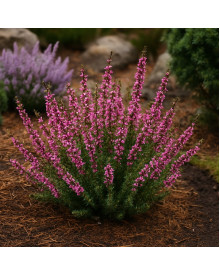
Heather (Calluna vulgaris) is one of the few dwarf shrubs capable not only of surviving but also of actively developing in nutrient-poor, acidic soils. However, for successful cultivation in Ukraine, it is important to take into account both the climate and soil characteristics. Heather originates from the harsh northern regions of Europe, where acidic peat soils and cool summers prevail. That is why its ideal conditions are sunny locations with loose, acidic, well-drained soil. Soil preparation is the key stage that directly determines the plant’s growth and flowering. If the soil on the site is neutral or alkaline, it must be acidified. This can be done by adding:
high-moor peat (mixed with sand and pine needles);
sawdust from coniferous trees;
sulfur or specialized acidifying fertilizers.
Special attention should be paid to drainage. Heather is extremely sensitive to stagnant water in the root zone: excess moisture combined with insufficient acidity will almost certainly lead to the death of the plant. For this reason, especially in the flat regions of Ukraine (Poltava, Kyiv, Vinnytsia regions), it is advisable to create raised beds or use a drainage layer of expanded clay, pebbles, or broken brick. The thickness of such a layer should be at least 10 cm. On top of the drainage, a special soil mix is added: 3 parts high-moor peat, 1 part sand, and 1 part coniferous soil.
The location also matters greatly. Although heather is a light-loving plant, it can tolerate light shade, especially in the southern regions of Ukraine, where summer sunlight is very intense. Under such conditions, partial shade at midday helps prevent overheating and drying out. In windy areas, it is worth providing natural protection with decorative stones, a hedge, or compatible neighboring shrubs that do not compete with heather for nutrients and space.
Proper planting of heather is an important step that determines how successfully the plant adapts. In Ukraine, the optimal planting period is spring, in the second half of April or at the beginning of May, when the threat of return frosts has already passed and the soil has warmed up sufficiently. Autumn planting is also possible, but undesirable: the short growing season does not allow the saplings to root fully, especially in the eastern and northeastern regions with early frosts.
When planting, it is necessary to take into account the width of the crown of a mature bush. Heather is a group plant rather than a solitary one. It looks best in masses or clusters of 5–10 plants. The distance between plants depends on the variety: compact forms are planted 30–40 cm apart, while spreading ones need 50–60 cm. When creating “heather gardens” or borders, it is better to use a staggered pattern, which ensures even development and prevents overcrowding. The planting hole should be 25–30 cm deep, taking the drainage layer into account. The roots are spread very carefully so as not to damage the sensitive mycorrhiza — the symbiotic fungus that provides nourishment to heather. The plant does not like transplanting, so it is better to choose a permanent place right away.
After planting, the saplings are watered generously with acidified water (pH approximately 4.5–5.5). The water can be acidified with citric or acetic acid (1 teaspoon per 10 liters of water), or rainwater can be used. Then the soil surface is mulched. Suitable materials include:
well-rotted conifer sawdust;
fine pine bark;
conifer forest litter.
Mulch protects the root system from overheating, reduces moisture evaporation, and maintains soil acidity. It is important to remember that heather roots are shallow and can be easily damaged by loosening, so instead of loosening, the mulch is simply renewed as it becomes compacted.
Despite its reputation as a drought-tolerant plant, heather in the conditions of Ukraine requires regular watering, especially during the first 1–2 years after planting. Its shallow root system reacts quickly to drying of the upper soil layer, while excessive moisture is also harmful. The optimal schedule is once a week in the absence of rainfall. In the hottest months (July–August), especially in the southern and central regions of Ukraine, watering is increased to 2–3 times a week. It is very important to use soft water: rainwater, filtered water, or settled water. Hard water containing calcium and alkaline impurities gradually makes the soil more alkaline, which negatively affects the plant’s health.
To maintain the decorative appearance of heather, moderate feeding is required. The plant reacts poorly to excess nitrogen, which stimulates green mass growth at the expense of flowering. The best choice is specialized fertilizers for heather plants or rhododendrons. They are applied in spring, at the beginning of the growing season. Recommended options include:
complex fertilizers with a predominance of phosphorus and potassium;
magnesium supplements, especially on sandy soils;
iron-containing products if signs of chlorosis appear.
Feeding is carried out 1–2 times per season, always on moist soil, avoiding contact of fertilizer with the leaves and shoots. Organic matter (humus, manure) should not be used, as it is alkaline and can change the pH. In autumn (September), a small dose of potassium-phosphorus fertilizer can be applied to improve winter hardiness.
Heather care also includes sanitary pruning. It is carried out in spring, before sap flow begins. Dry, damaged, and weakened shoots are removed, and a compact bush is shaped. Overly severe pruning is not recommended, since flower buds form on the previous year’s shoots. Only the faded inflorescences are cut back, slightly shortening the tips by one-third of their length. This stimulates thickening of the bush and more abundant flowering in the next season.
Although heather belongs to frost-resistant plants, under Ukrainian conditions it requires additional protection, especially in the eastern and northeastern regions, where winter temperatures may fall to −25 °C or lower with unstable snow cover. Even the hardiest varieties suffer not so much from frost as from frequent thaws, wind, and drying of the leaves by the winter sun when the root system is still in frozen soil.
Preparation for winter should begin as early as September–October. During this period, watering and feeding are stopped, especially if autumn is rainy. This helps the plant gradually enter dormancy. The soil around the bushes is generously mulched with peat, conifer litter, dry leaves, or sawdust, forming a layer 10–15 cm thick. This protects the root system from freezing and sudden temperature fluctuations. In addition, hoops can be installed over the above-ground part of the plant and covered with nonwoven material — agrofabric with a density of 50–60 g/m². Such material does not interfere with gas exchange, retains heat, and protects the evergreen leaves from sunburn.
In regions with mild winters and abundant snowfall (Lviv, Zakarpattia, Ivano-Frankivsk regions), heather often overwinters successfully without cover, especially if it grows in groups. However, in the north and east of the country (Chernihiv, Sumy, Kharkiv regions), significant damage is possible without winter protection. In early spring, it is important to remove the cover gradually in order to avoid overheating and damping off. This is best done in cloudy weather in late March or early April. It is also necessary to avoid sudden exposure of the leaves to bright sunlight after the cover is removed, as this may cause burns on the weakened plant.
Propagating heather is not only a way to increase the number of ornamental bushes on the site, but also an opportunity to preserve valuable varieties or forms. In Ukraine, several methods are used: seed propagation, cuttings, division of the bush, and rooting by layering. Each method has its own advantages and specific features that should be taken into account.
Seed propagation is the most difficult and slowest, but it allows many plants to be obtained. The seeds are sown in March–April in containers with an acidic substrate (a mixture of peat and sand in a 2:1 ratio). They are not covered with soil, but only lightly pressed into the surface. The containers are covered with glass or film and placed in a warm location with a temperature of +18...+22 °C. Seedlings appear after 3–4 weeks. The seedlings grow very slowly: they are planted in a permanent place no earlier than after 1.5–2 years, and flowering begins only in the 3rd or 4th year. This method is mainly suitable for botanical collections or professional nurseries.
Cuttings are the most common method of propagating heather in Ukrainian conditions. In July–August, young semi-woody shoots 5–7 cm long are cut. The lower leaves are removed, the cuttings are planted in an acidic peat-sand mixture at a 45° angle, and covered with jars or mini-greenhouses. Rooting takes 6–8 weeks at a temperature of +18...+20 °C. It is important to maintain stable moisture without water stagnation. In autumn, the rooted cuttings are transplanted into pots and kept in a cool room until spring. In spring, the young plants are planted in open ground.
Division of the bush and propagation by layering are simpler methods for those who already have mature plants. Division is carried out in spring or autumn: the bush is carefully dug up and divided into several parts with roots. They are replanted immediately in new places. It is important not to damage the central part of the plant. Layering is done in June–July: a flexible shoot is bent to the ground, fixed with pins, and covered with acidic substrate. Roots form in 2–3 months. In autumn or the following spring, the young plant can be separated from the parent. This method works especially well in moderately humid regions such as Zhytomyr or Cherkasy regions.
Although heather is considered relatively resistant to diseases and pests, problems may arise if cultivation practices are not followed properly or if there is excessive moisture. This is especially true in the western and northern regions of Ukraine, where the climate favors the spread of fungal infections.
The most common diseases are:
Phytophthora — causes wilting, darkening, and dieback of shoots. The main cause is stagnant moisture in the root zone.
Gray mold — appears as a gray coating on leaves and shoots. It spreads in damp weather and in dense plantings.
Powdery mildew — less common, but it occurs during sharp temperature fluctuations. A characteristic white coating appears on the leaves.
Prevention includes:
proper planting with drainage;
controlled watering;
removal of diseased plant parts;
regular mulching.
If symptoms of disease appear, fungicides such as “Fundazol,” “Previkur Energy,” and “Hom” are used. Spraying is carried out in the evening or in cloudy weather, and repeated after 7–10 days if necessary.
Pests that may threaten heather in Ukraine include spider mites, aphids, and scale insects. They develop especially actively in hot, dry years. The best protection is regular inspection and preventive treatment with insecticides such as “Fitoverm” and “Actellic,” as well as general strengthening of the plants through proper care.