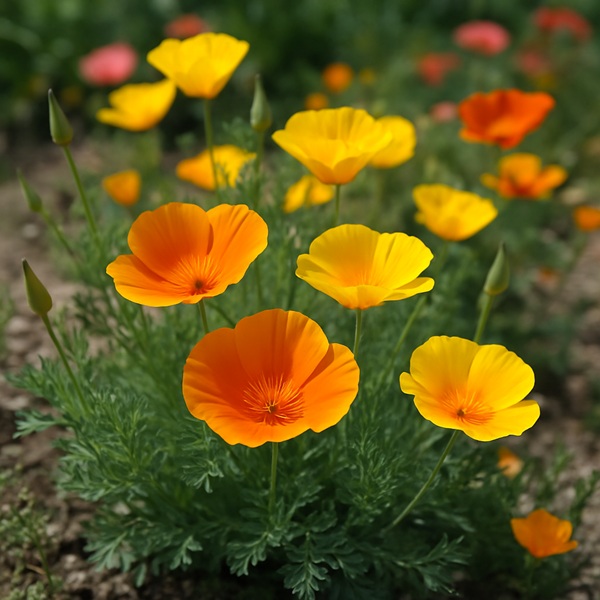
Eschscholzia, also known as the California poppy, is a graceful annual plant that attracts attention with its bright flowers and delicate, lacy foliage, creating a sense of natural lightness in any flower bed. Its thin, elegant stems are crowned with vividly colored blooms — most often yellow or orange, although pink, cream, salmon, and purple shades also exist. Unlike its relative, the opium poppy, eschscholzia contains no narcotic substances and is completely safe to grow in home gardens. This plant originates from the southwestern part of North America, where it grows in sandy soils under an arid climate, which explains its excellent adaptation to Ukrainian conditions, both in the south and in the north.
For Ukrainian gardeners, eschscholzia is appealing not only as an ornamental plant, but also because of its unpretentious nature. It tolerates heat well, is not afraid of short periods of drought, and does not require constant watering or fertilization. In open ground, the plants create bright floral “carpets,” ideally complementing mixborders, rabatkas, alpine gardens, or sunny areas along pathways. Eschscholzia is especially often planted along borders, since its flowers open only in sunny weather and close in the evening or before rain — this gives the garden a lively sense of movement.
In addition to its decorative value, eschscholzia also deserves attention as a medicinal plant. In folk medicine, infusions made from its petals are used to improve sleep and reduce nervous tension. It also attracts bees and other pollinators, which is an added bonus, especially near fruit and berry crops. All of this makes eschscholzia increasingly popular among Ukrainian flower growers. And although this plant is quite undemanding, proper planting and basic care ensure abundant and prolonged flowering.
Eschscholzia is not highly demanding, but for its full development several basic factors matter. The most important of these is light. In shade or even partial shade, the plant becomes stretched, the flowers open only partially, and flowering itself becomes weak and short-lived. That is why it should be grown in open sunny areas, preferably with southern or southwestern exposure, protected from wind and water stagnation. The plant does especially well in raised beds, along pathways, or on sandy slopes.
Soil is the second important factor. Eschscholzia prefers light sandy loam or sandy substrates with good drainage. In rich, “fat” soils, it produces too much greenery and loses flowering intensity. With excessive moisture, there is a risk of root rot. Heavy clay soils need prior improvement — by adding sand, compost, or perlite. The optimal acidity is slightly alkaline or neutral, with a pH of 6.5–7.5.
Sowing in open ground is done in spring, from mid-April to early May, when the soil has already warmed up but still retains natural moisture. In the southern regions of Ukraine, sowing begins earlier, from late March. For long, uninterrupted flowering, sowing is practiced in several stages, with intervals of 2–3 weeks. This approach allows you to get “waves” of flowering from June to September. In addition, winter sowing in autumn is possible, producing strong, hardened seedlings in spring.
Eschscholzia is propagated only by seed, and it is best sown directly into open ground without prior germination. This approach is the most effective, because the plant has a taproot system that does not tolerate transplanting well. Although the seedling method is possible, it requires particular care: during pricking out, the main root is easily damaged, which slows development. So direct sowing is the main and most convenient method for Ukrainian conditions.
Seeds should be sown into prepared furrows at a depth of 1–1.5 cm. The distance between rows should be about 25 cm, and between plants 15–20 cm. Overcrowding is undesirable, because it leads to stretching and weaker flowering. After sowing, the soil is lightly firmed or dusted with sand. The first seedlings appear within 7–10 days under favorable temperatures. Until they emerge, the soil should be kept from drying out completely, with moderate watering if necessary.
When the seedlings grow stronger, the plantings are thinned, leaving the strongest specimens. Fertilizing is not needed at this stage, especially if the soil was improved beforehand with humus or ash. Later, eschscholzia does not require intensive feeding: it is enough to apply a complex mineral fertilizer with increased phosphorus and potassium content 1–2 times per season. Feeding is done during budding and at the peak of flowering.
By nature, eschscholzia uses moisture very economically. In the dry climate of California, where it comes from, rain is rare, so the plant has adapted perfectly to limited moisture. This is exactly why it is ideal in Ukrainian gardens for regions with limited watering or for plots where daily care is not possible. However, during the first 2–3 weeks after seedlings emerge, as well as during long dry periods, regular soil moisture is necessary.
Watering should be deep but infrequent — it is better to water less often but more thoroughly, so that moisture penetrates into the lower layers of the soil. Surface watering encourages weed growth and gives the plant little benefit. The best time for watering is in the morning. In the southern regions, this helps prevent overheating, and in the northern ones, it helps avoid excess moisture overnight. During rainy periods, especially in western Ukraine, extra watering may not be needed at all.
In addition to watering, important care measures include weeding and loosening. Eschscholzia does not like competition from weeds, especially when young. Regular loosening prevents the soil from compacting and allows the root system to breathe. Mulching is particularly effective: it reduces moisture evaporation, suppresses weed growth, and preserves a stable soil structure without frequent interference.
Although it looks delicate, eschscholzia is actually quite resistant to most diseases and pests. However, with excessive moisture or dense planting, it can still become diseased, especially during cool summers typical of western Ukraine. The main threats include:
Root rot — most often occurs when moisture stagnates in heavy soils. Symptoms include wilting and blackening at the base of the stem.
Mold — appears in dense plantings and during frequent rains. It develops on leaves and buds.
Powdery mildew — a white coating on the leaf surface, appearing in damp air.
To prevent disease, the following measures should be observed:
plant with proper spacing;
ensure good ventilation in the planting;
do not overwater;
remove dead plant parts regularly.
At the first symptoms, biofungicides such as Fitosporin or copper-based preparations may be used. As for pests, the most common are:
Aphids — appear in hot weather. They can be removed with a soap solution or Fitoverm.
Thrips — tiny pests that cause silvery spots on the leaves. Systemic insecticides such as Aktara or Confidor are effective.
Slugs — may damage leaves in rainy weather. Traps, ash, or Groza granules work well.
Overall, eschscholzia remains a low-risk crop, which is one of the reasons for its popularity in organic and natural-style gardens.
One of the main advantages of eschscholzia is its ability to flower for a long time and very abundantly. With proper care, it decorates the garden from early June until the first autumn frosts. But to maintain flowering at its peak, a few simple rules should be followed. The most important is to remove faded flowers in time. This not only improves the appearance of the planting, but also stimulates the formation of new buds.
Another method is staggered sowing. If seeds are sown at intervals of 2–3 weeks, continuous waves of flowering can be ensured. While some plants lose their ornamental value, others are just beginning to bloom. This is especially appropriate in borders, near gazebos, or in front gardens. The same approach is also effective in naturalistic plantings and public flower beds.
To collect seeds, several flower heads are left to mature. About 3–4 weeks after flowering, the seed pods dry out, turn brown, and begin to open. They should be cut before they split open and then dried further in paper bags. The seeds should be stored in a dry, dark place. They remain viable for 2–3 years. In this way, eschscholzia not only decorates the garden, but also allows plantings to be renewed every year at no extra cost.
To sum up, eschscholzia is an example of the perfect balance between beauty and simplicity. It is suitable for both beginners and experienced gardeners. It is a flower that brings joy without trouble.