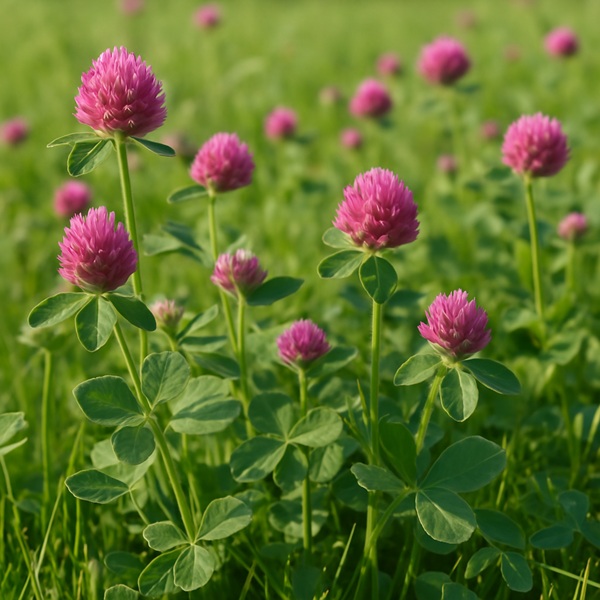
Clover is more than just grass. In Ukraine, where soils are depleted in some areas and the climate is not always stable, this crop is a real find: it improves soil structure, enriches it with nitrogen, suppresses weeds, and delights the eye with dense greenery.
The plant is successfully grown both on farms and on private plots — at the same time serving as a green manure crop, lawn cover, livestock feed, and even a decorative element in the garden landscape.
Farmers value clover for its high yields, while homeowners appreciate its low-maintenance nature and natural decorative appeal. It is especially useful in organic farming, since it does not require chemicals to grow and recovers well after mowing.
It blooms for a long time and abundantly, making it a favorite among beekeepers: clover honey not only has a pleasant taste but also healing properties. It is no surprise that in recent years interest in this crop has been growing both among farmers and supporters of eco-friendly approaches.
There are many varieties of clover, but in Ukraine the two most common are meadow clover (red clover) and creeping white clover. The first is an excellent choice for forage and mulch production, while the second is a favorite for ground cover landscaping and creating durable lawns. Each type has its own advantages, and the choice depends on the specific goals of the landowner.
Clover prefers light and moderate moisture. It does not tolerate standing water, but drought is also harmful to it, especially at the germination stage. Ideal growing conditions are areas with good aeration, drainage, and access to sunlight. This is especially relevant for white clover, which is often sown as lawn grass: in the shade it loses its density and attractiveness.
What should be taken into account:
Soil. Clover grows best in neutral or slightly acidic soils. If the acidity level is below pH 5.5, liming should be carried out.
Previous crops. Cereals, vegetables, or fallow plots are ideal. After perennial plants with a powerful root system, it will be difficult for clover to establish itself.
Cultivation. The area must be carefully cleared of perennial weeds, especially root-suckering ones. In the early stage of development, clover grows slowly and cannot withstand competition.
Before sowing, the soil is dug over, loosened, and leveled. Humus or compost is added. Phosphorus-potassium fertilizers are acceptable, but in moderate amounts — clover will receive its main nutrition from the air thanks to its symbiosis with root nodule bacteria.
An interesting technique is inoculating the seeds with such bacteria before sowing: this increases survival and activates nitrogen fixation.
Sowing dates in Ukraine depend on the region. In the southern and central regions, the best time is March–April, as soon as the soil warms up to 5–6°C. In the northern and western regions, sowing is often shifted to late April.
Winter sowing is also possible: it allows for early, uniform emergence in spring, but it is important to prevent the seeds from germinating before frost begins.
Sowing technique:
Seeding rate — from 1 to 2.5 kg per 100 square meters, depending on the variety and purpose (lawn, forage, green manure).
Sowing depth — no more than 1–2 cm. If buried deeper, the small seeds may fail to emerge.
Method — manual or mechanical, preferably followed by rolling the soil, especially during spring sowing. This improves seed-to-soil contact.
Recommendation: because the seeds are very small, they are often mixed with sand in a 1:5 ratio to ensure even distribution. Sometimes clover is sown in a mixture with bentgrass, ryegrass, or oats — in such cases it acts as a nitrogen donor and soil stabilizer.
After sowing, it is important to maintain moderate moisture. The plant needs moisture at the germination stage, but it does not tolerate waterlogging. During the first 2–3 weeks, clover develops slowly and is especially sensitive to weeds. In small areas, manual loosening or spot weeding is recommended.
After the first seedlings appear, clover does not require much effort, but proper care at this stage is especially important. The first 3–4 weeks are the most vulnerable: young plants gain strength slowly, and any external factors such as drought, shading, or weeds can negatively affect the density and uniformity of the cover.
If the plant is grown as green manure or a forage crop, maintenance will be minimal, but if clover performs a decorative or lawn function, regular care procedures should be followed.
Watering is necessary only during dry periods. At the same time, it is important not to allow overwatering, which harms the root system and provokes fungal diseases. One moderate watering per week in the absence of rain is quite sufficient, especially when the clover has already formed a dense cover.
Regular mowing stimulates branching, strengthens the root system, and rejuvenates the plant. After mowing, the green mass recovers quickly, maintaining an attractive appearance throughout the warm season.
Special attention should be paid to weed control. At an early stage of development, weeds can suppress clover. However, after forming a dense cover, it becomes a natural barrier against unwanted vegetation itself.
If the plant is used as a lawn component, herbicides should not be used. It is better to apply mechanical weeding or remove weeds by hand during the first weeks after sowing. Later, clover will become a natural filter, crowding out competitors thanks to its density.
Clover is fairly resistant to most diseases, but if growing conditions are disrupted, certain problems may arise. The most common in Ukraine are anthracnose, powdery mildew, and rust. All these diseases occur mainly in conditions of high humidity, especially if the sowing is too dense or not mowed regularly.
To avoid infection, it is enough to follow basic agricultural practices: control moisture, avoid overcrowding, and mow on time.
Anthracnose appears as brown spots on leaves and stems. At the first signs, it is advisable to mow the grass and remove it from the site — this prevents the spread of infection.
Powdery mildew appears in hot and humid weather, especially on white clover. It can be controlled by regular trimming and removing affected plants. If necessary, natural infusions can be used — for example, garlic or conifer needle extracts.
Among pests, the greatest danger comes from clover cutworm, aphids, meadow moths, and thrips. They damage leaves and flower heads, which affects both decorative appearance and yield. In small areas, they can be collected by hand or treated with a soap solution.
In extreme cases, biological products based on Bacillus thuringiensis or plant-based insecticides may be used. At the same time, it is important to consider bee safety, especially if clover is grown as a honey plant.
Prevention is the most effective method. Regular mowing, crop rotation, moisture control, and proper agricultural practices create natural immunity. And healthy clover, in turn, becomes a barrier not only to weeds but also to pests, forming a self-sustaining ecosystem on the plot.
Perennial clover varieties, especially creeping white clover and hybrids, winter successfully in most regions of Ukraine. At the end of the growing season, clover does not require complex preparation for winter. The main thing is to avoid standing water in autumn and carry out the last mowing no later than the end of October.
This allows the plant to better withstand frost and prevents damping off.
An interesting fact: even if clover looks destroyed after winter, its underground buds and nodules often survive under the snow, and in spring they form young shoots again. By May, the area is covered with greenery once more. This is especially convenient for lawns — the cover restores itself without the need for reseeding.
However, after 2–3 years it is advisable to carry out partial renewal of the planting, especially if the clover has lost density or suffered from pests or drought.
For renewal, surface overseeding is used — without digging, simply distributing seeds over the thinned areas and lightly rolling them in. This can be done in spring or autumn, depending on the condition of the cover.
It is also beneficial to combine clover with other perennial crops — for example, bentgrass, bluegrass, or timothy. This helps maintain a stable, dense cover throughout the season.
Clover in the landscape and in the garden is not just a practical solution, but also an aesthetic one. A soft green carpet, resistant to trampling and temperature fluctuations, will decorate an area no worse than expensive lawn grasses.
And when you add its ecological value, ease of care, and benefits for the soil, it becomes clear: clover is a strategic crop for sustainable agriculture and eco-friendly gardening in Ukraine.