Chlorophytum is one of the most undemanding, hardy, and versatile indoor plants, confidently holding a leading position among декоративно-листяні plants in Ukraine. It is native to the tropics and subtropics of Southern Africa, but thanks to its adaptability, it has spread throughout the world. In Ukraine, chlorophytum thrives in apartments, on loggias, in offices, schools, and hospitals, and in summer even on balconies and terraces. Its main advantages are resistance to temperature fluctuations and drought, tolerance of partial shade, and the ability to purify the air from toxins, dust, and harmful substances.
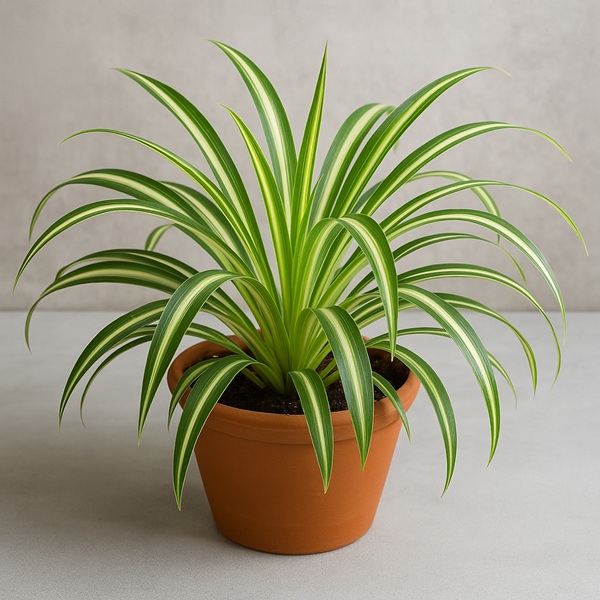
The most common species is the spider plant (Chlorophytum comosum), which forms a lush rosette of arching leaves with characteristic white or yellow stripes. It grows quickly and easily produces runners with baby plants that can be used for propagation. In addition to the classic green form, there are variegated and miniature cultivars that combine beautifully in arrangements. Chlorophytum can be grown in hanging planters, floor pots, and mixed with other species. It suits any interior, from classic to modern minimalism or eco-style.
Ukrainian plant growers value chlorophytum highly for its tolerance of different conditions: it easily endures dry air from radiators, lack of light in winter, and irregular watering. Because of its air-purifying ability, it is often placed in bedrooms, children’s rooms, kitchens, and bathrooms. It is known to absorb formaldehyde, xylene, carbon monoxide, and tobacco smoke, and is also said to neutralize electromagnetic radiation. This is especially relevant in large Ukrainian cities such as Kyiv, Kharkiv, Dnipro, and Odesa, where environmental conditions are often far from ideal. Thus, chlorophytum is not only a decoration, but also a natural air filter that improves the indoor microclimate.
For full development, it is important not only to choose the right place for chlorophytum, but also to select suitable soil, a proper pot, and follow the basic planting rules. Although the plant is not demanding about soil, it is sensitive to structure: the substrate should be loose, light, and well-draining. In Ukraine, where water is often hard and indoor air is dry, good drainage and a neutral or slightly acidic soil reaction are especially important.
Soil:
The best composition is turf soil + leaf soil + peat + sand in a 2:2:1:1 ratio;
A universal store-bought substrate with added vermiculite or perlite can also be used;
To prevent rotting, it is advisable to add a little charcoal;
The optimal pH level is 6.0–6.5.
Choosing a pot:
The material can be plastic or ceramic, but drainage holes are essential;
The diameter should exceed the size of the root rosette by 2–3 cm;
Since the root system grows actively, repotting should be done every year, especially for young plants.
Repotting:
Use transshipment, without disturbing the root ball;
Do not water the plant for 1–2 days before repotting;
After repotting, water only after one day and keep the plant in partial shade for 5–7 days;
The best time is March–April.
Repotting can be combined with rejuvenation and propagation by dividing the clump or separating the baby plants. In regions with a humid climate, such as western Ukraine, it is worth paying attention to room ventilation to avoid rot, while in the southern regions it is important to control soil drying and overheating.
Chlorophytum is a flexible and adaptable plant that can survive in different conditions. However, for full growth and to preserve its decorative appearance, it is important to create a suitable microclimate. In Ukrainian conditions, where summers are hot and sunny while winters are dark and dry, lighting, temperature, and humidity need to be considered carefully. Chlorophytum grows well both on a sunny windowsill and deeper inside a room, but variegated forms need more light, otherwise their contrasting color fades.
Lighting:
Optimal: bright, diffused light, especially for variegated forms;
Acceptable: partial shade, suitable for western and northern windows;
Undesirable: direct midday sun, which causes leaf burns;
In winter: supplemental lighting with grow lamps is recommended, especially in cloudy weather;
Ideal placement: eastern windows or the deeper part of a bright room.
Temperature:
In summer: +20 to +26°C, tolerates up to +30°C;
In winter: +14 to +18°C, briefly down to +10°C;
Drafts and sudden temperature changes should be avoided, especially near windows.
Humidity:
Chlorophytum tolerates dry air well, so added humidity is not critical;
It is helpful to spray the leaves from time to time, especially during the heating season, and wipe off dust;
In summer, it is beneficial to move the plant to a balcony or garden in a shaded spot.
As we can see, chlorophytum adapts easily to the Ukrainian climate: a normal apartment environment and moderate care are enough for it. But under optimal conditions, with good light, regular watering, and feeding, the plant grows rapidly, becomes lush, and produces more runners with baby plants.
Chlorophytum is a moisture-loving plant, but it is very sensitive to stagnant water in the pot. This is especially relevant in Ukraine, where summers are hot and winters bring overly dry indoor air because of heating. Irregular or incorrect watering often causes problems: the leaves wilt, brown spots appear, and the roots begin to rot. To avoid this, a moderate and regular watering routine should be maintained.
Watering schedule:
Spring–summer: 2–3 times a week, or more often if needed;
Autumn–winter: once a week if the room temperature is not below +18°C;
Water: soft, room-temperature, settled water;
Between waterings, the top 2–3 cm of soil should dry out;
When moisture is lacking, the leaf tips dry out, especially in variegated varieties.
Feeding:
From March to September, every 2 weeks with a complex fertilizer for ornamental foliage plants;
In winter, no more than once every 1.5 months, or not at all;
Fertilizers should be diluted to a lower concentration than stated on the package;
Excess nitrogen causes excessive leaf growth while reducing the formation of baby plants.
Different regions of Ukraine require slightly different care: in the west, humidity is higher, so ventilation must be monitored, while in the south it is better to increase air humidity through spraying and humidifiers. Regular watering and sensible feeding stimulate the growth of new shoots and maintain decorative appeal all year round.
One of chlorophytum’s main advantages is how easily it can be propagated even indoors. Even an inexperienced grower can obtain several new plants without difficulty. In Ukraine’s climate, this is especially convenient, since propagation works well both indoors and on balconies or terraces during the warm season.
Propagation methods:
By baby plants (runners):
✦ Small plants with roots form at the ends of long flower stalks.
✦ They can be rooted in water or planted directly into soil.
✦ Within 1–2 weeks, the baby plant is fully established.
By dividing the clump:
✦ During repotting, an adult plant can be divided into several rooted sections.
✦ Each part is planted separately, and they quickly establish and produce new shoots.
By seed:
✦ Used rarely, mainly for breeding;
✦ The process is long and has a low germination success rate.
The best period for propagation is spring and summer. Young chlorophytums can be used for greening offices, schools, classrooms, and balconies. They quickly develop foliage, purify the air well, and do not require complicated care. Thanks to this, chlorophytum has become a favorite among houseplants in Ukrainian homes.
Chlorophytum is considered an extremely hardy plant, but careless maintenance or unfavorable conditions can still cause certain problems. The most common are overdrying, overwatering, and the appearance of some pests. In Ukraine, especially during the winter season, it is important to monitor the plant’s condition carefully.
Problems and causes:
Dry leaf tips: a result of dry air or potassium deficiency;
Yellowing leaves: may be caused by overwatering or lack of light;
Pests, though only occasionally: mealybug, aphids, and spider mites.
✦ Treatment: spraying with insecticides, washing with a soapy solution, and isolating the affected plant.
Prevention:
Regular wiping of the leaves;
Ventilating the room;
Removing dried leaves and excess baby plants.
Decorative use:
In apartments: in planters, on windowsills, and in hanging arrangements;
In offices and schools: because of its low-maintenance nature and air-purifying ability;
In summer: for greening balconies, terraces, and garden gazebos;
In arrangements: combines well with zamioculcas, spathiphyllum, and syngonium.
Chlorophytum is an ideal plant for Ukrainian conditions: simple, hardy, useful, and aesthetically appealing. It will decorate any space and delight even those who do not have much time to care for flowers.