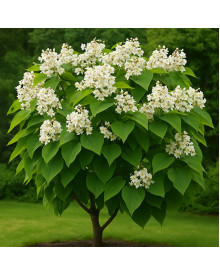
Chestnut is one of the most well-known and symbolic trees that can be found both in the wild and in urban landscaping across Ukraine. In our country, the most widespread species is horse chestnut (Aesculus hippocastanum), which is often confused with sweet chestnut (Castanea sativa). The former is an ornamental tree with a dense crown, palmately compound leaves, and striking candle-like flower clusters, while the latter is a southern fruit crop that requires specific care. In Ukraine, especially in city landscaping, it is horse chestnut that is most commonly used because of its tolerance to shade, resistance to dust, exhaust fumes, and drought. Kyiv, for example, has long been associated with blooming chestnuts — white-pink “candles” that decorate the streets in May and June.
Horse chestnut can reach up to 25 meters in height, while the diameter of its crown may extend to 15 meters. It is a powerful tree with deep roots and a massive trunk. It can live up to 200 years, and under favorable conditions, even longer. Its inflorescences consist of white, cream, or pinkish flowers gathered into dense vertical panicles up to 30 cm long, which open in May. Flowering is accompanied by a delicate fragrance that attracts bees — chestnut is a good honey plant. In autumn, the fruits ripen: dense spiny capsules containing a glossy nut, the so-called “horse chestnut.” Although it is inedible for humans, it is actively used in pharmaceuticals and veterinary medicine.
Chestnut has long become not only an ornamental tree but also a practical species in Ukraine. It is widely planted in avenues, parks, squares, near buildings, and along roads. It tolerates urban conditions well, is not afraid of polluted air, and adapts easily to different soil types. However, in recent decades the tree has suffered from pests and diseases, especially the leaf miner moth, which can completely discolor the leaves as early as July. This has become a serious problem for Ukrainian cities such as Kyiv, Lviv, and Cherkasy, where chestnuts were mass-planted during the Soviet period. Despite this, with proper care and the selection of resistant varieties, chestnut remains an important element of landscape greening.
Planting a chestnut tree requires a careful approach, since it is a large tree that needs space for full development. Sunny or partially shaded locations are best suited for it. Under Ukrainian conditions, this may be either the southern side of a garden or a spacious area near a fence or building — the main thing is that the distance to the nearest object should be at least 4–5 meters. Chestnut does not like cramped conditions; its roots need aeration and well-drained soil. The best soils are loams and sandy loams with a neutral or slightly alkaline reaction (pH 6.0–7.5). On heavy and waterlogged soils, the tree develops slowly and becomes vulnerable to fungal diseases.
Preparing the planting pit is an extremely important stage. Its size should be no less than 80×80×80 cm, especially if the sapling has an open root system. A drainage layer of crushed stone, broken brick, or expanded clay is laid at the bottom. On top of the drainage goes a mixture of turf soil, humus, sand, and a little wood ash. Some gardeners also add lime or dolomite flour to reduce acidity. The best time for planting is spring, from late April to early May, when the soil has already warmed up and there is no danger of frost. Autumn planting is acceptable only in warm regions, in the south and center of the country.
The sapling is placed vertically, with the root collar left at soil level. After backfilling with soil, the pit is watered generously with at least 20 liters of water and mulched with peat or humus. It is very important to install a support immediately — a stake to which the sapling is tied, especially in windy areas. In the first year, the chestnut needs regular watering, loosening of the tree circle, and weed removal. When planting saplings with a closed root system, in containers, the procedure is simpler — it is only necessary to carefully transfer the soil ball without disturbing the roots. Such saplings establish themselves faster and grow more actively.
The first 2–3 years after planting are decisive for forming a healthy and strong tree. During this period, the root system develops actively, the crown is formed, and the future quality of the plant depends greatly on environmental conditions. Special attention is given to regular watering, especially in summer. A young tree needs watering 2–3 times a week, with 15–20 liters each time. After every watering, the soil is mulched or carefully loosened to preserve moisture and ensure air access. Strong overwatering should be avoided, as it may cause root rot, especially on heavy soils.
Pruning a young tree is also very important. In spring, before sap flow begins, formative pruning is carried out: the central shoot is shortened, competing branches are removed, and 3–5 strong branches directed upward and sideways are left. In this way, a symmetrical crown is established. In summer, pruning is minimal — only dry, damaged, or deformed shoots are removed. In autumn, sanitary cleaning is carried out by cutting out broken or frost-damaged branches. Mature trees hardly need pruning, but in urban conditions it is often used to control height and shape.
Feeding begins in the second year after planting. In spring, compost or humus is applied to the tree circle, as well as mineral fertilizers with a high nitrogen content, such as ammonium nitrate or urea. In summer, phosphorus-potassium complexes are used to stimulate flowering. In autumn, wood ash or superphosphate is applied to strengthen the roots before wintering. It is important not to oversaturate the soil with fertilizers: an excess of nutrients may lead to vigorous leaf growth at the expense of wood formation and flowering. It is also worth avoiding chemicals in the tree circle — chestnut is sensitive to herbicides, especially at a young age.
Despite its outward strength and endurance, chestnut is quite vulnerable to a number of diseases and pests. This has become especially relevant over the last two decades in Ukraine, when the chestnut leaf miner moth (Cameraria ohridella) began to spread widely. It can destroy the tree’s leaves by mid-summer. This pest lays eggs on the underside of the leaf, and the hatched larvae feed on the leaf tissue. As a result, the leaves darken, become covered with spots, and fall prematurely, disrupting photosynthesis. The tree weakens, loses its decorative value, and becomes more vulnerable to secondary infections.
Methods of controlling the moth require a comprehensive approach:
Regular collection and destruction of fallen leaves in autumn, since the pest’s pupae overwinter in them.
Treatment with insecticides such as Aktara, Calypso, or Inta-Vir in May and June.
Injection of biological products into the tree trunk — an expensive but effective method already used in Kyiv and Lviv.
In addition to the moth, chestnuts in Ukraine often suffer from fungal diseases such as powdery mildew, leaf spot, and bark necrosis. Symptoms include a white coating on the leaves, brown spots, and cracks on the trunk. Fungicides such as Skor and Topaz, as well as preventive spring spraying with Bordeaux mixture, help in controlling them. Among pests, aphids, scale insects, and gall mites are also dangerous — soap solutions, garlic infusions, or specialized preparations are effective against them.
Winter hardiness should also be mentioned separately. In the northern and eastern regions of Ukraine, young trees during the first 2–3 years after planting require protection. The root zone is mulched with an 8–10 cm layer of peat, leaves, or pine needles, and the trunk is wrapped with agrofabric or burlap. Mature trees usually overwinter without protection, especially if they are already well-established and fully developed.
Chestnut is not just a tree, but a full-fledged compositional element of landscape design. In Ukraine, it is used both in public and in private landscaping. With proper planning, it can perform several functions at once: creating shade, zoning space, and giving a garden a sense of grandeur. Its spreading crown provides coolness even on the hottest days, while its flowering is a true spectacle.
The most popular ways of using chestnut in landscaping are:
Avenues — planting trees along paths or driveways.
A central accent planting — on a lawn, in a flower bed, or as part of a park composition.
Greening private properties — for shade, ornament, and attracting birds.
University and school grounds — as a symbol of maturity and knowledge.
Chestnut combines harmoniously with lindens, birches, and ornamental apple trees. Shade-loving plants such as hostas, periwinkle, lungwort, and ferns grow well under its crown. However, crops that require direct sunlight should not be planted beneath it. On the other hand, the area under the tree is ideal for arranging a resting place — a bench, hammock, or table in the shade.
Varieties of chestnut resistant to pests are becoming increasingly popular. For example, Baumannii is ornamental, with double white flowers, does not produce fruits, and is ideal for cities. The variety Monstrosa is compact and suitable for smaller plots. These varieties are already available in Ukrainian nurseries, especially in the western part of the country.
Chestnut is a tree that combines beauty, resilience, and symbolism. In Ukrainian realities, it has not only decorative but also cultural value. With proper planting and care, the tree can live for decades, beautifying a plot or an urban space. Its advantages are obvious: drought resistance, tolerance of various soils, adaptation to city conditions, and the ability to grow quickly.
Advice for Ukrainian gardeners:
Chestnut is a tree with a decades-long future, so plan the planting site with the future in mind.
It does not require complex agricultural practices, but it does need space for crown and root system development.
The best site is well-lit, with drained soil and no close proximity to buildings or utilities.
The leaves are the first indicator of problems, so monitor their color and condition.
Fallen leaves should be removed — this is the most effective prevention against pests and diseases.
And finally, let us not forget the cultural meaning of chestnut. In Ukrainian consciousness, this tree is a symbol of spring, the city, light, and stability. It adorns squares, boulevards, and gardens, and appears in poems, songs, and memories. By planting a chestnut on your own property, you are not simply creating shade — you are adding a piece of national spirit to the landscape.
Chestnut is the choice of those who value longevity, elegance, and natural harmony. It gives a garden completeness and depth, and its flowering is a true celebration of spring.