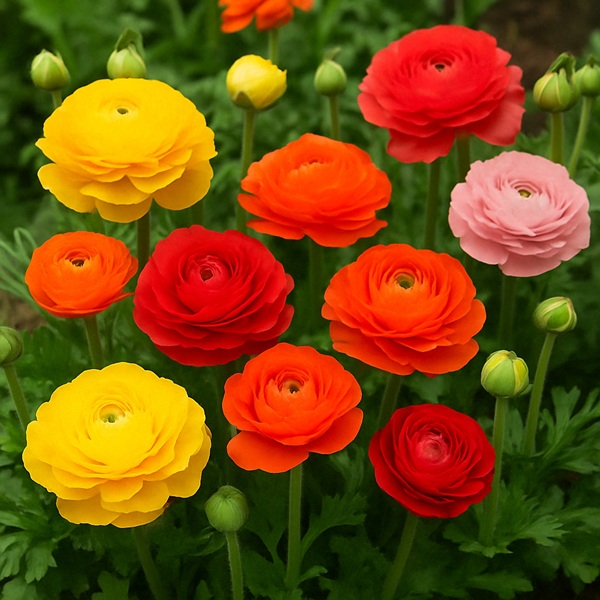
Buttercups, or ranunculuses (Ranunculus), are a genus of perennial or annual herbaceous plants from the buttercup family, comprising more than 400 species. The most popular in ornamental gardening are Persian buttercups (Ranunculus asiaticus), admired for their lush flowers that resemble miniature peonies or roses. Their color palette is striking: pure white, cream, pink, red, burgundy, lemon, peach, green, and even bicolored varieties. Ranunculuses are especially valued by florists — they can last up to 10 days as cut flowers while retaining their shape and vivid color.
These plants have a compact form: stem height ranges from 20 to 60 cm depending on the variety. The flowers may be double, semi-double, or single, and they form at the tops of sturdy flower stalks. The blooming period lasts from May to June, provided they are planted on time and cared for properly. The foliage is divided, bright green, and remains decorative throughout the growing season. The root system is made up of tuber-like roots that resemble tiny “spiders.” These tubers are the main planting material for ornamental garden ranunculuses.
Ukraine’s climate is generally favorable for growing ranunculuses in open ground, especially in the southern and central regions. Buttercups do well in moderately warm spring weather, a cool start to summer, and in the absence of sharp temperature fluctuations. In the southern regions such as Odesa, Mykolaiv, and Kherson, they need light shading during the heat, while in the northern regions such as Chernihiv and Sumy, they need protection from spring frosts and timely lifting of the tubers in autumn. It is worth remembering that ranunculuses do not overwinter in open ground — the tubers must always be dug up and stored indoors until the next season.
To achieve beautiful and long-lasting flowering, it is important to choose a suitable planting site. The best place is sunny or lightly shaded during midday hours. In shade, the plants become elongated, the flower stalks turn fragile, and the flowers themselves are less bright and less numerous. Ideal conditions are diffused light in the morning and protection from direct sun during the day. Buttercups prefer light, loose, fertile soil with good drainage. In damp areas where moisture stagnates, the tubers rot. If the soil is clayey or heavy, it should be improved by adding sand, peat, and compost, then digging and leveling it thoroughly.
The optimal soil pH is neutral or slightly alkaline, from 6.0 to 7.0. In autumn before planting, it is advisable to add compost or humus, and in spring, a complex mineral fertilizer. While preparing the bed, care should be taken to provide drainage for excess water, especially in low-lying areas. Sometimes raised beds are created for ranunculuses to prevent moisture from collecting around the roots. The site should also be protected from drafts, especially during the first weeks after planting, while the plants are still rooting.
The planting material consists of tubers that resemble small brown “octopuses.” Before planting, they are recommended to be soaked for 4–6 hours in warm water or a growth stimulant solution. The tubers are planted at a depth of 4–5 cm, with the “legs” pointing downward. The distance between plants depends on the variety and planting density, ranging from 10 to 20 cm. After planting, the bed is watered well, but overwatering must be avoided. In case of return frosts, the planting should be covered with agrofibre or film.
Buttercups are a demanding crop, especially during active growth. The main rule of care is moderation. Watering should be regular, but without excess moisture. The soil should be kept slightly moist, especially during bud formation. Too much moisture leads to tuber rot and the development of fungal diseases. In hot weather, watering is done in the morning, avoiding water on the leaves and buds. Mulching with peat or sawdust helps retain moisture and reduces the need for watering.
Feeding begins 10–14 days after planting, once the plants have rooted. The first fertilizer should contain nitrogen to stimulate green growth. During the budding stage, complex mineral mixtures with an emphasis on phosphorus and potassium are used. Mineral fertilizers for flowering plants work well, as does organic matter such as herbal infusions and ash. Buttercups are fed once every 10–14 days until flowering ends. After cutting off faded flower stalks, one more phosphorus-potassium feeding may be given to stimulate repeat flowering or the formation of strong tubers.
Shaping the bush includes not only removing faded buds, but also thinning overcrowded plantings. When there is not enough light, ranunculuses become stretched, so it is important to ensure good air circulation. Timely removal of weak and diseased leaves improves ventilation and reduces the risk of disease. With proper care, the plants bloom for a long time, develop dense foliage, and produce strong flower stalks. Removing spent blooms can extend the flowering period by almost a month.
After flowering ends, buttercups gradually lose their decorative appeal. In July, the above-ground parts begin to yellow and dry out — this is the signal to prepare for digging up the tubers. In Ukraine, especially in the northern and central regions, tubers cannot be left in the ground for winter, since they cannot withstand even frosts down to –5°C. The best time for lifting them is late July to early August, when the foliage has dried completely. The tubers are carefully dug up by hand or with a fork, trying not to damage them.
After lifting, the tubers are cleaned of soil without dividing them into parts and dried for 2–3 days in a shaded place with good ventilation. They are then sorted, damaged specimens are discarded, and the rest are stored in a dry, cool place at +4 to +10°C in paper bags or boxes filled with dry peat, sand, or sawdust. Buttercups do not tolerate high humidity — under such conditions they begin to rot or become moldy. During storage, the tubers should be checked regularly: if rot is detected, the damaged areas are removed and the remainder is treated with brilliant green antiseptic or powdered charcoal.
Buttercups are propagated mainly by dividing the tubers or by seed. The most effective method is division of the tubers during lifting: one mother tuber often produces 5–7 daughter ones. In spring, they can easily be separated and planted individually. Seed propagation is more labor-intensive — the seeds are sown in January or February, the seedlings are pricked out, and only after 4–5 months can the first flowers be seen. In addition, plants grown from seed do not always retain varietal traits. That is why this method is more suitable for breeding or amateur experimentation.
Buttercups are prone to certain diseases, especially in conditions of excessive moisture and overcrowded planting. The most common fungal infections are root rot, fusarium, and powdery mildew. Root rot develops where water stagnates, most often in heavy soils. The main signs are plant wilting even when the soil is moist, an unpleasant smell, and rotting roots. In most cases, the plant cannot be saved — that is why prevention is essential: drainage, moderate watering, and loosening the soil.
Powdery mildew appears as a white coating on the leaves, especially after rainy weather or sharp temperature swings. It can be controlled with copper-based fungicides or biological preparations. Fusarium causes curling of the leaves and browning of the stems — affected plants are removed, and the rest are treated with preparations based on Trichoderma or Fitosporin. Among pests, the most common are aphids, spider mites, and thrips. Soap solution, wormwood, garlic, or tobacco infusions are effective against them. In cases of heavy infestation, bioinsecticides or pyrethrum-based preparations are used.
Regular inspection of the plants makes it possible to detect problems in time. It is important to observe crop rotation and not plant buttercups in the same place for several years in a row. If disease is detected, plant residues should be removed after the season, and the soil treated with potassium permanganate or a biofungicide. Good ventilation, thinned plantings, and dry weather are the best disease prevention measures. With basic cultivation practices in place, buttercups rarely become ill and reward the gardener with long-lasting decorative flowering.
Buttercups are a true adornment of the flower garden. Thanks to their perfect flower shape and rich color palette, they are widely used in ornamental gardening. They look especially good in the front of mixed borders, in border plantings, on alpine slides, and in rabatkas. Buttercups also grow beautifully in containers, flowerpots, and balcony boxes. Ideal companions for them include pansies, freesias, carnations, violas, heucheras, and alyssums. They also combine wonderfully with hosta foliage, ferns, and groundcover plants.
To create a harmonious composition, buttercups are combined with plants that bloom at the same time — in May and June. For example, with daffodils, irises, aquilegias, and forget-me-nots. White and cream buttercups contrast beautifully with the green mass of the garden, while pink, orange, or crimson ones create vivid color accents. They are best planted in groups of 5–7, as this allows them to form dense flowering islands. Buttercups are suitable both for formal display areas and for small front gardens or flower beds near the entrance to the house.
In floristry, buttercups hold one of the leading positions. They are cut at the half-open stage — this allows them to stand longer in water and continue opening gradually. They are used in spring and wedding bouquets, as well as arrangements in pastel or bright tones. Buttercups pair well with peonies, early roses, lisianthus, and ornamental grasses. Thanks to the firm structure of their petals and their refined shape, ranunculuses have become a true trend in modern floristry, both in classical and minimalist styles. They combine elegance with natural beauty.