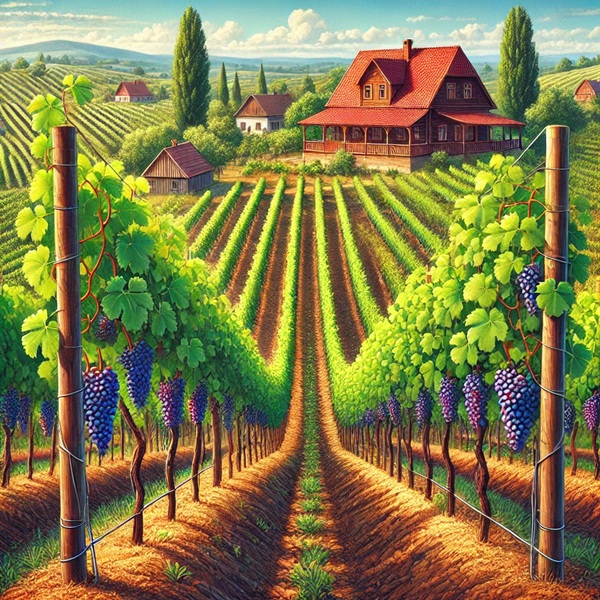
Growing grapes in Ukraine begins with choosing the right variety and planting site. Ukraine’s climate is diverse — from moderately continental in the north to warmer and drier in the south. This makes it possible to grow both table and technical (wine) varieties. In the southern regions — Kherson, Odesa, and Mykolaiv — grapes can grow almost without winter covering. In the central part of the country, it is better to choose frost-resistant varieties, while in the north and west the vine must be covered for winter.
Grape varieties are conventionally divided into early-ripening, mid-ripening, and late-ripening. Under Ukrainian conditions, especially popular varieties include Arcadia, Libya, Codryanka, Vostorg, Kesha, as well as older, time-tested ones such as Isabella and Moldova. When choosing a variety, it is important to consider its resistance to diseases (downy mildew, powdery mildew, gray rot), yield, ripening period, and the taste qualities of the berries.
The planting site for grapes should be sunny, with a southern or southwestern slope, and protected from northern winds. Grapes perform best on light, well-drained soils: loams or sandy loams with a neutral or slightly alkaline reaction. If the soil is heavy and clayey, it is improved by adding sand and humus. In lowlands and waterlogged areas, grapes do not grow well — the root system suffers from excess moisture and lack of air.
Before planting, the site is cleared of weeds, especially perennial ones such as couch grass and thistle, leveled, and marked into rows. The spacing between rows depends on the vine-training system and planting type — for arbors, 1.5–2 m is sufficient, while for commercial plantings it may be up to 3 m between rows and 1.5–2 m between bushes.
The optimal time for planting grapes is spring (April–May) or autumn (late September to October), depending on the region. In spring, the soil should warm up to +10°C. Autumn planting is also effective, but it requires careful winter covering of the seedlings, especially in the northern and central regions of Ukraine.
The planting hole is prepared in advance — at least 2 weeks before planting. Its depth should be 60–80 cm, and its diameter about 60 cm. A drainage layer (crushed stone or gravel) is placed at the bottom, followed by a layer of fertile soil mixed with humus (1–2 buckets), ash (1 cup), and superphosphate (100–150 g). A layer of clean soil is then added on top of this mixture so the seedling’s roots are not burned. Some growers install a plastic pipe (50 mm in diameter) in the hole for convenient root watering.
A seedling with an open root system is soaked in water or a growth stimulant (for example, Kornevin or Heteroauxin) for 12–24 hours before planting. It is then carefully placed in the hole, with the roots spread out. The root collar (or the graft union, if the seedling is grafted) should remain at soil level. After planting, the seedling is watered abundantly (up to 2 buckets of water) and mulched.
During the first year of growth, grapes need minimal but regular care: watering in dry periods, loosening the soil, and removing weeds. It is important to monitor shoot growth and pinch off extra shoots, leaving one or two to form the bush. A support is also installed — a stake or a temporary trellis.
Proper grape care begins in the second year. One of the most important cultivation practices is bush training — giving the vine a certain shape that ensures good ventilation, light exposure, ease of harvest, and disease protection. In Ukraine, the most commonly used systems are fan training, cordon training (horizontal cordon), arch training (for arbors), and double Guyot — a classic form for wine varieties.
A trellis is an essential part of a vineyard. It may be a single-plane or double-plane structure made of wire stretched between posts. During the growing season, the shoots are tied to the trellis to direct their growth and prevent breakage. Pinching is also carried out — removing lateral shoots that shade the bush and take away nutrients.
Watering grapes depends on the age of the bush and the climate of the region. Young plants are watered once every 7–10 days, while mature ones are watered 3–4 times per season, especially during active growth and cluster formation. Drip irrigation is the best solution for private vineyards, especially in the dry southern regions.
Feeding is an important part of care. In spring, nitrogen fertilizers are applied (ammonium nitrate, urea); in summer, phosphorus-potassium fertilizers (superphosphate, potassium sulfate); in autumn, ash and humus. Foliar feeding with micronutrients (boron, magnesium, zinc) is especially useful during budding and berry set. Organic matter — well-rotted manure or compost — is added once every 2–3 years.
In Ukraine, grapes are prone to a number of diseases, especially in wet weather. The most common are downy mildew, powdery mildew, gray rot, and anthracnose. For prevention, contact and systemic fungicides are used: Bordeaux mixture, Ridomil Gold, Topaz, and Horus. Treatments are carried out in stages: before bud break, before flowering, after flowering, and during berry growth. It is important to rotate products to avoid resistance.
Among pests, the most dangerous are grape phylloxera (which attacks the roots), mites, leafrollers, and wasps. Insecticides such as Actellic, Karate, and Confidor are used against insects. Wasps can be managed with sweet-bait traps and by covering grape clusters with mesh. It is important to inspect the bushes regularly, remove affected parts, carry out pruning, and avoid overcrowding plantings.
Autumn treatment of the vineyard is one of the key protection stages. After leaf fall, spraying with iron sulfate (3–5%) is recommended to destroy fungal spores and prepare the vine for winter. Fallen leaves and prunings are also burned so they do not remain as sources of infection.
Grapes are a crop sensitive to frost, especially grafted and southern varieties. That is why covering technology is widely used in Ukraine. In October–November, after the first frosts, when the leaves have fallen, the vine is pruned and removed from the trellis. Pruning is carried out according to the training system, leaving the required number of fruiting units. It is important to make cuts with sharp secateurs and, when necessary, treat them with garden pitch.
Covering is done in several ways. The classic method is dry covering: the vine is laid on the ground, covered with soil (10–15 cm), and then topped with agrofabric, plastic film, straw, or spruce branches. It is important to ensure ventilation so moisture does not accumulate under the cover. In the south of the country, grapes are often left uncovered or protected only lightly.
In winter, the condition of the cover is checked and extra insulation is added if needed. In spring, in March–April, the cover is removed gradually to prevent the buds from damping off. After the vine wakes up, sanitary pruning is carried out, leaving only live buds. This is also the time for the first feeding and disease protection treatment.
A systematic approach to grape care — from proper planting to winter preparation — ensures stable yields, high berry quality, and the overall health of the bush. Under Ukrainian conditions, by following proper cultivation practices, grapes can be grown successfully both for personal use and for sale or winemaking.