Acacia is one of the most recognizable trees in the Ukrainian landscape. Although the name “acacia” botanically refers to different plants, in Ukraine it most often means black locust (Robinia pseudoacacia), also known as white acacia. This is an undemanding, fast-growing tree that thrives in Ukraine’s climate, tolerating drought, poor soils, and urban pollution. It is valued not only for its ornamental qualities, but also for its ability to stabilize slopes, improve soil structure, and attract bees. In recent years, acacia has become especially popular in landscape design, agriculture, and private household plots.
The most common types of acacia that have adapted well in Ukraine are:
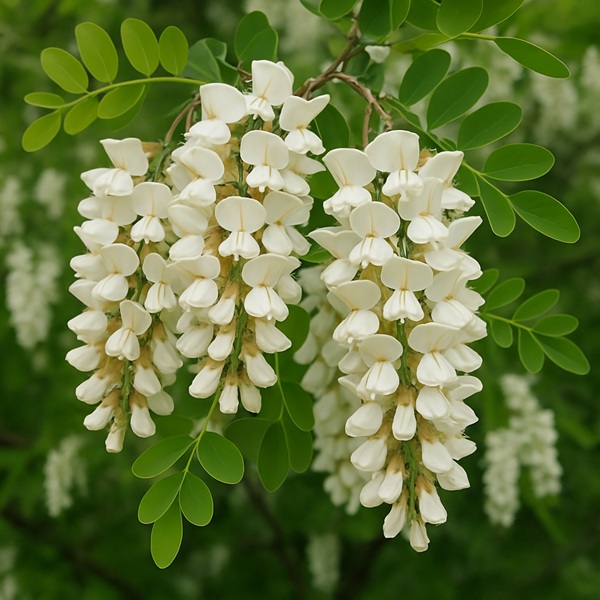
Black locust (white acacia) — a tree up to 25 m tall, with fragrant white clustered blossoms.
Yellow acacia (Caragana arborescens) — a shrub up to 4 m tall, with bright yellow flowers; ornamental and drought-resistant.
Silver acacia (mimosa) — does not tolerate frost and is grown in containers or in the south of Ukraine.
Acacia dealbata (globular form) — an evergreen ornamental tree suitable for growing in protected conditions.
White acacia is especially often planted for street greening, creating alleys, and stabilizing slopes and embankments. It tolerates heat, sandy and poor soils, polluted air, and strong wind well, which makes it highly versatile. Its flowering period is May to June. At this time, the trees fill the air with a pleasant honey-like fragrance and serve as a powerful nectar source. Acacia is one of Ukraine’s main honey plants, especially in the central and southern regions, where beekeepers deliberately plant it to increase hive productivity.
Planting acacia is not difficult, but it does require attention to several important factors that depend on the climate zone. This is a light-loving and heat-loving crop that grows best in open, well-lit areas with well-drained soil. Acacia does not tolerate stagnant water, so in regions with a high groundwater level, such as Polissia and the Carpathians, it is better to choose elevated sites or create artificial drainage. The tree grows best in loose, neutral, or slightly alkaline soils — sandy loam, loam, and chernozem.
Preparation for planting includes:
choosing a sunny site;
digging the soil to a depth of 30–40 cm;
removing weeds and rhizomes;
adding sand to heavy soils and lime to acidic soils;
fertilizing with compost, humus, or ash, but not fresh manure.
Seedlings with either open or closed root systems are used for planting. If the roots are bare, they are treated with a growth stimulant such as Kornevin, then planted in spring or autumn once the threat of frost has passed. The planting hole should be at least 60 cm deep. It is advisable to place drainage at the bottom, such as broken brick or gravel, especially in clay soils.
The seedling is set vertically, with the root collar level with the soil surface. After planting, water generously — up to 20–30 liters per plant. In dry regions such as Mykolaiv, Kherson, and Kirovohrad, mulching the root zone with cut grass or agrofabric is recommended to retain moisture. During the first two years, regular watering and loosening are needed, especially in summer heat.
Once established, acacia requires very little care, although certain cultivation practices help improve its growth and decorative value. In the first 2–3 years, it is important to maintain comfortable conditions: protection from strong wind, timely watering, weeding, feeding, and sanitary pruning. Later, the tree becomes fully self-sufficient. With proper care, its growth can exceed 1 meter per year, and flowering will remain steady and abundant.
Main care elements:
Watering: young trees — weekly; mature trees — only during prolonged drought.
Loosening: after rain or watering — 2–3 times per season.
Feeding: in spring — a complex fertilizer; in summer — humus or ash.
Pruning: sanitary pruning in spring; formative pruning at an early growth stage.
Tying: to a stake if needed.
It should be remembered that acacia has a strong root system capable of damaging drainage systems, pavements, or foundations. For this reason, it should be planted no closer than 4–5 meters from buildings. Black locust may also produce numerous root suckers — these can be dug up for propagation or removed regularly if the tree is being grown as a specimen plant.
Acacia propagates quite easily, which makes it accessible to gardeners and landscapers. There are several main methods: by seed, by root suckers, and by cuttings. In Ukraine’s climate, the first two methods are the most convenient and widely used, since they require no special equipment and provide a high success rate.
Seed method:
seeds are collected in September–October from ripe pods;
before sowing, seeds require stratification or scarification, such as nicking or scalding with boiling water;
they are sown in spring in a loose substrate of humus and sand (1:1);
germination occurs in 10–14 days at +20 to +25°C;
seedlings are pricked out after 2–3 true leaves appear.
By root suckers:
they are separated with part of the root in spring or autumn;
they are planted immediately in a permanent place or temporarily in a pot;
they establish quickly and may flower in the second or third year.
Cuttings:
carried out in June–July using semi-woody cuttings 15–20 cm long;
rooting takes up to 5 weeks in greenhouse conditions;
used less often, mainly for ornamental varieties such as weeping or globular forms.
In southern Ukraine, seeds can be sown directly in open ground in late April. In northern and western regions, the seedling method is preferable. In the first year, young plants usually reach 50–70 cm in height, and by the second year they already become decorative young trees.
Despite its high resistance, acacia can still be affected by certain diseases and pests, especially in weakened or overcrowded plantings. Young plants growing in waterlogged or acidic soils are the most vulnerable. The main rule of care is prevention and quick response to the first signs of damage.
The most common diseases:
Powdery mildew — a white coating on the leaves that causes curling and leaf drop. Treatments: Topaz, Skor, and pruning affected leaves.
Root rot — occurs when water stagnates. Treatment: fungicides, improved drainage, and reduced watering.
Sooty mold — often develops after aphid infestation.
Pests:
Aphids — suck sap and deform shoots. Remedies: soap solution, Iskra, Actellik.
Leafrollers — damage young leaves. Controlled with contact insecticides.
Psyllids — deform leaves and cause them to stick together. Methods: pruning, washing, and sticky trunk bands.
Preventive measures:
spring whitewashing of the trunk with lime;
sanitary pruning before the growing season;
mulching around the trunk circle;
maintaining the proper distance between trees.
In general, acacia is considered a hardy crop, and with minimal care it withstands external stress well. But periodic inspection and timely action help prevent serious damage.
Acacia is a versatile plant widely used in Ukraine both decoratively and for practical purposes. It is ideal for greening cities, villages, and home plots, and it is also useful in agriculture, beekeeping, and forest reclamation. It is valued for its rapid growth, hardiness, and the fact that almost every part of the tree can be used — from the flowers to the wood.
Main uses:
Landscape design: alley plantings, specimen trees on lawns, and hedge formation.
Beekeeping: a powerful spring honey plant that produces high-quality acacia honey.
Agriculture: stabilizing ravines, creating shelterbelts, and protecting soils from erosion.
Urban greening: resistant to gas and dust, and does not require special care.
Wood: hard and durable, used in carpentry and construction.
Traditional medicine: flowers and bark are used in decoctions, teas, and tinctures.
Thanks to its abundant flowering and dense crown, acacia provides excellent shade, while its root system improves soil structure. In the private sector, ornamental forms of acacia — weeping, globular, and purple-leaved — are increasingly used. They are well suited to small plots, terraces, and front yards.
Acacia is a tree that combines beauty, usefulness, and resilience. With minimal care, it will serve as a decoration for the property, a source of nectar for bees, and an exceptionally valuable element of the natural environment in Ukrainian conditions.