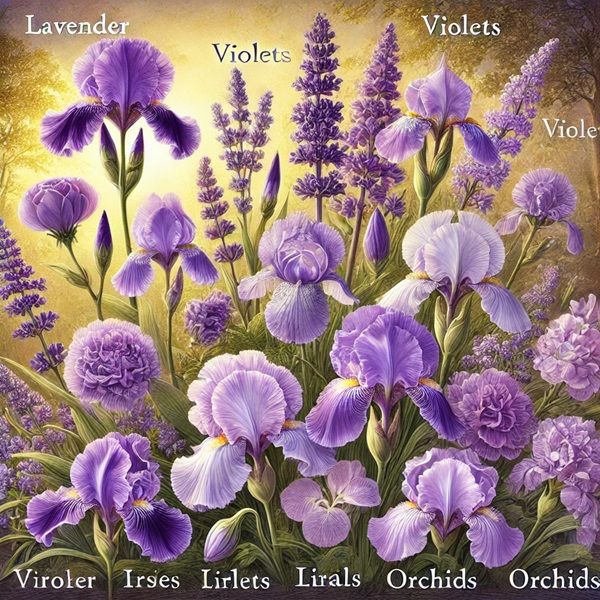
Purple flowers are a true treasure for gardeners and florists. This color symbolizes nobility, mystery, refinement, and harmony. Plants with purple-toned blooms can become a vivid accent in a garden, flower bed, bouquet, or home collection of houseplants. Purple flowers can be found among many types of plants: annuals, perennials, bulbous plants, ornamental shrubs, and even trees. They can be seen in natural ecosystems, tropical forests, alpine meadows, and steppes, as well as in greenhouses and on windowsills.
The purple shade in flowers is formed thanks to anthocyanins — natural pigments that also give color to many berries and vegetables, such as eggplants, blueberries, and plums. These pigments change their shade depending on soil acidity and lighting conditions. That is why the same flower variety may look different under different conditions. In this article, we will look at the most popular purple flowers and explore the особенности of their cultivation and care.
Purple flowers are widely used in landscape design because they combine easily with other shades and make it possible to create striking arrangements. Among the most popular plants are:
Lavender (Lavandula) — one of the best-known purple flowers, grown as both an ornamental and aromatic plant. Lavender blooms in mid-summer, attracting bees and butterflies. It is used to create borders, hedges, and fragrant flower beds.
Violets (Viola) — small but highly decorative plants that can bloom in both spring and autumn. Some varieties, such as pansies, have uniquely colored petals with transitions from white to deep purple.
Aster (Aster) — a late-blooming plant that flowers closer to autumn, decorating the garden with rich purple shades. Asters are cold-hardy and can bloom until frost.
Bellflower (Campanula) — this flower comes in different shades of purple, from pale lilac to deep dark tones. Bellflowers decorate flower beds, rock gardens, and borders.
Clematis (Clematis) — a magnificent climbing vine that covers fences, arches, and building walls with lush purple flowers.
These plants are easy to grow in the garden, and thanks to the variety of cultivars, you can create beautiful floral arrangements that delight the eye throughout the season.
Bulbous and perennial plants with purple flowers make it possible to create a garden that blooms year after year without the need for annual sowing. Among the most popular are:
Hyacinths (Hyacinthus) — spring flowers with dense inflorescences and a rich fragrance. They come in different shades, but purple hyacinths are especially popular because of their brightness.
Irises (Iris) — graceful flowers often called the peacock among flowers. Purple irises look especially striking and are often used as cut flowers.
Tulips (Tulipa) — spring flowers that can have rich purple shades. Among them, the cultivar Queen of Night stands out in particular, with its dark purple, almost black petals.
Lupine (Lupinus) — the tall, candle-like inflorescences of lupines can have deep purple shades. They are undemanding and can grow even in poor soils.
Crocuses (Crocus) — early-blooming plants that appear immediately after the snow melts. Their delicate purple flowers become the first heralds of spring.
Perennial plants require minimal care, yet they can decorate a garden for many years.
Purple flowers can be grown not only in the garden, but also at home. Among the popular houseplants are:
Saintpaulias (Saintpaulia) — African violets that bloom year-round. They come in different shades of purple, from light lilac to rich eggplant tones.
Phalaenopsis orchid (Phalaenopsis Orchid) — an elegant plant with large purple flowers. The orchid requires high humidity, moderate watering, and diffused light.
Gloxinia (Sinningia speciosa) — a plant with velvety purple flowers. Gloxinias grow well at room temperature and in abundant light.
Coleus (Coleus) — an ornamental foliage plant with bright purple patterns on its leaves.
Streptocarpus (Streptocarpus) — another plant with delicate purple flowers that blooms several times a year.
Purple indoor flowers not only decorate an interior, but also create an atmosphere of comfort.
Purple flowers, like other ornamental plants, require proper care. The main recommendations are:
Lighting
Most purple flowers prefer bright but diffused light.
Some plants, such as irises or asters, grow well both in full sun and in partial shade.
Watering
Bulbous plants such as hyacinths and crocuses do not tolerate stagnant water, so it is important to provide good drainage.
Indoor flowers, such as saintpaulias, require regular but moderate watering.
Feeding
In spring and summer, plants are fed with fertilizers high in potassium and phosphorus.
For orchids and violets, specialized fertilizers are used.
Purple flowers are the embodiment of refined beauty, elegance, and mystery. They can become the main decoration of a garden, flower bed, or home. With proper care, they will delight you with vivid colors throughout the year, creating an atmosphere of harmony and comfort.