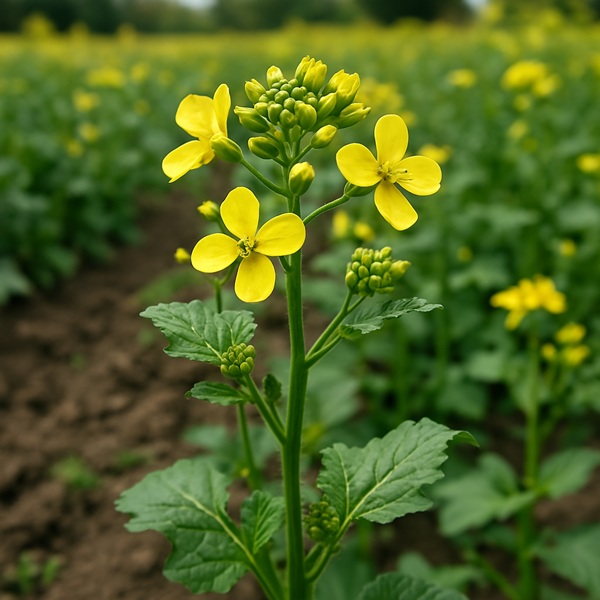
Mustard is one of the best-known and most versatile agricultural crops actively grown in Ukraine for both food and agronomic purposes. It is an annual plant from the cruciferous family (Brassicaceae), distinguished by rapid growth, a short vegetation period, and high resistance to unfavorable conditions. Mustard is cultivated as an oilseed, spice, fodder, green manure, and even ornamental crop. It is valued for its ability to quickly build up green mass, loosen the soil with its powerful root system, suppress weeds, and enrich the soil with organic matter.
In Ukraine, the three most widespread mustard species are:
White mustard (Sinapis alba) — the most common type, used as green manure and as a seasoning. It germinates quickly (within 3–5 days), flowers early (30–40 days after sowing), is resistant to diseases, and grows well under conditions of insufficient moisture.
Sarepta mustard (Brassica juncea) — Indian mustard, popular as a spice and oilseed crop. It has a rich flavor and is well adapted to the conditions of central and southern Ukraine.
Black mustard (Brassica nigra) — a rarer and more demanding species that produces the hottest seeds. It is used in cooking and pharmaceuticals.
Ukraine’s climate is highly suitable for growing mustard in almost all regions — from the west to the south and east. It tolerates short-term frosts and drought, and grows well on different soil types except overly heavy or waterlogged soils. Mustard is especially widely used as a green manure crop — its green mass is incorporated into the soil before the flowering stage to improve soil structure, enrich it with nitrogen, and reduce the number of soil pests. It is very valuable in crop rotation: it is sown after potatoes, cereals, corn, and also during the off-season on cleared plots.
Tip: to achieve the maximum effect as a green manure crop, mustard green mass should be plowed into the soil no later than 30–40 days after sowing — before mass flowering begins.
Choosing the right sowing time is the key to high mustard yields, regardless of whether it is used as a main crop or as green manure. Thanks to its cold tolerance and fast development, mustard can be sown very early — as soon as the soil dries slightly and the air temperature reaches +5...+7 °C. In the southern regions of Ukraine, this is possible as early as mid to late March; in the northern regions, in the first half of April. Mustard is also sown in summer (after harvesting early crops) or before winter (October–November) if the goal is to improve soil health in spring.
Spring sowing:
Optimal for obtaining seeds or green manure biomass.
Makes the best use of spring moisture.
For white mustard, the sowing rate is 12–15 kg/ha (120–150 g per 100 m²).
Seeds are sown to a depth of 1.5–2 cm with row spacing of 15–30 cm.
Summer sowing:
Used mainly for green manuring or as an intermediate crop after harvesting early potatoes, winter wheat, or cabbage.
It is important to sow before drought sets in, especially in the southern and eastern regions.
Pre-winter sowing:
Carried out in late October or November, after a stable temperature of about +2...0 °C is established.
Seeds are sown 2–3 cm deep into dry soil so they do not germinate before frost.
In spring, mustard produces early shoots that suppress weeds.
Soil preparation for mustard begins in autumn with shallow cultivation, plowing, or digging. In spring, harrowing, leveling, and rolling are carried out on heavy soils. The soil should be loose and free of large clods. It is especially important to consider acidity: if the pH is below 5.5, lime or ash should be applied. Mustard does not tolerate stagnant water, so poorly drained areas are unsuitable.
Please note: mustard should not be sown after other cruciferous crops such as cabbage, radish, or turnip, as this increases the risk of diseases such as clubroot, phoma, and alternaria.
Although mustard is an undemanding crop, it can produce excellent results with proper care, especially in the early stages of growth. Growing conditions in Ukraine are generally favorable, but the first 3–4 weeks after emergence require attention — mainly in weed control, maintaining moisture, and ensuring soil aeration.
Watering:
Mustard tolerates short droughts, especially during the rosette stage. However, during long dry periods, particularly in the southern regions, 1–2 irrigations are recommended — during active growth and at the budding stage. Drip irrigation or inter-row watering works best. Excess moisture leads to root rot and lower disease resistance.
Weeding and loosening:
In the early stages (up to 3–4 weeks), it is important to remove weeds, since they compete for light and nutrients. Once the rows close, mustard suppresses unwanted vegetation on its own. Loosening is carried out after rain or watering to prevent soil crusting and improve aeration.
Pests and diseases:
The main pests are crucifer flea beetles, aphids, cabbage moths, and cutworms. They are most dangerous at the stage of 2–4 true leaves. Preventive measures include early sowing, dusting with ash, and mulching. In case of heavy infestation, biological products such as “Bitoxybacillin” and “Lepidocide” or insecticides are used. Diseases include alternaria, clubroot, and downy mildew. In rainy years, outbreaks are possible, but overall the crop is quite resistant.
Tip: foliar feeding with boric acid (1 g/L) at the budding stage stimulates seed formation and increases oil content by 5–7%.
Mustard is an early-maturing crop. Depending on the variety and sowing time, the growing season lasts from 60 to 90 days, which makes it possible to harvest at different times — from early summer to mid-autumn. In Ukraine, it is most often grown for seeds, especially in the central and southern regions. However, timely harvesting is extremely important, because when overripe, the pods crack and the seeds are lost.
Signs that the crop is ready for harvest:
yellowing of the lower leaves;
drying of the pods and a change in their color;
the characteristic rustling of seeds when the pod is shaken.
Harvesting is best done in the morning or evening, when the plants are slightly damp with dew — this reduces seed loss. In small areas, sickles or pruning shears are used; on farms, reapers are used. The stems are tied into bundles and hung in a ventilated place to ripen. After drying, they are threshed by hand or mechanically, the seeds are cleaned, and then dried further to a moisture content of no more than 8–10%.
Seeds are stored in glass jars, cloth bags, or paper packets in a dry, dark room at a temperature of +10...+15 °C. Under such conditions, germination remains viable for up to 3 years. Some can be kept for future sowing, while the rest can be sent for processing to oil presses, spice manufacturers, or feed producers.
Tip: if you plan to use mustard seeds in cooking, make sure the plot was environmentally clean and not treated with chemicals.
Mustard is one of the best green manure crops, especially in organic farming, which is gaining popularity in Ukraine. When incorporated into the soil, mustard’s green mass acts as a “green fertilizer”: it loosens the soil, saturates it with nitrogen and potassium, and improves moisture retention. In addition, mustard roots release phytoncides that suppress soil-borne pathogens, including late blight, rots, and nematodes.
Advantages of mustard as a green manure crop:
Rapid growth: ready for incorporation just 30–40 days after sowing.
Produces up to 3 kg/m² of green mass.
Suppresses weeds, including perennial ones.
Improves soil structure and air permeability.
Has phytosanitary properties and helps cleanse the soil of pathogens.
The green mass is incorporated into the soil before flowering begins — at the budding stage, when the plants are still soft and decompose well. This is done with a flat cutter, hoe, or rotary tiller to a depth of 5–7 cm. In dry weather, it is advisable to moisten the soil before incorporation. After 2–3 weeks, the main crops can be planted — mustard prepares the soil especially well for tomatoes, potatoes, cabbage, and eggplants.
Tip: do not use deep plowing after mustard — this preserves the biological activity of the soil and stimulates the development of beneficial microflora.
Mustard is an extremely versatile crop used in many fields. In Ukraine, it is grown both in household plots and on farms. It is valued in the food, cosmetic, medical, agricultural, and even energy sectors. Mustard oil is rich in omega-3 fatty acids and vitamins E and K, has antibacterial properties, and does not oxidize during heat treatment. The press cake left after oil extraction is used as a feed additive, fertilizer, or fuel.
Main areas of mustard use:
Cooking: seasoning, mustard powder, and an additive to meat dishes.
Medicine: mustard plasters, ointments, and oils for treating colds, pain, and skin conditions.
Cosmetology: skin and hair masks, anti-cellulite products.
Agriculture: green manure, biological pest protection, and soil structure improvement.
Industry: biofuel, soap, dyes, and industrial lubricants.
For farmers, mustard is attractive because of its low sowing and maintenance costs, high profitability, and quick capital turnover. Under favorable conditions, white mustard yields may reach 15–20 centners per hectare, and Sarepta mustard up to 25 centners per hectare. Demand for mustard seed remains stable both on the domestic and foreign markets, especially in EU countries where organic products are highly valued. Mustard fits perfectly into the crop rotation of organic farms, replacing chemical fertilizers.
Regardless of the purpose — improving soil health, obtaining oil, or producing spices — mustard remains one of the most universal and valuable crops in Ukraine for both private and industrial use.