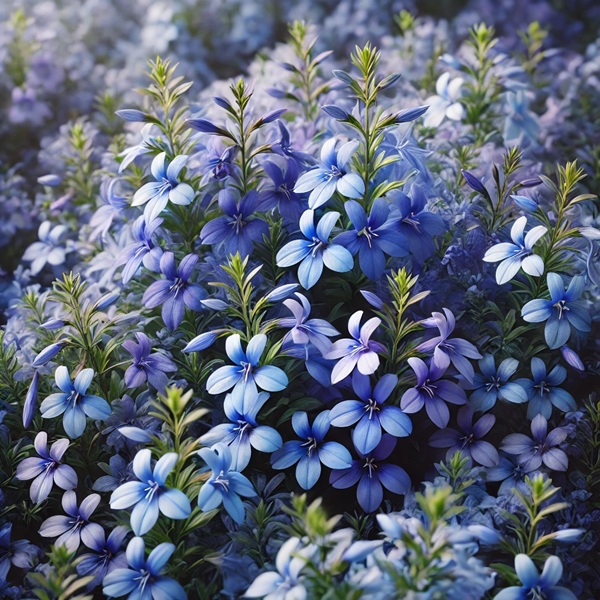
Lobelia is a graceful herbaceous plant that has won gardeners’ affection thanks to its ornamental appeal, low-maintenance nature, and versatility in landscape design. In Ukrainian conditions, where the climate ranges from moderately continental to steppe, lobelia feels comfortable in almost all regions, especially when proper cultivation practices are followed. There are more than 300 species of this plant, but in ornamental floriculture the most widespread is Lobelia erinus and its numerous hybrid forms. It can be upright, bushy, or trailing, with small flowers in blue-violet, white, pink, or lilac shades.
Lobelia is native to South Africa, but in the Ukrainian climate it is grown as an annual, since it does not tolerate frost. Still, the plant thrives outdoors from May to October, decorating flower beds, rabatkas, hanging planters, balcony boxes, and borders. Its main ornamental value is its abundant, almost continuous flowering, in which the greenery is hidden beneath a dense carpet of bright buds. Despite its miniature size, lobelia requires attention during cultivation, especially at the seedling stage. It is important to understand its biological traits: thin and fragile stems, tiny seeds, slow initial growth, and sensitivity to excess moisture and cold. All of these features shape certain cultivation rules that any Ukrainian flower grower should follow when deciding to decorate a plot with lobelia.
Sowing lobelia for seedlings is a key stage that largely determines the success of the whole season. In Ukrainian conditions, where return frosts may occur until mid-May, growing it through seedlings is essential. The optimal sowing period is from mid-February to early March, depending on the region: in the southern oblasts you can start earlier, while in the northern and western ones a little later. Lobelia has extremely tiny seeds that are almost impossible to distribute evenly by hand. That is why gardeners often mix the seeds with dry sand or snow, or use pelleted seeds. They are sown on the surface of a moist, loose substrate without covering them with soil, because lobelia needs light to germinate.
The optimal germination temperature is +20 to +23°C. The first seedlings appear in 7–14 days, but they are extremely delicate and require careful handling. To create greenhouse conditions, the trays are covered with glass or transparent film, aired daily, and cleared of condensation. As soon as the first sprouts appear, the cover is removed, and the trays are moved to a cooler, well-lit place to prevent stretching. Watering should be done only through the tray; otherwise there is a risk of rotting. Pricking out is carried out when the seedlings reach 3–4 cm, and most often they are transplanted in clusters of 5–10 plants per cell, which ensures lush flowering later on. The process of growing seedlings is long and requires patience, but it is exactly what guarantees the ornamental effect of lobelia in summer.
Lobelia in a flower bed is like a floral haze that highlights the brightness of neighboring plants or acts as an ornamental accent on its own. But to achieve this effect, it is important to choose the right planting site. In Ukraine, where summer may be either mild or hot, especially in the southern and eastern regions, lobelia needs comfortable conditions for steady growth and abundant flowering.
Main requirements for the planting site:
Lighting: lobelia prefers sunny locations, but in regions with scorching sun it is better to plant it where there is light afternoon shade.
Soil: it needs a loose, fertile, well-drained substrate with a neutral or slightly acidic reaction. Sandy and sandy loam soils are suitable provided regular watering is maintained.
Moisture: the plant tolerates neither drought nor stagnant water. A moderately moist regime should be maintained without overwatering.
Protection from wind: lobelia has fragile stems, so it is best planted in places protected from drafts, especially important for trailing forms.
Before planting, the soil should be dug over, enriched with humus or compost, and, if necessary, a little sand should be added to improve drainage. Fresh manure is not recommended, since it promotes leafy growth at the expense of flowering and may trigger fungal diseases. The planting period for seedlings is from the second half of May, once the danger of return frosts has passed. Young plants are planted 10–15 cm apart, and in the case of trailing varieties, 4–5 small bushes are placed in one hanging planter or pot.
For lobelia to bloom as long as possible and delight with abundant, vivid flowering, it needs regular care. This is not a plant that grows entirely “on its own.” Its main feature is a shallow root system, because of which any disruption in watering immediately affects the condition of the flower.
What lobelia needs for ideal growth:
Watering: regular, especially on hot days. It is better to water more often but in smaller amounts — drying out leads to wilting, while excess moisture causes root rot.
Feeding: lobelia is sensitive to excess nitrogen. It should be fed carefully, using complex mineral fertilizers with a predominance of potassium and phosphorus. Recommended feeding times:
two weeks after planting;
at the beginning of mass flowering;
in mid-summer, to stimulate repeat flowering.
Pruning: after the first wave of flowering, in July, the plant can be trimmed back — pruning stimulates the growth of new shoots and repeat flowering. About one-third of the length is cut off, after which the lobelia is well watered and fed.
Weeding should not be forgotten either: lobelia does not tolerate competition from weeds well. Mulching the soil around the plantings helps preserve moisture and reduce weed growth. Regular removal of faded flowers also helps prolong the flowering period, although because of the flowers’ small size this is difficult to do by hand — light trimming helps with that.
Despite its delicate appearance, lobelia is able to withstand seasonal temperature fluctuations and even short periods of drought. At the same time, however, it is vulnerable to a number of diseases and pests, especially in conditions of high humidity or dense plantings, which often occur in Ukrainian gardens during the damp part of spring, for example in May and June in the west and north of the country.
The most common problems:
Black leg — a fungal disease that affects seedlings. It occurs when the soil is too wet and ventilation is poor. It shows up as blackening at the base of the stem and wilting of seedlings.
Prevention: seed treatment, soil sterilization, and moderate watering.
Treatment: fungicides such as Fundazol or Previkur, and removal of affected plants.
Gray mold — appears in cool, damp weather. It is especially typical of the western and northern regions of Ukraine.
Symptoms: gray coating on leaves and stems, wilting of shoots.
Solution: thinning the plantings and treating with copper-based preparations.
Powdery mildew — affects plants in hot weather when temperatures fluctuate sharply.
Symptoms: a whitish coating on the leaves, curling, and halted growth.
Treatment: spraying with sulfur-based preparations or biofungicides such as Trichodermin.
Aphids and spider mites are the most common pests of lobelia. Aphids are active in spring and autumn, while spider mites appear in summer, especially in the southern regions.
Control: washing the plants with soapy water and treating with insecticides such as Aktara or Fitoverm.
Remember: prevention is the best protection. Keeping proper spacing between plants, controlling watering, and choosing a well-ventilated site significantly reduce the risk of disease. And at the first signs of infection, do not delay — a quick response helps preserve not only a single plant, but the whole composition.
Lobelia opens up endless possibilities for landscape design, both in a classic cottage-garden style and in modern urban greening. Its abundant and long-lasting flowering, wealth of shades, and variety of forms make it a universal tool for floral compositions. In Ukraine, it is actively used both on home plots and in public landscaping — flower beds, squares, and courtyards.
The most popular ways to use lobelia:
Border plantings — low-growing varieties beautifully frame the edges of flower beds, paths, and alpine gardens, creating a soft “border” of color.
Trailing compositions — cascading forms look especially impressive in hanging baskets, balcony planters, and flowerpots. In the southern regions, lobelia is often planted in partial shade for protection from the heat.
Balcony boxes — combining white and blue lobelia with petunia or alyssum creates light, airy arrangements.
Floral carpets — thanks to its compact growth and abundant flowering, lobelia is ideal for creating ornaments and patterns in flower beds.
Successful combinations:
with lavender and sage — for fragrant, textural flower beds;
with petunia — a classic summer pairing for bright planters;
with ornamental cabbage and viola — for autumn arrangements.
Lobelia’s color palette is ideal for creating both contrasts and soft transitions in flower gardens. It does not overpower other plants, but gently highlights their beauty.
Today, lobelia is increasingly used in vertical greening, rooftop decoration, balcony gardens, and even in floristry — for decorating wedding arches and floral panels. Ukrainian florists value it for its texture and miniature elegance in arrangements.
-220x275.jpg)