


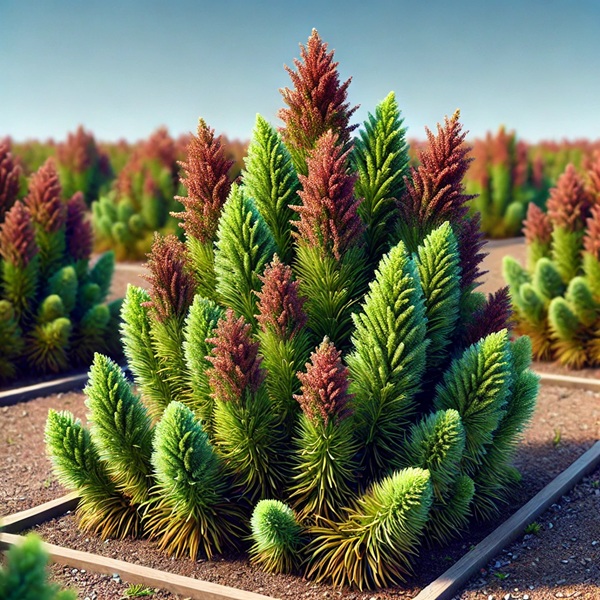
Kochia (Kochia) is an unusual annual plant widely used in ornamental gardening in Ukraine thanks to its form, texture, and changing color throughout the season. It belongs to the amaranth family, formerly classified in the goosefoot family, and originates from the arid regions of Asia and Europe. In cultivation, the most common species is Kochia scoparia, also known as burning bush, summer cypress, or bassia.
One of the main ornamental features of kochia is its dense, bushy form, which resembles miniature conifers. It is easy to shape and is used as a green border, hedge, accent plant in flower beds, and in mixed borders. The plant reaches a height of 40 to 100 cm depending on the variety and growing conditions.
Kochia is valued for:
resistance to drought and heat;
rapid growth, up to 10 cm per week;
the ability to remain decorative from spring until late autumn;
its color change: the foliage is green in summer and turns purple, burgundy, or even crimson in autumn.
The plant may be rounded, oval, or conical in shape. The leaves are small, linear, and densely cover the shoots. Its flowering is inconspicuous: tiny, barely noticeable flowers appear in the leaf axils and have no decorative value. The main visual effect comes precisely from the dense crown and the color of the foliage.
Kochia is widely used in landscape design: it is planted in formal compositions, used to decorate rabatkas, pathways, and alpine beds. It combines beautifully with marigolds, petunia, zinnia, and low-growing ornamental grasses. It is often used as a seasonal alternative to thuja or juniper when fast-growing green forms are needed.
Across Ukraine, kochia is grown everywhere — from Zakarpattia to Luhansk, from Volyn to Crimea — thanks to its resistance to extreme weather conditions. Even in the dry southern regions of Ukraine, kochia maintains its lush form with minimal watering.
Despite its refined appearance, kochia is an amazingly hardy and undemanding plant. However, to achieve maximum ornamental value, density, and vividness of the bush, the basic cultivation requirements should still be followed.
Planting site. Kochia is very light-loving and needs full sun exposure. In partial shade, the plant loses its compact shape, stretches out, becomes loose, and the foliage color fades. The best location is the southern or southeastern side of the plot, along paths, fences, or in flower beds with southern exposure.
Temperature conditions. Kochia is a heat-loving plant that does not tolerate frost, especially spring frosts. The optimal temperature for growth is from +18 to +28 °C. When the temperature drops to +5 °C, growth slows to a halt, and frost kills the plant. That is why sowing and planting dates should be followed carefully.
Soil. Kochia grows best in light, loose, well-drained soils with a neutral or slightly alkaline reaction, pH 6.5–7.5. It develops well on sandy and light loamy soils. On heavy, compacted, acidic, or waterlogged soils, root rot, stunted growth, and deformation of the bush shape may occur.
Site preparation. In autumn or spring, the site is dug to a depth of 25–30 cm, weeds and perennial roots are removed. Humus, 3–4 kg/m², wood ash, 100–150 g/m², and if needed sand or vermiculite are added before digging. Fresh manure is not recommended, since it triggers excessive leafy growth at the expense of crown density.
The planting pattern depends on the purpose:
single plantings — 30–50 cm between plants;
borders — 20–25 cm in the row;
hedges — in 2 staggered rows, with 30 cm spacing;
carpet compositions — dense planting, 15–20 cm between plants.
It is important to consider the size of the mature bush and avoid overcrowding, which reduces decorative appeal.
Kochia is propagated only by seed. In Ukraine, both direct sowing in open ground and the seedling method are used, especially in regions with a cool spring or when an early decorative effect is needed.
Sowing dates. Direct sowing into the ground is carried out no earlier than mid-May, after frost has fully ended. For seedlings, seeds are sown in late March to early April in a greenhouse or on a windowsill.
Seed preparation. Stratification is not required, but it is advisable to soak the seeds in a growth stimulant such as Epin or Zircon for 6–8 hours. This improves uniform germination and growth vigor.
Germination conditions. Seeds are sown on the surface, only lightly pressing them into the moist substrate. They are not covered with soil. The optimal germination temperature is +18 to +22 °C. Seedlings appear in 5–7 days if light and moisture are sufficient.
Seedling care. Young kochia seedlings are very delicate and vulnerable to diseases, especially damping-off. That is why it is important to:
water only through the tray;
ventilate regularly;
provide supplemental light when sunlight is insufficient;
prick out at the stage of 2–3 true leaves.
Seedlings are planted into open ground after stable temperatures are established and the soil has warmed to +15 °C. The plants are hardened off 7–10 days before transplanting.
Planting in open ground. The holes are arranged according to the chosen pattern, and it is advisable to add a little wood ash to the bottom. After planting, the bushes are watered, and the soil around them is mulched with peat, bark, or cut grass.
Kochia is a low-maintenance plant, but proper care helps it reach its maximum ornamental potential. Its dense form and vivid foliage are easily maintained with basic cultivation practices.
Watering. Although kochia is drought-resistant, it responds well to regular watering. During hot periods, it is watered 1–2 times a week; in very dry weather, every other day. On sandy soils or in containers, watering is needed more often. Excess moisture should still be avoided.
Loosening and weeding. After watering, the soil around the plants is loosened and weeds are removed. This is especially important in the first month after planting, since kochia does not tolerate competition well.
Feeding. For active growth and rich color, the following are recommended:
10–14 days after planting — a nitrogen fertilizer, such as ammonium nitrate or nettle infusion;
during active growth — a complex mineral fertilizer;
in August — ash or a phosphorus-potassium mix for autumn coloring.
Too much nitrogen causes the crown to become loose and the shoots to stretch excessively.
Crown shaping. Kochia tolerates trimming very well. Shaping begins when the plant reaches 20–30 cm in height, usually around mid-June. Garden shears or a trimmer are used. The plants are given rounded, oval, or pyramidal forms. Up to 3–4 trimmings may be carried out during the season.
Kochia is highly resistant to most pests and diseases. Problems usually arise when moisture is excessive or plantings are overcrowded.
Damping-off threatens young seedlings. Prevention includes ventilation, ash, tray watering, and drainage.
Root rot develops because of stagnant water. Treatment is difficult, so prevention is the main measure.
Aphids and spider mites may appear during drought. Treatment includes a soap solution, garlic infusions, or Fitoverm.
Seed collection. Kochia produces seeds that remain viable for 2–3 years. Not all ornamental varieties repeat the parent traits. For collection:
leave several bushes until autumn;
after the inflorescences turn brown, cut them off and dry them;
shake out the seeds, clean them, and store them in paper bags.
Kochia is an extremely versatile ornamental plant with enormous potential. It is actively used both in urban and private landscaping.
Ways it is used:
borders along paths and flower beds;
low hedges;
designing geometric flower beds and rabatkas;
topiary forms;
container compositions on balconies and terraces;
a background for bright flowering annuals.
In autumn, when the foliage turns burgundy-purple, kochia becomes a vivid accent in compositions. Thanks to its strong tolerance of pruning, it can be used to create logos, green lettering, figures, and ornaments.
Kochia is an ideal choice for both beginners and experienced gardeners in Ukrainian conditions. Ease of cultivation, heat resistance, ability to be shaped, and seasonal color change make this plant one of the most expressive in ornamental landscaping.
-220x275.jpg)
-220x275.jpg)

-220x275.jpg)
