Tulips are among the most popular spring flowers, symbolizing nature’s awakening and the arrival of warm days. They decorate flowerbeds, balconies, and gardens, creating bright floral displays. However, for tulips to delight with abundant blooming year after year, they need proper care. In this article, we will look at the main aspects of growing tulips: choosing bulbs, planting, watering, feeding, pruning, and preparing them for the next season.
Choosing high-quality planting material is the key to beautiful and healthy tulips. The bulbs should be firm, without signs of damage or rot. The optimal size is 3–5 cm in diameter. It is best to buy bulbs in autumn, just before planting, so they do not dry out.
Before planting tulips, it is important to prepare the soil properly. These flowers prefer light, fertile, and well-drained soils. The best option is loamy or sandy loam soil with a neutral or slightly alkaline reaction (pH 6.5–7.5). If the soil is heavy, sand and peat are added to improve drainage, and if it is too light, humus and compost are added to increase fertility.
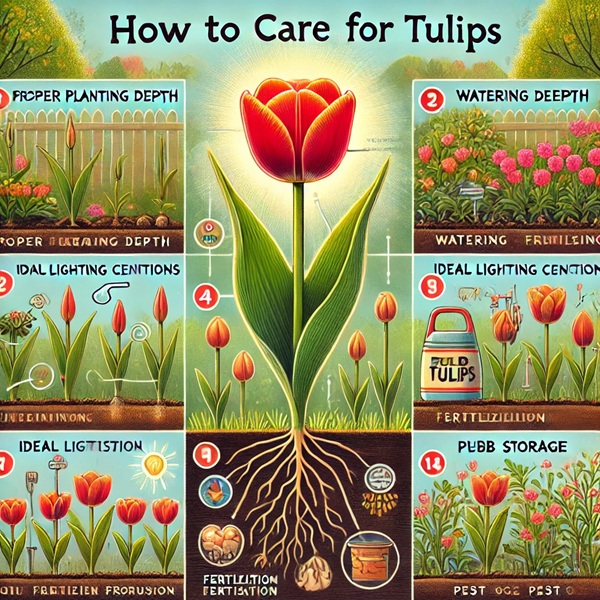
Tulips are planted in autumn, 4–6 weeks before the onset of frost. In different regions, this period falls between September and November. The optimal soil temperature at planting time is 8–10 degrees Celsius. The bulbs are planted at a depth of 10–15 cm, depending on their size, leaving 10–12 cm between them.
Before planting, it is recommended to soak the bulbs in a fungicide solution or potassium permanganate to protect them from fungal diseases. After planting, the beds are mulched with peat or fallen leaves, which helps retain warmth and moisture in the soil.
Tulips need moderate but regular watering. In spring, when active growth begins, the soil should remain moist but without standing water. The optimal watering schedule is once a week, depending on weather conditions. During dry periods, the frequency of watering is increased.
The best way to water is at the root, avoiding water on the leaves and buds so as not to provoke fungal diseases. After flowering, watering is gradually reduced, and once the leaves turn yellow, it is stopped completely.
Feeding plays an important role in forming strong stems and large buds. The following fertilizing schedule is used:
In early spring, nitrogen fertilizers are applied to stimulate leaf growth.
During the budding period, phosphorus-potassium fertilizers are applied to improve flowering.
After flowering, potassium fertilizers are used to strengthen the bulbs before dormancy.
Organic fertilizers such as humus and wood ash are added in autumn before planting. Fresh manure should not be used, since it can cause the bulbs to rot.
After flowering, tulips continue receiving nutrients through their leaves, so the foliage should not be cut off immediately. Only the faded buds are removed, so the plant does not waste energy on seed formation.
When the leaves have completely turned yellow, they are cut back, leaving a small part of the stem. At this stage, the bulbs enter dormancy, and preparation begins for digging them up.
Tulips can be grown without digging them up for 2–3 years, but to get large flowers it is recommended to dig up the bulbs every year after the leaves have yellowed, usually in late June to early July.
The bulbs are dug up in dry weather, cleaned of soil, and dried in a well-ventilated room. They are then sorted: damaged and diseased specimens are discarded, while healthy ones are kept for storage.
The optimal storage temperature is 20–25 degrees Celsius during the first weeks, then it is gradually lowered to 15 degrees. The bulbs are stored in a dry place, arranged in a single layer in wooden boxes or paper bags.
Before autumn planting, the bulbs can be treated again with a fungicide solution to prevent disease.
Tulips are propagated by daughter bulbs that form on the mother bulb. When the bulbs are dug up, these offsets are separated and grown for 1–2 years until they become fully flowering plants.
The most common problems when growing tulips are:
Bulb rot — caused by excess moisture and poor drainage.
Solution: proper watering and fungicide treatment.
Tulip breaking virus — appears as streaks and spots on the petals.
Solution: there is no treatment; infected plants must be removed.
Fusarium — a fungal disease that causes root rot.
Solution: preventive treatment of the soil and bulbs helps.
Aphids and mites — damage leaves and buds.
Solution: insecticides are used for control.
Tulips are not only a symbol of spring, but also low-maintenance flowers that, with proper care, will delight you with their blooms every year. Following recommendations on planting, watering, feeding, digging up, and storing the bulbs will help you grow strong and healthy plants, filling the garden with bright colors every spring.