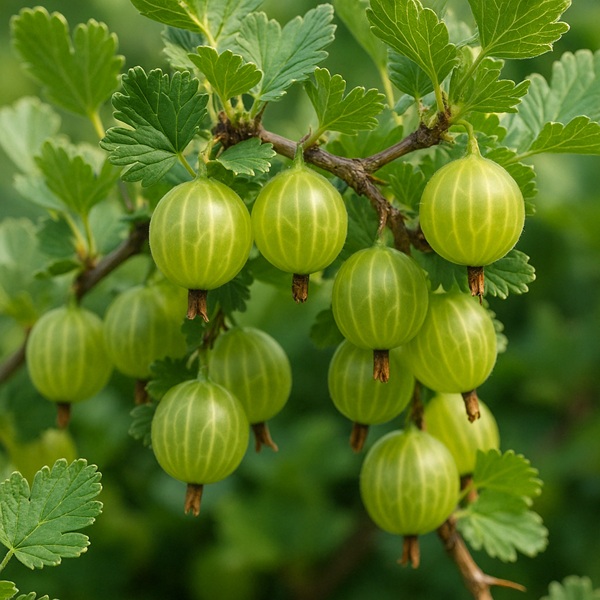
Gooseberry is one of the most beloved berry crops found in home gardens throughout Ukraine. It is valued for its early fruiting, stable yields, low maintenance requirements, and, of course, for its fragrant, tasty berries rich in vitamins, organic acids, and trace elements. Thanks to gooseberry’s ability to adapt to different climate zones and soil types, it is grown in both the southern and northern regions of Ukraine.
Gooseberry is a shrub 1 to 1.5 meters tall with a deep root system and thorns that protect the plant from being eaten by animals. The leaves are dense, slightly hairy, and deep green in color. The berries may vary in color — green, yellow, red, or purple — and in shape they may be smooth or slightly hairy. Gooseberry varieties ripen at different times, from June to August, which makes it possible to enjoy a long harvest period. The berries are excellent both for fresh consumption and for preserves, jams, compotes, drying, or freezing.
For Ukrainian regions, there is a wide selection of varieties resistant to frost, drought, and disease. Popular ones include ‘Malachite,’ ‘Yuvileiny,’ ‘Kolobok,’ ‘Captivator,’ ‘Russkiy,’ and others. When choosing a variety, it is important to consider not only flavor, but also resistance to common diseases such as powdery mildew. For the southern regions of Ukraine, drought-resistant and shade-tolerant varieties are suitable, while in the northern and central parts of the country it is better to plant frost-hardy forms with a short growing season.
Choosing the right place to plant gooseberries is very important for the plant’s future development and productivity. Gooseberries prefer well-lit areas protected from strong wind, without shading from trees or buildings. In the shade, the bushes become elongated, the berries grow smaller, the number of ovaries decreases, and the plant’s general condition worsens. Sites with a southern or south-western orientation and a slight slope, which ensures runoff of excess moisture, are best.
The soil for growing gooseberries should be loose, moderately moist, rich in humus, and neutral to slightly acidic (pH 6–6.5). On heavy clay or waterlogged soils, bush development becomes difficult, so before planting it is necessary to improve the soil structure with sand, humus, and peat. Planting pits are prepared 1–2 weeks before planting, measuring 40×40×40 cm, with organic matter added — humus, compost, wood ash, and superphosphate. This creates a supply of nutrients for the first years of growth.
The best time for planting is autumn, from late September to October, when the root system is still able to adapt to the new place. Spring planting is carried out in March or April, before active sap flow begins. The seedling is placed in the hole at an angle of about 45°, which stimulates the formation of new shoots. The root collar is buried 5–6 cm below the soil surface. After planting, the bush is watered generously with 10–12 liters of water and mulched with straw, sawdust, or peat. The branches are shortened, leaving 4–5 buds on each — this promotes proper crown formation.
The first year after planting gooseberries is the most important for properly establishing future yields. The main task is to ensure stable moisture and optimal conditions for rooting and growth. The plant should be watered weekly depending on weather conditions. Excess moisture and drying out of the soil are equally harmful. Mulching is highly beneficial — organic mulch helps retain moisture, suppresses weed growth, and improves soil microflora.
During the growing season, the plot should be weeded regularly, since young plants do not tolerate competition from weeds well. Particular care is needed near the base of the bush so as not to damage the shallow root system. Feeding in the first year is usually unnecessary if a sufficient amount of organic matter was placed in the planting hole. However, in summer the plant can be fed once with mullein or poultry manure infusion diluted at a ratio of 1:10 to support leaf development.
Bush formation begins in the very first year. In autumn, the first sanitary pruning is carried out: damaged, broken, and weak shoots are removed. From the second year onward, 3–4 of the strongest replacement shoots are left each year and the rest are cut out. This makes it possible to form, over 4–5 years, a productive, evenly lit bush with 10–15 main branches. Regular pruning ensures that light reaches all parts of the bush, promotes air circulation, makes harvesting easier, and reduces the risk of fungal diseases.
Gooseberry is a moisture-loving crop, but it does not tolerate excessive wetness. In Ukraine, especially during the dry periods of May and June when the ovaries are forming and the berries are filling, regular but moderate watering is necessary. On average, 30–40 liters of water are used per mature bush once a week. If the summer is hot and dry, the interval between waterings is reduced to 5 days. Excessive dryness leads to dropping ovaries and small, unsweet berries, while stagnant water causes root rot.
In spring, at the beginning of the growing season, gooseberries need nitrogen feeding to build green mass. Urea or ammonium nitrate is best, at 30 g per bush. During budding and fruit set, complex mineral fertilizers with phosphorus and potassium are applied, as these promote abundant flowering and strengthen the shoots. After harvest, in July or August, gooseberries are fed with wood ash, one glass per bush, or with superphosphate and potassium salt, which helps the plant prepare for winter. Organic feedings such as compost and humus are also useful in autumn, worked into the soil during digging.
In the southern regions of Ukraine, gooseberries need protection from sunburn and overheating. Young bushes often suffer from intense sun: the berries lose color and the leaves wilt. It is best to use agrofibre or light shade netting, which provide protection during the hottest hours of the day. Heavy mulching with straw, peat, or well-rotted sawdust also helps: mulch retains moisture, cools the soil, and prevents erosion. Loosening the soil after watering is a necessary practice, as it improves aeration and reduces the risk of soil crust formation.
The most common and dangerous gooseberry disease in Ukraine is powdery mildew, also known as American mildew. Affected shoots, leaves, and berries become covered with a white coating that later turns brown; they lose turgor and dry out. The disease develops especially actively in warm, wet springs and in overcrowded plantings. For prevention, in early spring, before bud break, the bushes are treated with 1% Bordeaux mixture or sulfur-containing preparations. Repeat treatments are carried out after flowering and again 10–14 days later. Effective products include Topaz, Horus, and Skor, which destroy the fungal infection at an early stage.
Among pests, the most dangerous are the gooseberry moth, sawfly, aphids, and spider mite. The moth lays eggs in flowers, and its caterpillars damage the ovaries and fruits. The most effective control measures are collecting fallen leaves in autumn, digging over the soil around the bushes, and using pheromone traps and treatments with tobacco or garlic infusions or chemical insecticides such as Actellic and Calypso. Aphids are controlled with soapy water or biological products such as Fitoverm, while spider mites are treated with acaricides.
Timely prevention is the key to a healthy bush. Regular inspection of the plants, removal of affected parts, thinning of overcrowded bushes, and sowing repellent plants near the gooseberries such as calendula, marigolds, and basil all reduce the risk of disease and pest infestations. It is also important not to plant gooseberries next to currant bushes if they are affected by the same diseases or pests, and to remove plant debris from the site in time.
Pruning is an important element of gooseberry care. Sanitary, formative, and rejuvenating pruning are carried out every year. In spring, before bud break, frozen, damaged, and weak shoots are removed. In addition, branches older than 5–6 years that no longer bear fruit are cut out each year, as well as those lying on the ground or growing inward. Ideally, a mature bush should have 10–15 main branches of different ages, which ensures even lighting and air exchange.
Gooseberries can be propagated by horizontal and arching layers, by dividing the bush, or by green cuttings. The simplest method is layering: in April, a strong lower branch is selected, bent to the ground, fixed in place, and covered with moist soil. By autumn, a root system has formed, and the new plant is ready for transplanting. Division of the bush is used when rejuvenating old plants: the bush is dug up and divided into several parts with their own roots. Green cuttings are taken in June and rooted in a greenhouse under film or plastic bottles.
Bush rejuvenation is carried out from the sixth or seventh year onward. This may involve gradually pruning out the oldest branches or full renewal, when all shoots are cut back, leaving stumps 5–10 cm high. Such radical rejuvenation stimulates the formation of strong new shoots, and in 1–2 years the bush fully recovers. After pruning, it is important to apply organic or mineral fertilizers, water, and mulch the plant to support it during the period of active regrowth.