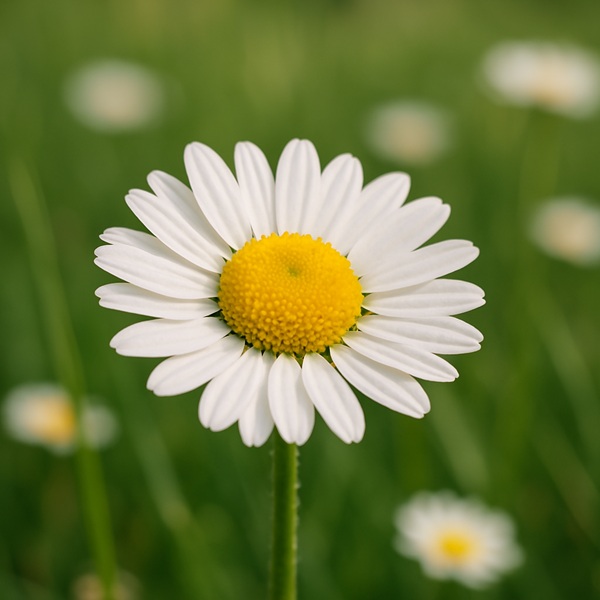
Daisies (Bellis perennis) are among the most recognizable and delicate flowers that bring gardens, flower beds, and balconies to life across Ukraine with the arrival of spring. They symbolize purity, freshness, and the awakening of nature, while their modest appearance hides remarkable resilience. Despite their apparent fragility, daisies are well adapted to the Ukrainian climate: they tolerate spring frosts calmly, are not afraid of rain, and can grow even in soils that are not especially fertile. This makes them particularly valuable for those looking for decorative yet low-maintenance plants to enhance a garden or yard.
There are many daisy varieties, including both simple and double forms with white, pink, red, and sometimes bicolored flower heads. They can be grown as:
Annuals — most often when sown from seed;
Biennials — the most common form in Ukrainian gardens;
Perennials — when propagated by dividing clumps or through self-seeding.
Advantages of daisies for Ukrainian gardeners:
Resistance to moderate frosts;
Easy propagation by seed, division, or self-seeding;
Long flowering period — from April to the end of June, and in favorable weather even into July;
Excellent combinations with other spring plants such as violas, primroses, tulips, and forget-me-nots.
Daisies establish well in most regions of Ukraine, from Zakarpattia to Kherson. In cooler and wetter areas, such as Lviv, Ivano-Frankivsk, and Rivne regions, they often overwinter in open ground and bloom as early as April. In warm and dry regions, such as Mykolaiv, Kherson, and Odesa, they are often grown as a seasonal crop and removed after flowering ends.
Choosing the right site and planting time is the key to healthy growth and bright, long-lasting flowering. Ukraine has a varied climate, and this should always be taken into account when planning. The best place for daisies is a site with good light in the first half of the day and light shade in the afternoon. Constant scorching sun may cause the flowers to fade, especially in double varieties.
Site and soil requirements:
Light: sunny or partial shade, especially important in the south and east of Ukraine;
Soil: loose, fertile, well-drained, preferably with neutral acidity, pH 6.0–7.0;
Moisture level: moderate, without stagnant water, since excess moisture is harmful to the roots;
Structure: loamy or sandy loam soil with added humus or compost.
Preparing the site for planting:
Dig the soil in autumn to a depth of 20–25 cm.
Add organic fertilizers such as well-rotted manure or compost.
In spring, loosen the soil again, level the surface, and remove weeds.
If acidity is high, apply lime.
Planting methods:
By seedlings — the best option for most regions. Seeds are sown in March, pricked out at the stage of 2–3 true leaves, and transplanted into open ground in May–June.
Direct sowing in open ground — possible from late April to mid-June. It is important to maintain moisture until seedlings emerge.
Winter sowing — suitable for southern regions such as Zaporizhzhia and Odesa, where winters are mild.
Planting pattern:
For compact varieties: 10–15 cm between plants;
For more vigorous ones: 20–25 cm;
Seed sowing depth: 0.5–1 cm, with the seeds only lightly pressed into moist soil rather than covered.
After planting, be sure to water and mulch with peat, humus, or dry grass to preserve moisture and protect the root system from temperature fluctuations. With the right approach, daisies will bloom the following year, forming dense and tidy clumps.
After planting, daisies need fairly simple but regular care. Their main advantage is their resilience to short-term unfavorable conditions. However, with proper cultivation practices, flowering will be longer and more abundant.
Main care elements:
Watering: regular but moderate. Moist soil is the key to lush flowering, especially in dry regions of southern and eastern Ukraine.
✦ During active growth and bud formation, water 2–3 times a week;
✦ After watering, it is advisable to loosen the soil so that a crust does not form.
Feeding:
✦ The first feeding is given 10–14 days after planting, using a complex mineral fertilizer;
✦ The second is during bud formation, with an emphasis on potassium and phosphorus;
✦ Excess nitrogen is undesirable because it stimulates leaf growth at the expense of flowering.
Pruning: removing faded flower heads encourages the formation of new buds. Light shaping can also be done, especially with double varieties.
Mulching: helps retain moisture and slows weed growth. Peat, cut grass, or humus-rich straw can be used.
Protection from heat: in southern regions, during intense sun, temporary shading with mesh or agrotextile is advisable.
In Ukrainian conditions, daisies respond especially well to cool and damp weather typical of spring and the first half of summer. Once the heat begins, flowering decreases, but with regular watering and removal of old flower stalks, repeat flowering can be achieved in autumn. This effect is more common in regions with mild autumns, such as Zakarpattia, Vinnytsia, and Chernivtsi regions.
Over time, daisies lose some of their decorative value: the flowers become smaller and the clumps less dense. To keep a flower bed attractive, plantings should be renewed periodically. There are several propagation methods, each suited to different conditions and climatic zones of Ukraine.
1. Propagation by seed:
✦ The simplest and most accessible method;
✦ Seeds are sown in March for seedlings, or from April to June in open ground;
✦ First flowering comes the following year;
✦ The seeds need light to germinate, so they are not covered, only lightly pressed into moist soil;
✦ Moisture is maintained until seedlings appear, usually within 7–14 days.
2. Division of the clump:
✦ Carried out in spring or in late summer, from August to early September;
✦ Clumps are carefully dug up, divided into 2–4 parts, and transplanted to a new location;
✦ Each division should have 2–3 rosettes and a well-developed root system;
✦ Flowering is retained the following year.
3. Self-seeding:
✦ Daisies reproduce easily on their own;
✦ After flowering, numerous seeds form, fall, and germinate in autumn or spring;
✦ To preserve varietal traits, self-seeded plants are best controlled by removing weak or reverted specimens.
Important: when propagated by seed, some hybrid forms, especially double ones, do not retain their varietal traits. For that reason, dividing clumps is the better way to preserve decorative qualities.
In central and northern regions of Ukraine, division is best carried out in spring so the plants have time to root well before winter. In southern and western regions, autumn propagation is also acceptable. The main thing is to avoid either drying out or overwatering during the first 2–3 weeks after transplanting.
Like most garden crops, daisies are susceptible to certain diseases and pest attacks, especially in wet weather or in overcrowded plantings. To preserve plant health and decorative value throughout the season, it is important to identify problems in time and respond properly.
The most common diseases:
Gray mold (Botrytis)
✦ Often appears in cool, damp weather;
✦ Signs: brown spots on leaves and stems, with a gray fuzzy coating;
✦ Cause: stagnant moisture and lack of air circulation.
Powdery mildew
✦ A white coating on the leaves that gradually becomes denser;
✦ Spreads during temperature fluctuations;
✦ Reduces decorative value and weakens the plant.
Rust
✦ Affects the underside of leaves, forming rust-colored spots;
✦ Especially active in wet weather.
Prevention and treatment:
Timely thinning of plantings;
Proper watering without overwatering;
Treatment with biofungicides such as Fitosporin or Trichodermin;
In severe cases, use chemical products such as Topaz, Skor, or Horus.
Pests dangerous to daisies:
Aphids — suck sap from young shoots and cause deformation;
Spider mites — especially active in hot weather, appearing as fine webbing on the underside of leaves;
Slugs — damage leaves and buds and are most active at night.
Control methods:
For aphids and spider mites: Aktara, Fitoverm, or Inta-Vir;
For slugs: ash, traps, or granules such as Groza or Meta;
Autumn cleanup of plant debris and digging the soil help reduce pest numbers for the next season.
Daisies are among the most versatile flowers in landscape design. Their compact habit, variety of colors, and delicate texture allow them to be used both in classic flower beds and in modern decorative solutions. In Ukraine, daisies are often used as background flowers in spring compositions or as a decorative plant in their own right.
The most popular uses:
Borders along paths and flower beds — white and pink varieties look especially effective when planted in dense rows;
Floral carpets — low-growing varieties are excellent for dense planting;
Alpine gardens and rockeries — daisies tolerate raised, well-drained spots well;
Container growing — for balconies, terraces, and inner courtyards;
Combinations with spring bulbs such as tulips, daffodils, and crocuses;
Pairing with viola, forget-me-nots, and primroses — a classic spring garden look.
Design recommendations:
Use different daisy shades to create soft transitions or contrasts;
Combine simple and double forms to add volume to the composition;
Plant daisies along the edges of flower beds — they hold their shape well and do not suppress neighboring plants;
They are ideal for romantic and retro-style compositions.
Beyond their decorative role, daisies also carry cultural significance: for centuries they have symbolized purity, simplicity, and youth. In folk medicine, they were used as a wound-healing and anti-inflammatory remedy. Today, daisies are not only an ornament of the spring garden, but also a living embodiment of natural tenderness.