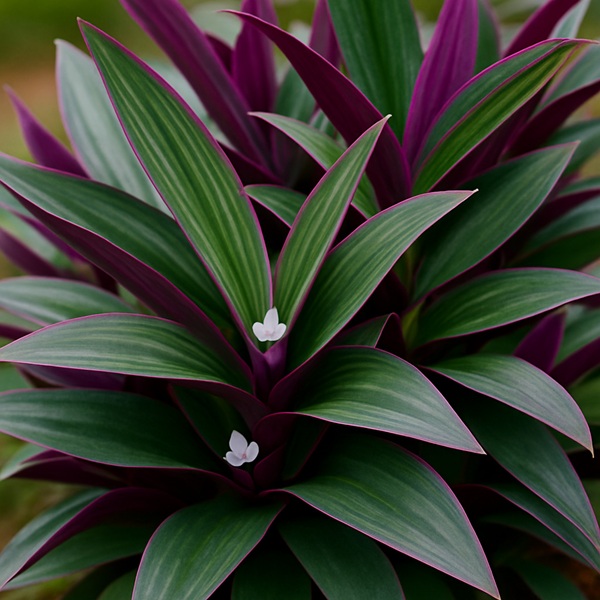
The rheo flower (Rhoeo), also known by its Latin name Tradescantia spathacea, is a bright and expressive tropical plant from the spiderwort family. It came to Ukraine from Central America and the Caribbean, where it grows as a ground cover or a border plant in gardens. In indoor floriculture, rheo is valued for its unusual foliage: the upper side is green or striped, while the underside is a rich purple. This contrast in color provides year-round decorative appeal.
Rheo is an undemanding plant, which makes it an excellent choice for both beginners and experienced growers. In addition to its vivid leaves, rheo is also interesting for its original flowering: small white flowers appear in axillary boat-shaped bracts that resemble an opened shell. Because of this feature, rheo has also earned another common name — “Moses in the cradle.” Although the flowers themselves are not very showy, their decorative bracts add expressiveness to the plant.
The most common species and varieties suitable for growing in Ukrainian conditions are:
Rhoeo spathacea — the classic type with purple-green leaves up to 30–40 cm long. It stands out for its hardiness and low-maintenance nature.
Rhoeo spathacea ‘Vittata’ — a cultivar with bright yellow stripes on the green upper side of the leaf and a purple underside.
Rhoeo discolor — has darker, glossier foliage and is ideal for decorative arrangements.
Rhoeo ‘Compacta’ — a compact form, convenient for small pots and windowsills.
All rheo varieties have similar care requirements, though they differ in growth rate, rosette density, and color intensity. With good lighting, the foliage becomes even brighter, especially on the reverse side. This makes rheo suitable for apartment interiors, winter gardens, florariums, balconies, and loggias.
Proper planting is the foundation of a strong and ornamental plant. In Ukraine, rheo is grown mainly as an indoor plant, but in summer it can be kept outdoors — on balconies, terraces, or in front gardens. The main thing is to avoid temperatures below +10°C, since rheo is heat-loving and does not tolerate drafts or sharp climate changes well.
Optimal planting conditions:
Soil: light, loose, and permeable to both air and water. The ideal mix is a universal substrate for ornamental foliage plants with added perlite, coconut fiber, and a little charcoal. An alternative is: 2 parts leaf soil, 1 part turf soil, 1 part sand.
Pot: shallow but wide, with mandatory drainage holes. Expanded clay or broken brick is placed at the bottom.
Acidity: neutral or slightly acidic (pH 6–7).
When planting, it is important not to bury the growing point of the rosette. After repotting, water the plant generously and keep it in partial shade for 2–3 days to help it adapt. Then move it to its permanent place with bright, diffused light. East- and southeast-facing windows are the best choice. South-facing windows are also possible, but summer shading at midday is necessary.
The temperature regime should be stable: in summer — +20 to +28°C, in winter — no lower than +16°C. If the temperature drops below +12°C, growth may be suppressed and the leaf color may lose intensity. Sharp changes in air humidity are also undesirable, as they may cause leaf deformation or leaf drop.
The watering regime is one of the most important factors for the health of the rheo flower. Despite its tropical origin, the plant does not tolerate stagnant water. Overwatering is especially dangerous in winter, as it quickly leads to root rot. At the same time, excessive drying out causes loss of leaf turgor and dry tips.
Watering recommendations:
Spring–summer: moderate watering 2–3 times a week, depending on the temperature. The top layer of soil should dry out by 2–3 cm. Excess water from the tray should always be poured off.
Autumn: reduce watering to once a week.
Winter: infrequent watering — about once every 10–14 days, when the soil is almost completely dry.
The water should be soft, settled, and at room temperature. Hard water leaves a white coating on the substrate and negatively affects leaf color. Watering with cold water can shock the plant.
As for air humidity, rheo is generally undemanding, but during the heating season indoor air becomes too dry. For that reason, it is recommended to:
place containers of water nearby;
use a humidifier;
keep the pot on a tray with damp expanded clay;
wipe the leaves with a damp cloth once a week.
Misting is not essential, but regular cleaning of dust from the leaves improves photosynthesis and the plant’s appearance.
The rheo flower is one of the easiest plants to propagate. The main method is dividing the clump or separating daughter rosettes that form at the base of the mother plant. This is best done in spring or summer, when the plant is actively growing and adapts easily after repotting.
Step by step, the process looks like this:
Carefully remove the plant from the pot.
Separate the daughter rosettes with roots.
Plant them in small pots with moist, loose substrate.
Keep them in partial shade for 3–5 days, lightly moistening the soil.
Propagation by tip cuttings is also possible. Cuttings 8–12 cm long are dried for a few hours, then rooted in water or in a peat-and-sand mix. In a humid mini-greenhouse at +22 to +25°C, rooting takes 1.5–2 weeks. This method is convenient because it allows you to form a symmetrical, compact bush — several cuttings can be planted in one pot at the same time.
Pruning of the rheo flower mainly serves a sanitary and rejuvenating purpose. Yellowed or dried leaves are cut off at the base. To preserve its decorative appearance, old lower leaves are removed once every 1–2 months. If the plant has become stretched or lost density, it is cut back and the top is re-rooted, while the older part is rejuvenated and repotted.
With proper care, the rheo flower rarely gets sick, but with overwatering, lack of light, or dry air, diseases or pests may appear. In indoor conditions in Ukraine, the most common problems are the following:
Root rot — caused by overwatering, especially in winter. Symptoms: wilting, dark spots near the base, unpleasant smell. Solution: repotting, removal of affected parts, fungicide treatment (Fundazol, Previkur).
Chlorosis — yellowing of leaves while the veins remain green. The cause is iron deficiency or excessive salt buildup in the substrate. Treatment with iron chelate (Ferovit) helps.
Leaf spot — dark spots with a dry edge. This signals a fungal infection. The affected parts are pruned off, and copper-based products are used.
Pests that sometimes threaten the rheo flower:
Spider mites — appear in dry air. The leaves become covered with pale dots and later with fine webbing. Effective products include Fitoverm and Actellic.
Scale insects — brown hard shields on petioles and veins. They are removed mechanically, then treated with an insecticide.
Aphids — attack young rosettes. A soap solution or Aktara is used for control.
Prevention includes:
avoiding stagnant water;
following the watering schedule;
regular ventilation;
treating the soil before planting;
checking new plants during quarantine.
Regularly wiping the leaves with a damp cloth and keeping conditions under control greatly reduces the risk of pests and diseases.
Despite its tropical origin, the rheo flower adapts very well to indoor conditions even in winter. However, it is important to follow the basic requirements for lighting, temperature, and watering in order to preserve its decorative effect during the cold season:
Temperature: no lower than +16°C. The optimal range is +18 to +22°C. At lower temperatures, the lower leaves may drop.
Lighting: bright and diffused. South- or east-facing windows are suitable. Additional lighting in winter is desirable.
Watering: limited. Water only after the substrate has dried out completely.
Feeding: none from late October until mid-March.
From March onward, the plant is gradually returned to an active routine — watering is increased, feeding begins, and repotting or rejuvenating pruning is carried out.
The rheo flower is an ideal option for decorating:
offices and windowsills;
rooms with partial shade;
arrangements in winter gardens;
container plantings on loggias or terraces in summer.
It combines beautifully with other foliage plants such as chlorophytum, zamioculcas, and sansevieria. In mixed plantings, different rheo varieties can be used together to create a vivid color palette. It is an undemanding but visually striking plant that easily brings life to any space.