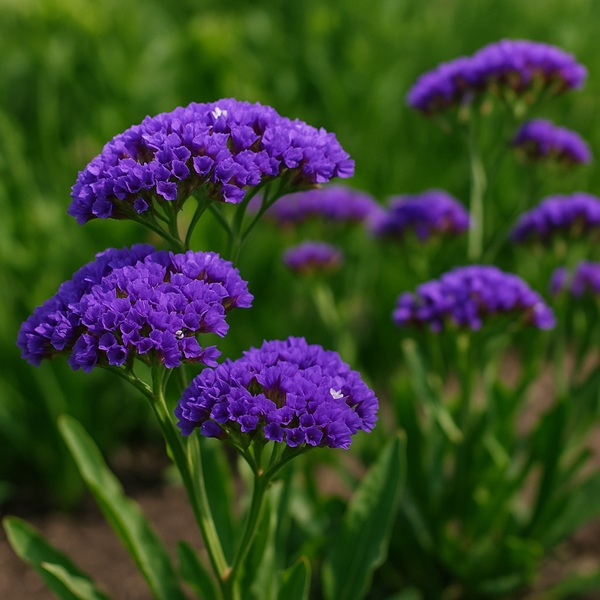
Kermek, or sea lavender, is an elegant yet undemanding plant widely used in gardening and floristry. It is valued for its decorative inflorescences that retain their shape and color even after drying. That is why kermek is also often called an everlasting flower or dried flower. The genus Limonium includes more than 120 species, but in Ukraine the most commonly grown are broad-leaved kermek, Gmelin’s kermek, Chinese kermek, Suvorov’s kermek, and hybrid varieties.
These plants form a basal rosette of leaves and a strong flowering stem with branched inflorescences made up of a large number of small flowers. The color range varies from white and yellow to bright blue, purple, pink, and bicolored shades. Flowering lasts from June until the end of September, and in some cases until the first frosts. Thanks to its ability to remain decorative when dried, kermek is actively used for winter bouquets, herbariums, and interior decoration.
Ukraine’s climate is very well suited to growing kermek in open ground. In the southern and central regions, the plant easily tolerates heat and drought; in the northern regions, it requires early sowing or seedling cultivation. One important thing to remember: kermek is light-loving and needs open, well-ventilated areas with well-drained soil. With proper planting and minimal care, the crop rewards growers with stable and long-lasting flowering even on poor and slightly saline soils.
Kermek prefers open, sunny areas without standing water or strong drafts. It is a sun-loving crop that does not tolerate shade at all — with a lack of light, flowering becomes weaker, and the shoots stretch and deform. The best soils are light sandy loam or sandy soils with a neutral or slightly alkaline reaction (pH 6.5–8.0).
Before planting, the site should be dug to a depth of 25–30 cm, carefully removing the roots of perennial weeds. If the soil is heavy, sand and lime are added to reduce acidity; if it is too light, humus or compost is added to improve fertility. Organic matter should be applied moderately: excess nitrogen stimulates leaf growth but slows flowering. In regions with prolonged rains, especially in the west of the country, it is advisable to form raised beds or slight mounds.
Kermek can be sown in two ways: directly into open ground or through seedlings. Under Ukrainian conditions, the seedling method is optimal, especially for the northern and central regions where spring is cool and unstable. Seeds are sown in March so that strong seedlings are ready by May. Direct sowing into the ground is possible in late April or early May, once the threat of frost has passed and consistently warm weather has set in.
Growing kermek through seedlings is the most reliable way to obtain strong plants that will bloom early and abundantly. Sowing is carried out in March to early April. The indoor temperature should not be below +18 °C. The seed planting depth is 0.5–1 cm. Seedlings need light, so containers are best kept on a south-facing windowsill.
Stages of growing seedlings:
Prepare containers with drainage holes, 10–12 cm deep.
Substrate: turf soil + peat + sand (2:1:1), with a pH close to neutral.
It is advisable to soak the seeds for 5–6 hours in a growth stimulant solution such as Epin or Zircon.
After sowing, cover with film or glass until seedlings emerge.
Germination temperature: +20 to +22 °C; after emergence: +18 °C.
Water carefully around the edges, avoiding overwatering.
Pricking out is done at the stage of 2–3 true leaves by transplanting the seedlings into separate cups or trays, deepening them to the cotyledons. Ten to twelve days before planting in the ground, the seedlings are hardened off by taking them outdoors and gradually increasing the time they spend in the open air.
Planting in a permanent location is carried out in mid to late May, when the temperature remains steadily above +10 °C. The distance between plants is 25–30 cm. A little humus or ash can be added to the planting holes. After planting, the soil is mulched, and if necessary, the plants are shaded for 2–3 days.
Kermek is one of the least demanding crops in the garden, but to achieve long-lasting, bright flowering and a strong bush, it still needs some minimal care. Once mature, the plant becomes resistant to heat and wind, although during the first months after planting it needs basic attention.
Watering. Kermek tolerates drought well, and this is one of its main advantages. Watering is only needed during long dry periods. Young plants are watered once every 5–7 days, while mature ones are watered no more than once every 10–14 days. The most important thing is to avoid stagnant moisture, as this leads to root rot.
Feeding. Two to three weeks after planting in open ground, the first feeding is applied — a complex mineral fertilizer with a predominance of potassium and phosphorus. Nitrogen should be used sparingly, otherwise the plant will put its energy into foliage at the expense of flowers. During the summer, 1–2 more feedings are acceptable, especially during bud formation.
Weeding and loosening. A clean area around the bush ensures good ventilation and reduces the risk of disease. Weeding is carried out regularly, especially in the early stages of growth. Loosening is done after rain or watering, to a depth of up to 5 cm.
In mid-summer, it is worth cutting off faded inflorescences if kermek is used as a decorative flowerbed plant. If it is intended for drying in bouquets, the faded flowers are left untouched until they fully mature. In autumn, the above-ground part of the bushes is cut back to the root, especially if the crop was grown as an annual.
The main value of kermek is its ability to retain its beauty after cutting. Properly dried flower stalks do not lose their color, do not crumble, and can be stored for several years. This feature is exactly why kermek is so actively used in floristry.
When to harvest. The optimal period is when the inflorescences are fully open, but before they begin to wilt. This is usually the second half of July or August. Cutting is done in the morning after the dew has dried. The stem should be fairly long — 30–40 cm — to make bouquet arrangement more convenient.
Drying. The collected flowers are stripped of leaves from the lower part of the stem, tied into bunches, and hung upside down in a dry, dark, and well-ventilated room. This may be an attic, a covered balcony, or a shed. Direct sunlight must be avoided, as it bleaches the petals. Drying takes 2–3 weeks. After that, the dried flowers can be stored in airtight boxes, paper bags, or vases without water.
Tip. To help preserve the shape and shine of the petals, the bouquet can be lightly sprayed with hairspray. This is especially useful for arrangements intended for long-term indoor display.
Ready dried flowers do not require special storage conditions, but it is better to avoid moisture and sharp temperature changes. Under such conditions, kermek can retain its decorative appeal for up to 3 years or even longer.
Kermek is a true all-rounder in garden design and floristry. Its attractive appearance, resistance to weather conditions, and ability to keep its color after drying make it an indispensable plant for many uses, from flowerbed design to creating original decorative panels.
In the garden:
– single plantings on lawns or near conifers;
– mixborders with other drought-tolerant flowers such as sage, echinacea, and lavender;
– borders along pathways;
– rock gardens, dry slopes, and rockeries;
– group plantings in sandy areas.
In floristry:
– winter bouquets, combined with lagurus, wheat, and gypsophila;
– gift arrangements and decorative cards;
– decorative garlands, wreaths, and Christmas ornaments;
– wall panels, florariums, and aromatic sachets.
Kermek pairs wonderfully with other dried flowers, does not cause allergies, requires no special care, and can decorate a home for many months. Thanks to its wide range of colors and varieties, it fits easily into both rustic and modern landscape compositions.
This is one of those plants that brings joy not only in summer, but throughout the entire year. Most importantly, growing it does not require much effort, which makes kermek an ideal choice for both beginners and experienced gardeners.