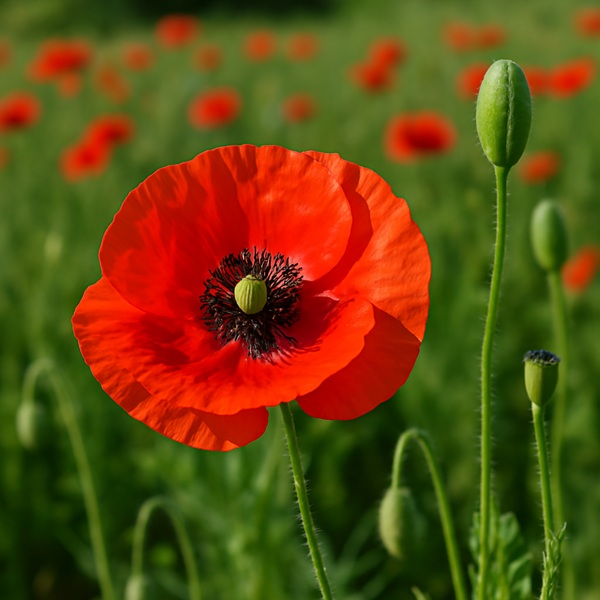
Poppy is one of the most recognizable and symbolic plants in Ukrainian culture, valued both for its ornamental appeal and its practical uses. It belongs to the genus Papaver in the poppy family (Papaveraceae) and includes more than 100 species. The best known in Ukraine are opium poppy (Papaver somniferum), corn poppy (Papaver rhoeas), and ornamental varieties of Oriental poppy (Papaver orientale). These plants are widely used in home gardening, the food industry, cosmetics, the production of natural oils, and landscape design.
The tradition of growing poppy in Ukraine goes back deep into the past. It played an important role in rituals, holidays, symbolism, and cooking. Today, it still holds an honored place in household gardens and agricultural practice. The most widespread type is the annual opium poppy, grown for seeds used in food and decoration. It forms an upright, slightly branched stem 60–120 cm tall, bluish foliage, and large flowers up to 10–15 cm in diameter. The petals may be red, pink, white, or purple. After flowering, the plant forms the characteristic capsules that contain thousands of tiny seeds.
Poppy is a light-loving and relatively undemanding plant that, with the right choice of site and sowing time, can bloom all summer. In Ukrainian conditions, it performs especially well in regions with a warm spring and a moderately hot summer. Its root system is adapted to loamy and sandy loam soils, and its short growing season makes it possible to obtain a full seed harvest just 90–120 days after emergence. It is important to remember that the cultivation of opium poppy on an industrial scale is regulated by law, since this plant is a source of narcotic substances. In the private sector, only a limited number of plants may be grown, strictly for ornamental or culinary purposes.
Note: poppy cultivation is allowed only for food or decorative purposes and only in limited quantities, up to 10 plants per plot. Violations of the law may result in penalties.
Despite its outward simplicity, poppy is fairly demanding when it comes to light and soil conditions. It prefers well-lit places with loose, structured soil of neutral reaction. The best soils for growing poppy in Ukraine are light and medium loams with deep cultivation and good air exchange. Poppy tolerates acidic or waterlogged soils poorly, since they promote fungal diseases, root rot, and lower germination. If the soil has a pH below 6.0, it should be limed beforehand with dolomite flour or ash.
It is best to begin preparing the site for sowing in autumn. The area is cleared of plant debris, dug over to a depth of 25–30 cm, and enriched with organic fertilizers such as humus or compost at 4–6 kg/m². In spring, as soon as the soil dries out, harrowing, cultivation, and leveling are carried out. It is very important to achieve a fine, crumbly soil structure, since poppy seed is tiny and needs close contact with the soil surface in order to germinate. If the soil is too loose or has not settled, germination problems may occur.
As for crop rotation, poppy should not be sown in the same place every year. The optimal return period for the crop is no sooner than after 4 years. Good preceding crops are cereals such as wheat, oats, and rye, as well as legumes and root crops such as carrots and beetroot. Poppy should not be grown after crucifers such as cabbage and radish, sunflower, or other crops that accumulate fungal diseases and nematodes. After poppy, it is good to sow green manure crops or potatoes, since the soil after it is loosened and enriched.
Tip: when planning sowing, always take the cleanliness of the plot into account. Weeds not only suppress seedlings, but also attract pests, especially at the budding stage.
Poppy is a crop with extremely small seed, so sowing technology has special requirements. The seed germinates in light, so it should not be buried deeply. The best time for sowing in Ukraine is early spring, as soon as the soil warms to +4 to +6 °C and the top layer dries out. This is usually late March to early April. Late sowing, in May or June, is undesirable, since the seedlings will face heat and may dry out even before budding.
The seeds are sown directly into open ground. Before sowing, they may be mixed with dry sand for more even distribution. The sowing rate is 0.5–1 g/m², or about 2,500–5,000 seeds. The layout depends on the purpose: for ornamental beds, a denser planting is acceptable, with 10–15 cm between plants, while for seed production a more open spacing is used, with 25–30 cm between rows. The seeds are placed into furrows about 0.5 cm deep, gently pressed with the palm or a roller, but not covered. Watering must be very gentle, from a watering can with a fine spray.
Seedlings appear in 6–12 days. At the stage of two true leaves, thinning is carried out, leaving 10–15 cm between plants. Overcrowding leads to stretched stems, weak flowering, and fungal damage. The beds must be weeded, especially in the first weeks after emergence, when poppy is weak and cannot tolerate competition. Moisture should also be monitored carefully: poppy tolerates neither drying out nor standing water.
Important: transplanting poppy is undesirable. It is better to sow it directly in its permanent place. If transplanting is absolutely necessary, it should be done only at the 2–3 leaf stage.
Throughout the growing season, poppy requires regular care, especially in the variable weather typical of most Ukrainian regions. The first priority is watering. Poppy is sensitive to lack of moisture during growth and budding. When water is insufficient, the plants remain short, the flowers are small, and the seed capsules form poorly. Excess moisture is also harmful, since overly wet soil can cause root rot and fungal development.
Poppy is watered moderately: once a week in rainy periods, and up to 2–3 times a week in dry weather, using 5–8 liters per m². Watering should be done at the root, early in the morning or in the evening, to avoid burns on the leaves and flowers. After watering, the topsoil should always be loosened. This improves aeration, prevents crust formation, and enhances water penetration. Mulching with grass, sawdust, or humus significantly reduces the need for loosening, retains moisture, and suppresses weeds.
Poppy needs feeding twice during the season. The first feeding is at the 3–4 true leaf stage, using a universal mineral fertilizer such as NPK 10-10-10 at a rate of 30 g/m². The second comes during budding, with an emphasis on phosphorus and potassium, for example monopotassium phosphate or potassium sulfate. Too much nitrogen leads to excessive leafy growth at the expense of flowering and productivity. Among organic options, grass infusion, wood ash, or chicken manure diluted 1:15 work well. All fertilizers are applied only to moist soil or together with watering.
Tip: it is useful to mulch poppy beds once after thinning, since this makes дальнейший care much easier.
Poppy flowering in Ukraine begins in late May and may continue until mid-summer depending on the variety. Each flower lasts only 2–3 days, after which seed capsules begin to form. If poppy is grown for decorative purposes, faded flowers should be removed regularly to prolong blooming. If the goal is seed collection, all capsules are left until fully ripe.
Ripe capsules have a characteristic brown or gray color, become hard, and develop openings at the top through which the seeds begin to spill out. Harvesting is done in dry weather, in the morning or evening, when the plants are not wet from dew or heat. The capsules are cut together with part of the stem and then dried in a ventilated room for 7–10 days. After drying, the seeds are threshed and sifted.
The seeds are stored in tightly closed paper packets, glass jars, or cloth bags at a temperature of +10 to +18 °C and relative humidity no higher than 50–60%. Under proper conditions, they remain viable for 3–4 years. Before sowing, it is advisable to treat the seeds with a weak potassium permanganate solution or a fungicide. For food use, only verified varieties should be used, since ornamental forms may have a bitter taste or unstable seed quality.
Important: always label the varieties during harvest, since ornamental hybrids often do not preserve their parental traits when self-pollinated.
Poppy is not only a food or agricultural crop, but also an extremely important plant in Ukrainian tradition. In Ukrainian folklore, poppy symbolizes memory, beauty, motherhood, innocence, and sacrifice. Its image appears in songs, fairy tales, embroidery, and decorative painting. Poppy fields inspired artists and poets, and poppy seed was always included in ritual dishes, especially kutia, during holidays.
In modern design, poppy is actively used as a bright accent in flower beds. Oriental and hybrid ornamental varieties with large flowers are especially striking. Poppy combines beautifully with cornflowers, sage, lavender, delphinium, and chamomile. It is grown in mixed borders, rabatkas, and wild-meadow style plantings. Low-growing varieties are ideal for borders, while taller ones suit the center of a flower bed.
Beyond its beauty, poppy is useful as a honey plant, attracting bees and other pollinators. Its root system helps prevent soil erosion. The dried capsules are used in floral compositions. Some varieties can even be grown in containers on balconies. It should only be remembered that poppy is prone to self-seeding: if the capsules are not collected in time, it may sow itself across the whole plot the following year.
To sum up, poppy is a symbol of Ukrainian culture, beauty, and living memory. At the same time, it is a simple and rewarding plant to grow, one that can decorate any yard, garden, or field.