Pineapple is an exotic plant that can be successfully grown at home. Many people believe that this fruit requires a special climate and professional care, but in fact it can be grown from the crown of an ordinary store-bought pineapple. The main thing is to follow the correct planting method and create favorable conditions for growth. In this article, we will take a detailed look at every stage of growing pineapple, from preparing the planting material to getting the first harvest.
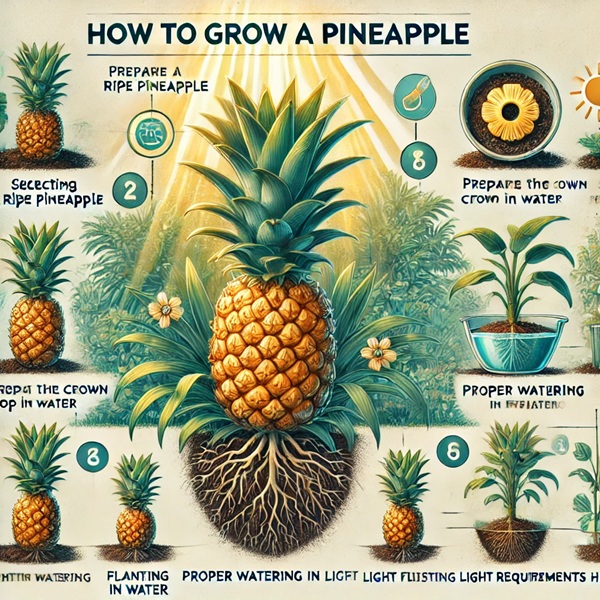
The first step in growing pineapple is choosing the right fruit. A fresh, ripe pineapple with green, firm leaves is best. Overripe fruits with soft skin or a dried-out rosette should be avoided, since the chances of successful rooting are minimal.
After buying the pineapple, the crown must be separated carefully. This can be done in two ways:
Carefully twist off the leaf rosette, holding the fruit with one hand and turning the crown counterclockwise.
Cut off the crown with a knife, leaving a small layer of flesh, which must then be removed to prevent rotting.
After separating the crown, the lower leaves are removed, exposing about 3–4 cm of the stem. This part will later produce roots. To speed up rooting, the cut can be treated with charcoal, or the crown can simply be left to dry for 2–3 days.
Next, the pineapple crown is placed in a glass of water so that the lower part is submerged by 2–3 cm. The water is changed every 2–3 days, and the glass is kept in a warm, bright place. The first roots will begin to appear in 1–2 weeks. Once they reach 4–5 cm in length, the pineapple can be transplanted into soil.
For planting pineapple, a light, nutritious, and breathable substrate is needed. You can use a ready-made mix for succulents or prepare the soil yourself by mixing:
2 parts leafy soil,
1 part sand,
1 part peat,
1 part humus.
A drainage layer must be placed at the bottom of the pot, such as expanded clay, pebbles, or broken brick, to prevent water from stagnating.
The pot should not be too deep, but it should be wide enough, since the pineapple root system spreads sideways. The optimal diameter is 15–20 cm.
For planting, make a small hole in the center of the pot, place the rooted crown into it, and cover it with soil so that the lower leaves remain above the surface. The soil is lightly firmed and watered.
After planting, the pot with the pineapple is placed in a warm spot with bright, diffused light. The optimal temperature is 22–26°C. For the first 1–2 weeks, the plant can be covered with transparent plastic film or a glass jar to create a greenhouse effect.
Pineapple is a heat-loving plant, so it needs plenty of light and warmth. It grows best on a south-facing or east-facing window, where it receives at least 8–10 hours of sunlight per day.
Watering should be moderate. The water should be soft, settled, and warm, around 30°C. The plant is watered into the leaf rosette, while the soil is also lightly moistened. Between waterings, the soil should be allowed to dry out slightly to avoid root rot.
Feeding begins 1–2 months after planting. During the active growing period, pineapple is fertilized once every 2 weeks, alternating between:
organic fertilizers, such as diluted humus infusion,
mineral fertilizers for tropical plants.
Lime-based and ash fertilizers are not recommended, since pineapple prefers slightly acidic soil.
Pineapple does not tolerate drafts well, so it should not be placed near an air conditioner or on an open balcony. In winter, the temperature should not fall below 18°C.
Pineapple grows slowly, and during the first few months it mainly develops its root system. After a year, it can be repotted into a larger pot, about 20–25 cm in diameter. Repotting is done by transferring the plant carefully without damaging the roots.
If the pineapple grows under favorable conditions, it may begin to form side shoots. These can be used for propagation by carefully separating them from the mother plant and rooting them in the same way as the crown.
With proper care, pineapple flowers 2–3 years after planting. The inflorescence appears in the center of the rosette and gradually turns into a fruit.
To stimulate flowering, the ethylene treatment method can be used. For this, a ripe apple or banana is placed next to the plant, and the pot is covered with a bag for 2–3 weeks. The ethylene released helps speed up the formation of the flower stalk.
After flowering, the pineapple forms fruit over 4–7 months. When the skin becomes golden yellow, the fruit can be cut.
After fruiting, the mother plant gradually dies, but it leaves side shoots from which new pineapples can be grown.
Rotting of the rosette — caused by excessive moisture.
Solution: reduce watering and check drainage.
Yellow or dry leaves — insufficient humidity or overly dry air.
Solution: increase humidity and lightly moisten the rosette.
Lack of growth — lack of warmth and light.
Solution: move the plant to a sunnier spot or use a grow lamp.
No flowering — lack of nutrients or low temperature.
Solution: apply fertilizer, raise the temperature, and use ethylene treatment.
Pineapple is a unique plant that can be grown at home without much difficulty. By following all the recommendations for planting, care, and creating favorable conditions, you can not only get a beautiful ornamental plant, but also enjoy an exotic fruit grown with your own hands.