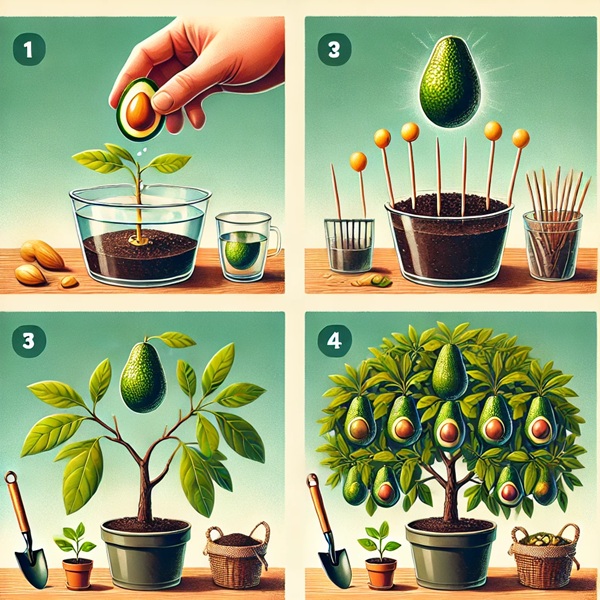
Avocado is not only a trendy superfood, but also an ornamental plant that can become a true highlight of your home or garden. Growing an avocado from a pit may seem like a simple task, but achieving fruiting requires a great deal of effort, patience, and attention. It is quite a demanding tree that needs special conditions, yet the result is worth every effort: fresh, aromatic fruits grown by your own hands will bring not only joy, but also pride in the work you have done. In this article from Marta Flowers, you will find detailed recommendations on how to grow an avocado with fruit at home or in your garden.
The first step toward growing a fruiting avocado is choosing the right pit. First, you need to buy a ripe fruit that feels soft to the touch. It is best to choose an organic avocado that has not been treated with chemicals, as this greatly increases the chances of successful germination. It is recommended to give preference to Hass varieties, since this type is the one most likely to bear fruit in home conditions.
Once you have chosen a ripe fruit, you need to carefully remove the pit. This should be done in a way that does not damage its surface, because cracks can lead to spoilage of the seed. Then the pit should be thoroughly rinsed under warm water to remove any remaining pulp. It is important to remember that an avocado pit has a top and a bottom: the pointed part should face upward, and the wider part downward, because that is where the root system will begin to develop.
The next step is preparing it for germination. One of the most effective methods is sprouting it in water. To do this, take toothpicks and carefully pierce the pit from the sides in four places. The toothpicks will help hold the seed above the water so that only its lower part is submerged. It is recommended to use filtered water and change it every two or three days to prevent bacteria from developing.
Within 2 to 6 weeks, you may see the pit begin to crack, sending out its first roots and shoot. At this stage, it is very important to maintain a stable water level and keep the room temperature no lower than 20 degrees Celsius. When the roots reach 5 to 7 centimeters in length and the first shoot appears at the top, the avocado will be ready to be planted in soil.
Once the roots and shoot have developed enough, it is time to transplant the avocado into a pot with soil. For planting, you need to choose a suitable container at least 20 centimeters in diameter, preferably with drainage holes. Avocado does not tolerate stagnant water, so drainage is extremely important to prevent root rot.
The soil should be loose and nutritious. The optimal mix consists of garden soil, humus, and sand in a ratio of 2:1:1. You can also add a little perlite or vermiculite to improve drainage and air exchange in the soil. Planting should be done so that the upper part of the pit remains above soil level, which helps prevent it from rotting.
After planting, regular watering should be established. Avocado likes moisture, but it does not tolerate overwatering, so it should be watered when the top layer of soil has dried out. It is best to use filtered or settled water at room temperature. It is also important to control air humidity, since the plant is sensitive to dry air. In winter, it is recommended to use humidifiers or place a container of water nearby.
Lighting is of great importance for successful avocado cultivation. This is a light-loving plant that needs at least 6 to 8 hours of sunlight per day. The ideal place for the pot is a south-facing windowsill, but in summer the plant should be protected from direct sunlight to avoid burns. During the darker winter months, grow lights can be used for additional lighting.
As the avocado grows, it needs regular pinching. When the plant reaches about 30 centimeters in height, the top should be pinched to stimulate the development of side shoots. This helps form a fuller crown and prevents the plant from stretching upward too much. The avocado should be pinched every 15 to 20 centimeters of growth to maintain its decorative shape and encourage branching.
Avocado is not only an ornamental plant, but also a potential fruit tree. To achieve fruiting, you need to shape the crown properly and create favorable growing conditions. Shaping begins with regular pruning, which helps control the tree’s growth and maintain its health. The main goal is to create a balanced crown shape so that sunlight reaches every branch.
Pruning should be done twice a year: in spring and in autumn. In spring, weak and damaged branches are removed to stimulate the growth of new shoots. Autumn pruning is needed to prepare the plant for winter. It is also important to remove overcrowded areas to ensure good ventilation and prevent fungal diseases.
To achieve fruiting, the avocado must receive regular watering and feeding. During the active growth period, from March to September, the plant needs nitrogen fertilizers, which stimulate the development of leaves and shoots. When preparing for fruiting, phosphorus-potassium fertilizers should be used, since they help with bud formation and fruit development. Fertilizing is done every 2 to 3 weeks in the form of liquid solutions.
Avocado is very sensitive to temperature conditions. For flowering and fruiting, it needs a temperature no lower than 25 degrees Celsius. When grown in an apartment, it is important to maintain a stable temperature and avoid sudden fluctuations. In summer, the pot can be placed on a balcony or terrace, but the plant should be protected from drafts and strong wind.
To stimulate flowering, a natural dormancy cycle should be provided. In winter, watering is reduced, and the temperature should be kept at 15 to 18 degrees Celsius. This allows the plant to rest and prepare for the next period of active growth and flowering.
Various difficulties may arise when growing avocado at home. One of the most common problems is the absence of flowering. Even with proper care, the plant may not bloom for several years. This is because avocado is a subtropical plant that requires conditions as close to natural as possible. The main reasons for lack of flowering may be insufficient light, lack of nutrients, or the absence of a dormant period.
Leaf drop may be caused by dry air or drafts. To avoid this problem, you should install a humidifier and keep the plant away from air conditioners or heating appliances. Yellowing leaves indicate either overwatering or a lack of nutrients. In that case, watering should be reduced and complex fertilizers applied.
The appearance of pests is another common problem. Avocado may be attacked by spider mites, aphids, or scale insects. To control them, insecticides or natural remedies such as a soap solution or garlic infusion can be used. Regular inspection of the leaves will help detect the problem in time and avoid serious complications.
Root rot is one of the most dangerous problems and often occurs because of overwatering. To avoid it, you need to follow a proper watering schedule and use a pot with good drainage. At the first signs of rot, the plant should be repotted into fresh soil after first treating the roots with a fungicide.
Achieving avocado fruiting at home is a long and difficult process that requires patience and attention. Usually, an avocado grown from a pit begins to flower after 5 to 8 years, and sometimes even later. At the same time, flowering does not always lead to fruit formation, because avocado is a cross-pollinated plant.
To increase the chances of successful fruiting, it is recommended to grow several plants at the same time. Under natural conditions, avocado is pollinated by insects, but at home hand pollination can be done with a soft brush. During flowering, carefully transfer pollen from one flower to another to stimulate fruit development.
Avocado fruits begin to form several weeks after pollination, and the ripening process may take from 6 to 9 months depending on the variety and growing conditions. It is important to maintain a stable temperature and provide enough sunlight throughout the fruit development period.
After harvest, the tree needs a recovery period. Watering is reduced, and the plant enters dormancy. This allows the tree to build up strength for the next fruiting cycle. During this time, avocado care includes moderate watering, maintaining the proper temperature, and infrequent feeding.
By growing a fruiting avocado yourself, you will not only get tasty and healthy fruits, but also create a unique plant that will delight you with its decorative appearance and greenery throughout the year. By following the advice from Marta Flowers, you can turn growing avocado into an engaging and productive process that brings both aesthetic pleasure and delicious fruits from your own work.