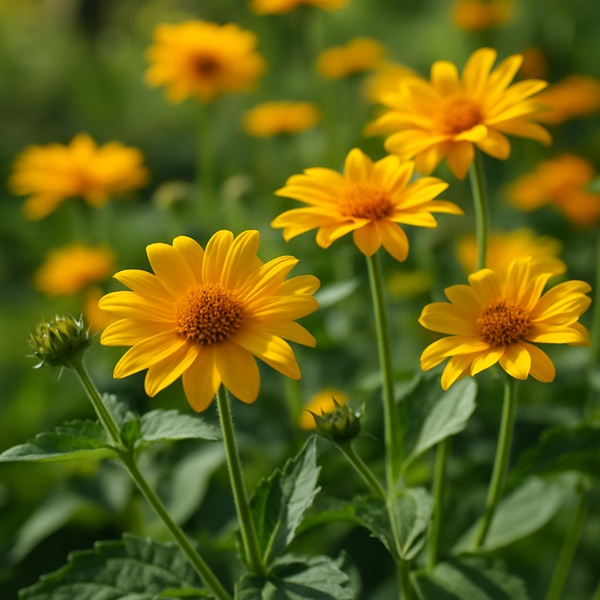
Heliopsis (Heliopsis) is a perennial herbaceous plant from the aster family (Asteraceae) that resembles a miniature sun. Its name comes from the Greek words helios — sun and opsis — appearance, which perfectly captures its look: the bright yellow flowers, gathered in basket-like flower heads, truly resemble little solar discs. In ornamental gardening, heliopsis is valued for its long flowering period, hardiness, and ability to create vivid color accents in flower beds.
In Ukraine, heliopsis is successfully grown both in open ground and in containers. It is exceptionally well adapted to the local climate: it tolerates mild winters with thaws, spring frosts, dry summers, and rainy autumns. It blooms from June until the end of September, and some varieties continue until the first frosts. Under favorable conditions, heliopsis can reach 1.5–1.8 meters in height, forming sturdy clumps that do not require staking.
The most common species and varieties include:
Heliopsis helianthoides (false sunflower heliopsis) — the best-known species, with simple or double bright yellow flower heads.
Heliopsis helianthoides var. scabra — has rougher leaves and deeper yellow flowers.
‘Summer Sun’ — a perennial with double lemon-yellow blooms, flowering from June to October.
‘Loraine Sunshine’ — a variety with decorative variegated foliage and bright yellow flowers.
‘Ballerina’, ‘Asahi’, and ‘Bleeding Hearts’ — hybrid forms often used in mixed borders or as cut flowers.
Heliopsis combines beautifully with other perennials such as echinacea, rudbeckia, sage, lavender, and ornamental grasses. It is planted at the back of flower beds, along fences, and near gazebos. Besides its aesthetic value, this plant attracts bees and butterflies, serving as a natural part of the ecosystem.
Heliopsis is an undemanding plant, but under the right conditions it shows its best ornamental qualities. The main factors when planting are a well-lit site, loose soil, and moderate watering after planting. In Ukrainian conditions, especially in wetter regions, it is important to provide drainage to avoid stagnant moisture.
The main site requirements are:
Light. Open sunny areas are best. In partial shade, the number of flowers decreases and the internodes become longer.
Soil. Light, fertile soil with a slightly acidic to neutral reaction (pH 6.0–7.5) is ideal. On heavy soils, sand and humus should be added.
Moisture. Heliopsis does not tolerate waterlogging. It grows well in dry areas, but during prolonged heat it needs watering.
Before planting, the area is dug to a depth of 25–30 cm, adding compost or humus (4–5 kg per m²). If the soil is heavy, sand or vermiculite is added. Seedlings are planted 40–60 cm apart so that they do not shade one another as they grow. After planting, water generously and mulch the root zone with peat, cut grass, or compost.
Planting can be done in either spring or autumn. Spring planting is especially useful for young plants that need time to adapt before autumn. Autumn transplanting or division is best carried out 3–4 weeks before frost so that the plant has time to root.
Heliopsis does not require frequent watering, but to maintain active growth and long-lasting flowering in summer, it is important to monitor soil moisture. This is especially true for young plants and new plantings. In Ukrainian conditions, where summers may be either dry or excessively rainy, it is best to judge by the condition of the soil.
Watering routine:
Spring: water 1–2 times a week in dry weather.
Summer: water as needed, after the top layer has dried out. In heat, up to 3 times a week.
Autumn: reduce watering, especially as temperatures drop.
Water at the base of the plant, avoiding wetting the leaves so as not to encourage fungal diseases. During bud formation and active flowering, it is recommended to feed once every 10–14 days with complex mineral fertilizers high in potassium and phosphorus.
You can alternate mineral and organic feeding: mullein infusion (1:10), herbal infusions, or poultry manure diluted 1:20. Fertilizers should be applied after watering, preferably in the evening or in cloudy weather. Excess nitrogen encourages leaf growth but suppresses flowering, which is important to keep in mind.
Although heliopsis is traditionally considered a garden plant, it is increasingly grown in containers — on balconies, loggias, and terraces. This makes it possible to control growing conditions and protect the plant from unfavorable weather. In Ukraine, where strong winds, sudden temperature swings, and local downpours are common, container growing is an excellent solution.
Recommendations for container growing:
container volume — at least 10–12 liters
soil — loose and nutritious: garden soil, humus, and sand (2:1:1)
drainage layer — essential (expanded clay, crushed stone, pebbles)
regular loosening of the topsoil
placement — southeast- or south-facing side, with shade at midday
watering — through the saucer or along the edge of the pot
In a container, heliopsis grows up to about 1 meter tall while keeping a good bush shape. For greater compactness, it can be pinched in spring. In autumn, after flowering ends, the plant is moved to a cool room (+3 to +7°C) or transplanted into open ground. Indoors, heliopsis requires as much light as possible and moderate watering.
In the countryside or in a home garden, heliopsis is used in mixed borders, flower beds, near fences, or as a background plant. It pairs well with phlox, echinacea, ornamental grasses, and lavender. Thanks to its dense growth and rich green foliage, heliopsis remains attractive even after flowering ends.
Heliopsis is a fairly resilient plant, but if care conditions are not followed, it may suffer from diseases or pests. This is especially true in cases of excessive moisture, overcrowded planting, lack of sunlight, or potassium deficiency. In most cases, timely prevention makes it possible to avoid problems.
Typical diseases:
Powdery mildew. Appears in humid conditions as a white coating. It is treated with sulfur- or copper-based preparations.
Septoria leaf spot. Brown spots with a yellowish border appear on the leaves. Treatment: Hom, Abiga-Peak; as prevention — Bordeaux mixture.
Fusarium. A vascular disease in which the leaves turn yellow and wilt. Repotting and systemic fungicides such as Previkur or Fundazol can help.
Pests that may threaten heliopsis:
Aphids. Settle on young shoots, distort the leaves, and slow growth. They can be controlled with Aktara, Inta-Vir, or garlic infusion.
Spider mites. Often appear in hot weather. The leaves become dull and covered with a fine webbing. Fitoverm and Vertimec are effective.
Thrips. Small, hard-to-notice pests that damage flowers and buds. Control measures include Confidor and Aktara.
Preventive measures:
sparse planting and good ventilation
timely removal of weeds and faded flowers
avoiding stagnant moisture
periodic treatment with phytosporin or biofungicides
It is especially important to avoid overfeeding with nitrogen fertilizers — this weakens the plant’s immunity and encourages disease. Regular inspection and preventive spraying are the best protection for heliopsis in open-ground conditions.
Heliopsis is an ideal choice for those who want a lush flower garden without too much effort. Its easy care, frost resistance, and ability to bloom abundantly every year make it a favorite in Ukrainian summer cottages and home gardens. Still, to preserve its ornamental value, a few basic rules should be followed.
Main care steps:
Watering. In hot weather — 2–3 times a week; in rainy weather — no more than once.
Loosening. After rain or watering to preserve soil aeration.
Mulching. In spring and autumn with a 5–7 cm layer of peat, cut grass, or straw.
Feeding. In spring — nitroammophoska; in summer — potassium sulfate and phosphorus fertilizers.
Pruning. Sanitary pruning in spring and autumn; decorative pruning if needed.
Propagation methods:
By division of the clump. The simplest method. Done in spring or autumn. The new sections are planted in a prepared site.
By seed. Sown in April–May directly into open ground or in March for seedlings. Flowering begins in the second or third year.
By cuttings. The top shoots are rooted in moist sand or substrate.
Heliopsis winters well throughout Ukraine. In the northern regions, winter mulching is advisable. From the very first warm days of spring, the plant recovers quickly and begins forming new buds.