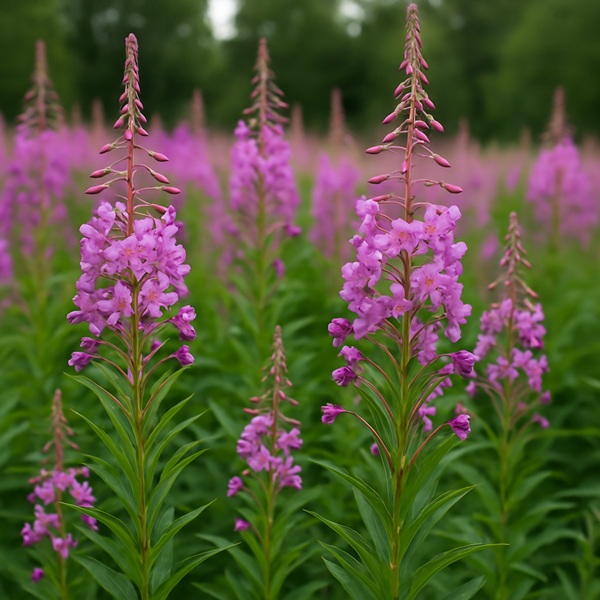
Fireweed (Chamaenerion angustifolium), better known as Ivan tea, is not just a wild plant with pinkish-purple flowers that decorates forest clearings and edges. It is a truly valuable plant that is increasingly being grown on household plots and even on farms. The leaves and flower clusters of fireweed serve as raw material for one of the most popular herbal drinks, which has gained renewed popularity in Ukraine amid growing interest in organic products, traditional herbal practices, and healthy living.
So what makes this plant so valuable? Fireweed contains a high amount of vitamin C, iron, manganese, flavonoids, tannins, and pectins. It contains no caffeine, does not irritate the stomach, and does not raise blood pressure. A drink made from it is recommended for stress, insomnia, digestive issues, and weakened immunity. In addition, fireweed is an excellent honey plant that attracts bees during flowering and improves the pollination of other crops. And now imagine that all of this can be grown right on your own plot — without chemicals, excessive costs, or complicated techniques.
It is worth remembering that although fireweed is considered a wild plant, it can absolutely be grown deliberately. It is a perennial that tolerates frost well, down to -40°C, does not require especially fertile soil, yet responds very well to care. For Ukraine’s moderately continental climate, fireweed is an ideal match. It can be planted both in open ground and on specially prepared plots for the later harvesting of leaves and flowers. At the same time, the plant can remain in one place for 5–7 years without transplanting, forming dense clumps and crowding out weeds. All it needs is the right care approach, and more on that below.
It may seem that if a plant grows on neglected meadows and forest edges, then it needs no particular cultivation technique. But if your goal is to obtain high-quality raw material for tea, the conditions are still worth optimizing. Let us begin with the site. Fireweed loves sunny places: open clearings, fields, and southern slopes. In shade, the plant stretches, flowers less, and loses its ornamental appeal. The best soils are light, loose, moderately moist, and slightly acidic or neutral. Sandy loam and sandy soils are the most suitable. Heavy clay soils need prior improvement by adding sand, compost, and humus.
There are two main ways to propagate fireweed: by seed and vegetatively, through root division. Seeds can be collected independently from wild plants or purchased from specialized stores. To ensure good germination, it is best to use fresh seed. Sowing is done in spring or before winter, either directly into open ground or for seedlings. The sowing depth is up to 1 cm. The seeds are very small and light, so it is convenient to mix them with sand for even sowing. For spring sowing, stratification is required, 2–3 weeks in the refrigerator.
The vegetative method is even more reliable. Rhizomes are planted in autumn or early spring. The roots are cut into pieces 5–10 cm long with several buds and laid horizontally in furrows at a depth of 5 cm. The distance between rows is 40 cm, and between plants 25–30 cm. By the second year, powerful rosettes form and begin flowering actively. Full harvesting of leaves for fermentation starts from the second season. Interestingly, even after part of the roots is dug out, fireweed recovers quickly thanks to its strong root system and regenerative ability.
The greatest advantage of fireweed is that it does not require excessive care. Once established, the plant becomes almost self-sufficient. Still, like any cultivated form, it rewards attentive care many times over. The main tasks are weeding, watering during drought, loosening the soil, and controlling spread. This is especially important in the first year, when the clumps are not yet dense and can easily be overwhelmed by weeds. From the second year onward, the plant begins to suppress unwanted vegetation on its own.
Watering is needed only during prolonged drought. Fireweed does not tolerate standing water, but in dry periods, especially during bud formation, it may suffer. The best option is to organize drip irrigation or water at the root in the morning. After moistening, mulching should follow, using hay, straw, or sawdust. This reduces evaporation, lowers weed pressure, and improves the soil microclimate. Feeding is needed only when necessary. Once per season, compost or nettle infusion is enough. Mineral fertilizers can be replaced with ash, which provides potassium and trace elements.
The most important stage is the flowering period. This is when the leaves accumulate the maximum amount of beneficial substances and essential oils. The leaves are harvested before the flowers fully open. There is an interesting cultivation trick: part of the planting is cut down, and within a few weeks fireweed produces a new wave of green growth. In this way, the harvesting period can be extended and a higher-quality crop obtained. Young shoots are especially tender in taste and have less bitterness, which matters for the future tea.
Many gardeners grow fireweed for its beauty or as a honey plant. But the main value of the plant lies in fermented tea made from its leaves. It is the harvest and proper processing of the raw material that determine the aroma, taste, and beneficial properties of the drink. So when should it be harvested? The best time is a dry morning during budding or at the beginning of flowering. At this point, the leaves are full of essential oils, have maximum biological activity, and are easy to remove by hand. Not all the leaves are picked, only part of them — a few from each bush, while leaving the top undamaged.
After harvesting, the leaves must first be lightly wilted. They are spread in the shade for 6–12 hours until they become soft. Then comes the most important stage: fermentation. The leaves are rolled by hand or between the palms until they begin to release juice. This mass is placed into lidded containers, enamel or glass, covered with a damp cloth, and left in a warm place for 12–36 hours. The temperature should be around +25 to +30°C. During this time, enzymatic processes take place in the leaves, shaping the aromatic, mellow taste of the drink.
After fermentation, the leaves are dried in an oven with the door slightly open or in a dryer at 50–60°C. The finished dry tea is stored in glass jars, metal tins, or paper bags in a dry, dark place. Interestingly, over time the flavor becomes deeper, just like classic black tea. Such a product is not only tasty and healthy, but also suitable for sale, both within Ukraine and abroad. Demand for organic fireweed continues to grow steadily, and anyone who knows how to ferment it properly will always have a market.
Fireweed naturally has high resistance to pests and diseases. But under intensive cultivation, especially in dense plantings, certain problems may arise. Most often, this is aphids. They settle on young leaves and on the underside of leaf blades, sucking out the sap. The signs are curling, stickiness, and loss of gloss. They are easy to control with a soap solution, garlic or tobacco infusion, or ash water. In cases of severe infestation, biological products such as Fitoverm or Actofit are worth using.
Another enemy is slugs. They are especially active in damp weather. They chew on young shoots and leaves, leaving characteristic traces. The solution is coarse straw mulch, dusting the ground with ash or eggshells, and hand collection in the evening. Among diseases, powdery mildew and rust may occur, usually as a result of excess moisture, poor ventilation, or overcrowding. Prevention includes keeping the correct spacing between bushes, timely thinning, and treatment with horsetail, garlic, or whey infusions.
In most cases, the plant remains healthy without chemical intervention. This makes it especially attractive for organic farming. Fireweed also recovers well after cutting, has a strong root system that holds the soil in place, and suppresses weeds. All of these are advantages that not only simplify care but also increase overall productivity even with minimal effort.
Is it realistic to turn fireweed into a source of profit? Absolutely. Even now, small tea farms are appearing in Ukraine that successfully grow and ferment this crop. The finished tea is sold at markets, in pharmacies, and online, and it is in demand. Its price can reach 500–800 UAH per kg, and from 100 square meters it is possible to harvest up to 5–7 kg of finished dry product. Considering that this is a perennial crop that does not require transplanting or yearly major expenses, the profitability is very high.
But the point is not only profitability. Fireweed is also a powerful ecological tool. It improves the soil, suppresses weeds, and stabilizes the microflora. It does not need toxic chemicals, does not deplete the land, and on the contrary helps enrich it. The plant attracts bees, bumblebees, and butterflies, increases biodiversity, and forms a beneficial ecosystem. This is especially important under climate change, when traditional crops suffer from heat, lack of moisture, or disease.
Fireweed is an excellent fit for agritourism, farms, eco-schools, and even summer cottage owners. Imagine tourists gathering leaves, learning how to ferment them, and taking home tea they made themselves. This is not just an experience, but also education. It is also a path toward health, self-sufficiency, and stable income. And most importantly, growing fireweed is an opportunity to bring back into daily life and onto the land a plant that lived alongside us for decades, but that we nearly forgot.