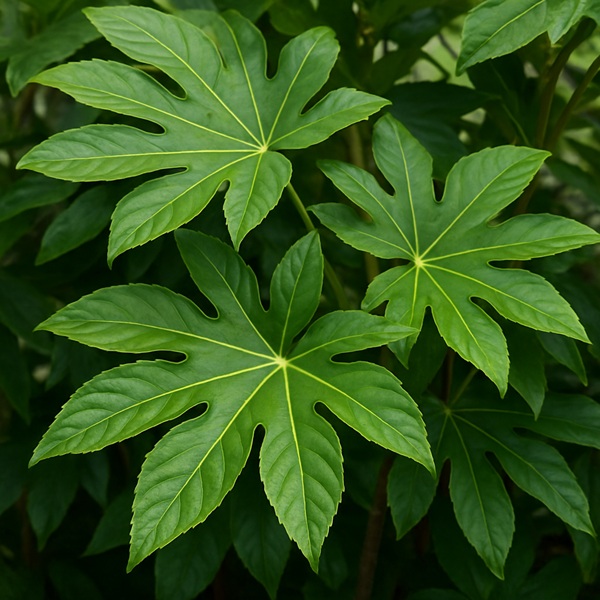
Fatsia is a decorative foliage plant that has gained popularity thanks to its exotic appearance and its ability to adapt well to indoor conditions. The genus Fatsia includes only a few species, but the most widespread is Japanese fatsia (Fatsia japonica). It is grown both in private homes and in public spaces. This is an evergreen shrub with large, deeply divided, palmate leaves that resemble maple leaves. Indoors, a mature plant reaches 1.5–2 m in height, and in conservatories it can grow even taller.
Fatsia remains decorative throughout the year. Its glossy, leathery leaves are deep green and may reach up to 40 cm in diameter. Variegated forms with white or cream edging look especially impressive. In autumn, under favorable conditions, the plant may bloom — the flowers are small, whitish, and gathered in rounded clusters. Flowering indoors is rare, but possible. The fruits are black berries, although they have no particular value in indoor cultivation.
The most popular species and varieties of fatsia are:
Fatsia japonica — the classic green form, suitable for halls, offices, and spacious rooms.
Fatsia japonica ‘Variegata’ — a variegated form with white-edged leaves. It requires more light to maintain its coloration.
Fatsia japonica ‘Spider’s Web’ — an extremely decorative variety with a silvery pattern across the leaves.
× Fatshedera lizei — a hybrid of fatsia and ivy, a climbing form ideal for vertical greening and more demanding in its care requirements.
Fatsia is a versatile plant that looks good both as a single accent and in combination with other shade-tolerant species. Thanks to its resistance to temperature fluctuations, dry air, and urban dust, it is ideal for apartments, offices, and even non-residential spaces.
Proper planting of fatsia is the key to its successful growth and attractive appearance. Although the plant is quite undemanding, it still needs a certain volume of soil, the right substrate, and stable lighting.
Pot:
Choose a stable, wide container with drainage holes. Ceramic or dense plastic works well. The size should exceed the root system by 2–3 cm. Since an adult fatsia becomes large and heavy, it is best to use a weighty pot to prevent tipping.
Substrate:
The plant prefers light, air-permeable soil with a slightly acidic or neutral reaction. Recommended composition:
2 parts leaf soil
1 part turf soil
1 part peat
1 part coarse sand or perlite
optionally: a little charcoal, vermiculite
Ready-made mixes for decorative foliage plants are also suitable, as long as they are not too heavy, clay-based, or poorly drained peat mixes.
Drainage:
A 2–3 cm layer of expanded clay, pebbles, or broken pottery should always be placed at the bottom. This prevents stagnant moisture and root rot.
Placement:
Bright, diffused light is ideal. Fatsia grows well near east- or west-facing windows. On southern windows, shading at midday is necessary. Variegated forms need more light. If light is insufficient, the leaves become smaller and lose their rich color. It is also important to protect the plant from drafts and radiators.
Repotting is done every 2–3 years using the transfer method. This preserves the microflora of the substrate and causes less stress to the plant.
Fatsia needs a clear moisture balance — it tolerates neither complete drying out nor water stagnation. Considering the dry air common in Ukrainian apartments, especially in winter, humidity becomes especially important.
Watering schedule:
Spring–summer: water generously 2–3 times a week after the top layer has dried.
Autumn–winter: reduce watering to once every 7–10 days.
Use settled water at room temperature. Hard water should be softened.
Excess water should be poured out of the saucer after watering to avoid souring the soil.
Air humidity:
Fatsia likes a humid environment, 50–60% or higher. If the air is too dry:
spray the leaves daily with clean water;
place a humidifier or bowls of water near the pot;
set the pot on a tray with wet expanded clay.
Additional care:
wipe the leaves with a damp cloth once a week;
give the plant a warm shower once a month at 30–35°C;
gently loosen the surface of the substrate after watering.
Common mistakes:
too much watering — root rot;
watering with cold water — slowed growth;
dry air — leaf edges dry out, spider mites may appear;
hard water — chlorosis and spotting.
A properly arranged watering routine and humidity level are the foundation of a healthy and attractive fatsia. With good care, it looks fresh and vibrant all year long.
Fatsia is one of those houseplants that is not only decorative, but also adaptable. It can adjust to moderately difficult conditions typical of city apartments: dry air, unstable lighting, and temperature fluctuations. At the same time, it responds gratefully to basic care in the form of regular moisture, light, and occasional pruning.
Adaptation after purchase:
A newly purchased fatsia should be placed in a calm spot without drafts or direct sunlight. During the first two weeks, it should not be repotted or stimulated into growth — let it adapt first. Only after that can it be transferred to a new pot with partial renewal of the substrate.
Shaping the plant:
Fatsia can be formed as either a compact shrub or a taller tree-like plant.
Pinching the tops stimulates branching — this is best done at the 4–5 leaf stage.
Overgrown or weakened branches are pruned back to healthy tissue.
Old yellowing leaves near the base should be removed regularly.
Feeding:
During the growing season from March to September, feed every two weeks with a complex fertilizer for decorative foliage plants. In autumn, reduce this to once a month. In winter, feeding should be stopped completely, especially if the temperature falls below +18°C.
With regular care, fatsia forms a dense crown, keeps its foliage bright, and remains decorative even during the colder months.
In most cases, fatsia is a healthy plant, but when growing conditions are disturbed, it becomes vulnerable to common indoor problems. Among the most frequent are root rot, fungal infections, chlorosis, and pests.
Main diseases:
Root rot
Symptoms: wilting, soft roots, soil with an unpleasant smell.
Causes: overwatering, cold water, lack of drainage.
Solution: repotting, cutting off damaged parts, treatment with fungicides such as Fundazol or Previcur.
Gray mold (botrytis)
Symptoms: gray coating on leaves, spreading spots.
Causes: high humidity without ventilation.
Treatment: remove affected areas, ventilate the room, use fungicides such as Horus or Topaz.
Chlorosis
Symptoms: yellowing between the veins, loss of rich color.
Causes: hard water, iron deficiency.
Prevention: use soft water, treat with iron chelates such as Ferovit or Micro-Mix.
Pests:
Spider mite — most common in winter. Symptoms: webbing, yellowing leaves.
Control: washing, increasing humidity, treatment with Fitoverm.
Scale insect — visible as brown “scales” on stems and leaves.
Remove by hand with cotton and soapy water, then treat with Aktara or Confidor.
Thrips — cause silvery spotting and deformation.
Use systemic insecticides or aerosol treatments.
Prevention:
regularly wipe the leaves;
keep new plants in quarantine;
ventilate the room without creating drafts;
monitor moisture carefully — no stagnation, no severe drying out.
Timely detection of problems and gentle treatment help avoid drastic measures and keep the plant attractive.
Fatsia is easy to propagate even for beginners — the most common methods are stem cuttings and dividing the plant. Both are effective, as long as temperature and humidity are maintained during rooting.
Propagation by cuttings:
Cuttings are taken in spring or summer, 10–15 cm long, with 2–3 leaves.
The lower leaves are removed, and the cut is treated with a rooting stimulant such as Kornevin.
They are rooted in a peat-sand mixture under film at +22 to +25°C.
After 3–4 weeks, the young plants are transferred into permanent pots.
Dividing the plant:
Suitable for large, multi-stemmed specimens. The root system is carefully divided into sections with a growth point. Each part is planted separately. After transplanting, shading, misting, and careful watering are essential.
Seasonal care schedule:
Spring: repotting, beginning feeding, pinching, shaping.
Summer: active growth, regular moisture, pest prevention.
Autumn: reduced watering, preparation for dormancy, disease prevention.
Winter: minimal watering, maintaining air humidity, supplemental light if needed.
Fatsia is a stable, undemanding, and rewarding plant. With basic care, it can decorate a space for decades, purify the air, and create an atmosphere of freshness even in city apartments.