Euonymus is an ornamental shrub or small tree valued by gardeners for its attractive foliage, bright fruits, and low-maintenance nature. In the conditions of Ukraine, planting euonymus can be successful in almost all regions thanks to its tolerance of moderate climatic conditions. However, to achieve the best results, it is important to take several factors into account. First of all, it is necessary to choose a suitable planting site. Euonymus prefers well-lit areas, although some species, such as European spindle or warty spindle, can also grow in partial shade. The soil should be loose, moderately fertile, and well-drained, since the plant does not tolerate stagnant water well. In Ukraine, loamy or sandy loam soils are most common, and these are suitable for this shrub, but if needed, the soil can be improved by adding sand or compost.
The planting process begins with choosing the saplings. In Ukrainian nurseries, you can buy both young plants with an open root system and saplings in containers. The optimal planting time is spring (April–May) or autumn (September–October), when the air temperature is stable and the soil still retains warmth. Before planting, it is necessary to prepare a hole approximately 50 × 50 cm and 40–50 cm deep, depending on the size of the root system. It is recommended to place a drainage layer of crushed stone or broken brick at the bottom of the hole to prevent root rot. The sapling is placed vertically, covered with soil, lightly firmed, and watered abundantly. The distance between plants depends on the species: for low-growing varieties, 1–1.5 m is enough, while for taller ones, up to 2–3 m is needed. After planting, the soil around the trunk is mulched with peat or bark, which is especially important for protection against sharp temperature fluctuations in the eastern and northern regions of Ukraine.
An important aspect of planting is the plant’s adaptation to local conditions. In the first year after planting, euonymus needs regular watering, especially during dry periods, which are common in the steppe zone of Ukraine. It is also worth paying attention to wind protection, which is important in open flat areas. Young saplings can be covered with agrofabric during their first winters, especially in regions with severe frosts, such as Sumy or Chernihiv regions. Proper planting is the key to successful growth and development of euonymus, so every detail deserves attention, from selecting the site to preparing the soil.
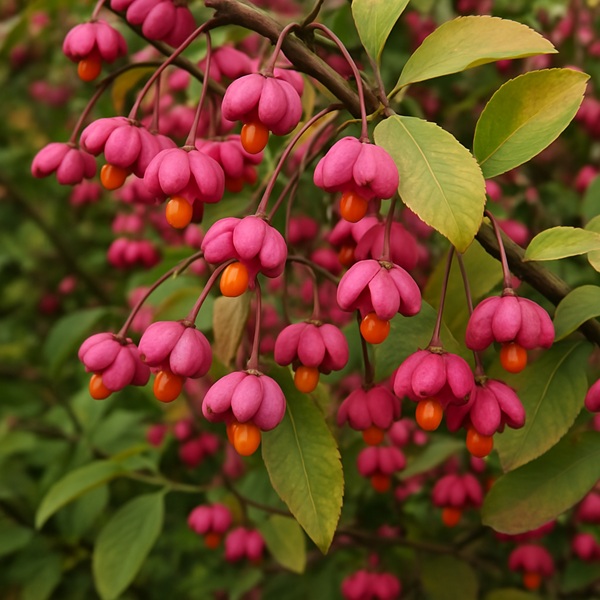
Euonymus is represented by numerous species and varieties that differ in shape, size, and leaf color. In Ukraine, both native species, such as European spindle (Euonymus europaeus), and ornamental varieties such as winged euonymus (Euonymus alatus) or Fortune’s euonymus (Euonymus fortunei) are popular. Each of them has its own cultivation characteristics, allowing gardeners to choose plants for the specific conditions of their plot. European spindle is a tall shrub reaching 3–6 meters, with bright red fruits that decorate the garden in autumn. It grows well in central Ukraine and is resistant to frosts down to -25 °C. Winged euonymus attracts attention with its unusual branch shape and fiery red foliage in autumn, making it ideal for decorative compositions. Fortune’s euonymus, by contrast, is low-growing and is often used as a ground-cover plant.
Growing euonymus begins with choosing the right variety. For example, in the southern regions of Ukraine, such as Odesa or Kherson regions, where the climate is warmer and drier, it is better to plant drought-tolerant species such as Japanese euonymus (Euonymus japonicus). In the western regions, where humidity is higher, varieties resistant to fungal diseases are more suitable, for example warty euonymus (Euonymus verrucosus). After planting, the plant requires minimal intervention, but for active growth it is recommended to apply organic or mineral fertilizers in spring. For one shrub, 20–30 g of a compound fertilizer diluted in water or a 5–7 cm layer of compost around the trunk circle is sufficient. Watering should be moderate, on average 1–2 times a week depending on rainfall.
The growth rate of euonymus depends on the variety and conditions. Fast-growing species, such as winged euonymus, can add 30–50 cm per year, while low-growing varieties grow more slowly. During cultivation, it is important to monitor the shrub’s shape. Pruning is done in spring or autumn to remove dry branches and give the plant the desired appearance. In the conditions of Ukraine, euonymus rarely suffers from diseases, but it may occasionally be affected by aphids or spider mites. For prevention, it is enough to spray the shrubs with a soap solution or insecticides at the beginning of the season. Successful cultivation of euonymus makes it possible to create a beautiful and long-lasting element of landscape design.
Caring for euonymus in the conditions of Ukraine does not require much effort, but certain procedures are necessary to maintain the plant’s health and ornamental value. Watering is one of the key aspects of care, especially in the first years after planting. Soil moisture should be moderate: overwatering can lead to root rot, while lack of water can cause the leaves to wilt. On average, an adult shrub needs 10–15 liters of water once every 7–10 days if rainfall is scarce. During the hot summer months typical of the southern and central regions of Ukraine, watering can be increased to 2 times a week. Young plants are watered more often — up to 3 times a week in small portions so the roots have time to absorb the moisture. During rainy periods, which are common in the western part of the country, additional watering is not needed.
Euonymus is fertilized to stimulate growth and flowering. In spring, in April or May, nitrogen-containing fertilizers are applied to promote the development of green mass. Both mineral blends, such as nitroammophoska, and organic matter — well-rotted manure or compost — are suitable. For one shrub, 20–30 g of granular fertilizer or 2–3 kg of organic material is enough. In summer, in June–July, potassium-phosphorus fertilizers can be added to strengthen the root system and prepare the plant for winter. For example, 15–20 g of superphosphate and 10–15 g of potassium sulfate per shrub will help improve frost resistance. In autumn, feeding is generally not carried out so as not to stimulate the growth of new shoots before cold weather.
Additional care includes soil loosening and mulching. Loosening is carried out to a depth of 5–10 cm around the shrub to improve air access to the roots, which is especially important on heavy clay soils common in central Ukraine. Mulching with peat, sawdust, or bark helps retain moisture and protects the roots from overheating in summer and freezing in winter. The mulch layer should be 5–7 cm thick. In regions with strong winds, such as the steppe zones, temporary covers can be installed for young shrubs. Such care provides euonymus with optimal conditions for growth and development in the Ukrainian climate.
Pruning euonymus is an important stage of care that allows you not only to maintain the plant’s decorative appearance but also to stimulate its growth. In the conditions of Ukraine, pruning is carried out twice a year: in spring (March–April) and in autumn (September–October). Spring pruning is sanitary in nature: dry, damaged, or frostbitten branches are removed, which is especially relevant after winter in the northern and eastern regions, where temperatures may drop below -20 °C. Autumn pruning is aimed at shaping the shrub and preparing it for wintering. For low-growing varieties, such as Fortune’s euonymus, light trimming is enough to preserve a compact shape. Tall species, such as European spindle, can be pruned more heavily, leaving one-third of the shoot length to create a hedge or a rounded crown.
Pruning tools should be sharp and disinfected to avoid infecting the plant. Pruners or garden shears are treated with alcohol or a potassium permanganate solution before use. During pruning, it is important to follow the shrub’s natural shape, especially for ornamental varieties such as winged euonymus, whose beauty is best revealed in free growth. On average, no more than 20–30% of the green mass is removed at one time so as not to weaken the plant. The cut branches can be used for propagation by cuttings — in Ukraine, this method works well for most euonymus species. The remains after pruning should be removed from the site to prevent the development of fungi or the attraction of pests.
Crown shaping depends on the gardener’s goals. In urban parks of Ukraine, for example in Kyiv or Lviv, euonymus is often used to create hedges, which requires regular trimming every 2–3 months during the active growth period (May–August). For single plantings, an annual shape correction is sufficient. After pruning, the shrub should be watered and given light feeding, for example with a urea solution (10 g per 10 liters of water), to speed recovery. Proper pruning not only improves the appearance of euonymus but also increases its resistance to unfavorable conditions, which is important in Ukraine’s changeable climate.
Euonymus is generally resistant to most diseases and pests, but in the conditions of Ukraine some problems can still arise, especially if cultivation practices are neglected. Among pests, the most common are aphids, spider mites, and scale insects. Aphids attack young shoots and leaves, causing them to curl and turn yellow, which is especially noticeable during dry periods in the south of the country. Spider mites are active in hot weather and leave fine webbing on the underside of the leaves. Scale insects, by contrast, appear more often in damp conditions typical of the western regions and look like small brown growths on the branches. To control these pests, people use folk remedies such as garlic infusion (100 g per 10 liters of water) or a soap solution (200 g of laundry soap per 10 liters of water), and in severe infestations, insecticides such as Actellic or Fitoverm.
Fungal diseases such as powdery mildew or leaf spot can develop in conditions of high humidity and poor air circulation in the shrub. Powdery mildew appears as a white coating on the leaves and is more common in the Carpathian region, where rainfall is higher. Leaf spot is visible as dark spots on the foliage and may occur after prolonged rains. For prevention, it is recommended to thin the crown during pruning and avoid overwatering the soil. If signs of disease appear, the shrubs are treated with fungicides such as Topaz or Fundazol according to the instructions. Spraying is carried out in dry weather, in the morning or evening, to avoid leaf burn. On average, 1–2 treatments at intervals of 10–14 days are enough.
Protection from pests and diseases also includes general maintenance measures. Regular loosening of the soil, removal of fallen leaves, and timely pruning reduce the risk of infection. In the conditions of Ukraine, it is important to take regional differences into account: in the east and south, emphasis is placed on protection from drought and mites, while in the west, the focus is on fungal prevention. A healthy euonymus that receives proper care rarely suffers from serious problems, which makes it a reliable choice for gardens throughout the country.
Preparing euonymus for winter is an important stage, especially in the regions of Ukraine with cold winters, such as Kharkiv, Sumy, or Chernihiv regions, where temperatures may fall to -30 °C. Most euonymus species, including European and winged forms, have good frost resistance, but young plants and some ornamental varieties need additional protection. The preparation process begins in autumn, after leaf fall, which in central Ukraine usually occurs in October–November. First, moisture-charging watering is carried out: 20–30 liters of water are applied under each shrub so the roots are saturated with moisture before frost. This is especially important in dry regions, where autumn may be rainless.
Next, the trunk circle is covered with mulch in a 10–15 cm layer. Peat, sawdust, dry leaves, or conifer branches are suitable. Mulching protects the roots from freezing and sudden temperature changes, which are common in the steppe zone of Ukraine. Young saplings (1–2 years old) are additionally covered with agrofabric or burlap, wrapping the trunk and lower branches. The branches of tall shrubs can be lightly tied with twine so they do not break under the weight of snow. In the southern regions, such as Odesa or Mykolaiv, where winters are mild (down to about -10 °C), mulching is enough, and covering is needed only for heat-loving species such as Japanese euonymus.
In spring, the cover is removed gradually, after the threat of severe frosts has passed — usually in March–April. Opening too early may result in shoot damage from returning cold snaps, while opening too late may cause the bark to overheat and rot. In the conditions of Ukraine, euonymus winters well when properly prepared, which allows it to preserve its ornamental appeal and health for many years. This approach makes the plant universal for gardens in different climatic zones of the country.