


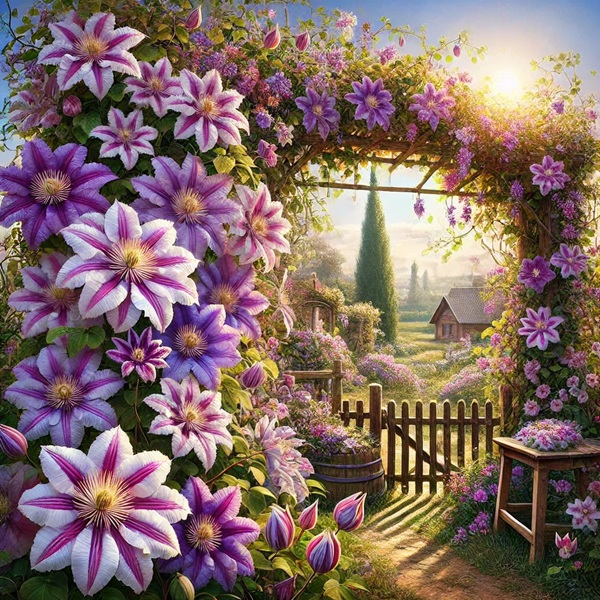
Clematis is one of the most refined and spectacular ornamental vines, holding a special place in Ukrainian horticulture. Thanks to its abundant and long-lasting flowering, variety of forms and shades, and ability to quickly cover any support, clematis has become an essential element of vertical landscaping. It is grown not only on private plots, but also in urban settings — in parks, near schools, churches, and administrative buildings.
The genus Clematis includes more than 300 species and several thousand cultivars. These plants belong to the buttercup family (Ranunculaceae) and are naturally distributed in the temperate climate of the Northern Hemisphere. In Ukraine, large-flowered hybrids are the most widespread, as well as small-flowered species such as grape-leaved clematis, Tangut clematis, purple clematis, and others. Depending on the cultivar, the plant may reach from 1.5 to 5 meters in height.
Clematis impresses with its diversity of forms: single, double, and semi-double flowers with rounded, star-shaped, or lanceolate petals. The color palette includes snow-white, pink, purple, burgundy, blue, and even greenish shades. Some cultivars have a delicate pleasant fragrance.
In Ukrainian conditions, clematis blooms from May to September, depending on the pruning group and climatic zone. Some cultivars flower on the current year’s shoots (group 3), others on the previous year’s shoots (group 1), and some on both types of shoots (group 2). Knowing this feature is critically important for proper pruning and plant shaping.
Thanks to its ornamental qualities, clematis is used for:
vertical greening of walls, fences, and gazebos;
decorating arches, pergolas, and trellises;
planting in containers for balconies and terraces;
creating living screens and zoning garden areas.
Clematis combines well with roses, hops, morning glory, and Virginia creeper, but it also looks excellent as a solo plant. Despite its delicate appearance, clematis is quite hardy and long-lived — a bush can grow in one place for up to 20 years.
A properly chosen site and good soil preparation are the key to successful growth and abundant flowering of clematis. This vine is sensitive to environmental conditions, but with proper cultivation practices it grows well in all regions of Ukraine — from Polissia to the southern steppe.
Lighting. Most clematis cultivars prefer sunny, warm areas with good air circulation. However, in the southern regions of Ukraine (Odesa, Kherson, Mykolaiv), light shading during midday hours is desirable to prevent overheating and petal fading. In shade, clematis grows, but blooms more weakly and later.
Wind protection. Clematis is sensitive to drafts, especially in spring. It is best planted near a wall, fence, or among shrubs — wherever there is natural protection from the wind. At the same time, support or training for the vine should be provided.
Soil. Loose, well-drained loam with a neutral or slightly alkaline reaction (pH 6.5–7.5) is ideal. Clematis tolerates acidic soils poorly — the leaves turn yellow and the shoots weaken. In such cases, liming is carried out with dolomite flour or ash.
Planting hole preparation. Depth — at least 60 cm, width — about 50 cm. Drainage is placed at the bottom (broken brick, crushed stone, expanded clay), followed by a layer of fertile mixture: garden soil, humus, sand, and superphosphate (100 g) in a 2:1:1 ratio. Ash and bone meal may also be added.
Planting. The best time is spring (April–May) or early autumn (September). A seedling with bare roots is pruned back to 2–4 nodes, the roots are spread out, and it is planted 5–10 cm deeper than the root collar level, which stimulates the growth of new shoots. Container-grown plants can be planted from May to September.
The distance between plants is 80–100 cm. After planting, the bush is watered abundantly and mulched with peat or humus.
Support. It must be installed at the time of planting. This may be a metal arch, wooden lattice, or plastic mesh. The support should be no thicker than 2 cm in diameter so the shoots can twine around it. Height — from 1.5 m.
Caring for clematis requires consistency, especially in the first years after planting. The main measures include watering, loosening, mulching, feeding, shaping the bush, and pruning. Proper cultivation techniques are the key to strong plant development and abundant flowering.
Watering. Clematis does not tolerate prolonged drought, especially during active growth and bud formation. In April–May, it is watered 1–2 times a week (5–10 liters of water per bush). In hot summer weather — 2–3 times a week. It is best to use warm, settled water and water in the morning or evening.
Loosening and mulching. After each watering, the soil should be loosened carefully to avoid damaging the roots located close to the surface. To retain moisture and prevent overheating, the soil around the bush is mulched with peat, bark, humus, or cut grass.
Feeding. Clematis responds very well to fertilizers. The schedule is as follows:
early spring: ammonium nitrate or urea (20–30 g per 10 liters);
before flowering: a complex fertilizer with phosphorus and potassium;
during flowering: organic fertilizers every 2 weeks (herbal infusion, diluted poultry manure);
after flowering: superphosphate and ash to prepare for winter.
Pruning is one of the most important stages of care. All clematis cultivars are divided into three groups:
Group 1 — flowers on last year’s shoots (Clematis alpina, montana). Pruning is minimal — only weak or damaged branches are removed after flowering.
Group 2 — flowers on both old and new shoots (hybrids Nelly Moser, The President). Moderate pruning is carried out: the shoots are shortened to strong buds at a height of 50–100 cm.
Group 3 — flowers only on the current year’s shoots (Jackmanii, Viticella). Pruning is almost complete, leaving 2–3 nodes above ground level (20–30 cm).
In Ukraine, the most popular cultivars are those of group 3 — for their abundant flowering and ease of care.
Clematis is quite a hardy plant, but under unfavorable conditions it may suffer from diseases and pests. It is also very important to prepare the bush properly for winter, especially in the northern and central regions of the country.
Main diseases:
Wilt — sudden wilting of shoots without visible reason. It is caused by a fungus entering through the roots. Measures: prune back to healthy tissue, treat with Fundazol or Previcur.
Powdery mildew — a white coating on the leaves, appearing in humid and hot weather. Treatment: Topaz, soda solution, garlic infusion.
Gray rot — brown spots on leaves and flowers. Regular mulching and good ventilation help prevent it.
Prevention: proper watering, fungicide treatments, drainage, sanitary pruning.
Pests:
Aphids — affect young shoots. They are controlled with Fitoverm, ash infusion, or garlic infusion.
Spider mites — signs include spots on leaves and webbing. Treatment: acaricides and increased air humidity.
Slugs — damage young shoots. Pine mulch, ash, and beer traps are used against them.
Wintering. In the southern regions of Ukraine, clematis often winters without cover. In the central and northern regions, cultivars of groups 1 and 2 must be covered.
Scheme:
Prune according to the group.
Treat the bushes with a copper sulfate solution.
Mulch the root collar with peat, humus, or leaves.
Bend the shoots to the ground and cover with spruce branches, agrofiber, or a box.
Remove the cover in spring after the frosts have passed.
Clematis is propagated by dividing the bush, cuttings, layering, or, more rarely, by seed. The choice of method depends on the cultivar and the purpose.
Division of the bush — in spring or autumn. A mature plant (3–5 years old) is dug up, the root system with shoots is divided, and the parts are planted separately.
Cuttings — in spring or summer. Shoots with two nodes are cut, treated with a rooting stimulant, and rooted in a peat-sand mixture. At a temperature of +20 to +25 °C, rooting takes place within 3–4 weeks.
Layering — in spring, the lower shoot is bent to the ground and covered with soil. After a year, it is separated from the mother bush.
Ornamental use:
as a focal plant or background in a flower bed;
for arches, pergolas, trellises, and facades;
for screens and zoning of the plot;
in containers on balconies and terraces.
It combines beautifully with roses, hydrangeas, elder, and conifers.
Clematis is a refined, hardy ornamental vine that is perfectly suited to the Ukrainian climate. With proper care, it will bloom abundantly all summer and decorate the garden for decades.
-220x275.jpg)
-220x275.jpg)
-220x275.jpg)
