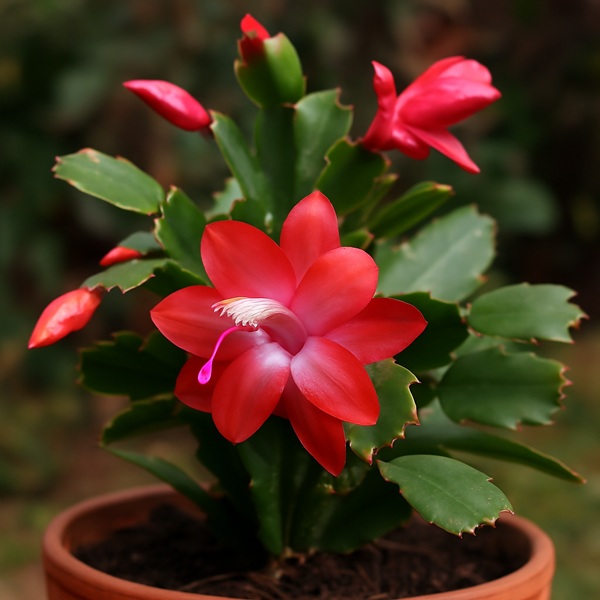
The Christmas cactus, also known as Schlumbergera, zygocactus, or holiday cactus, is an epiphytic plant from the cactus family that originates from the tropical forests of Brazil. In nature, it grows on trees, where it receives enough light, air, and moisture without needing dense soil. Although it is a cactus, its care differs greatly from that of typical desert succulents: Schlumbergera does not tolerate bright sun or long droughts, but instead prefers diffused light, moderate temperatures, and humid air.
The flowering period of the Christmas cactus usually falls in the winter months — in Ukraine, mainly November to December, and it may continue until February. This is exactly how it got its popular name. The flowers are large, tubular, and asymmetrical, appearing at the ends of the shoots. The color range varies: white, pink, red, crimson, purple, and yellow. With proper care, a mature plant can bloom twice a year, especially if it is given a rest period in autumn.
In Ukrainian conditions, the Christmas cactus is ideal as a houseplant. It does not require high temperatures and tolerates drops to +10...+12 °C well, which makes it suitable for growing on glazed balconies, in cool hallways, or near north-facing windows. In a mild winter, it can even be kept in an unheated room. The main requirements are the absence of drafts, sudden temperature changes, and moderate lighting. Unlike most indoor plants, Schlumbergera does not need bright sunlight — on the contrary, too much of it leads to burns and stunted growth.
Note: the Christmas cactus is ideal for shaded rooms — it grows well deeper inside a room under artificial light and does not need frequent repotting.
Planting a Christmas cactus begins with choosing the right pot and soil mix. Since Schlumbergera is an epiphyte in nature, it does not need heavy or overly rich soil. The main requirements are good air permeability, the ability to retain moisture, and a slightly acidic or neutral growing medium. The optimal pH level is 5.5–6.5. At home, a ready-made cactus or succulent soil works well, with added components to improve looseness.
The ideal substrate consists of:
2 parts leaf soil or universal potting soil;
1 part sand or perlite;
1 part chopped sphagnum moss or coconut substrate;
optionally, 0.5 part charcoal for rot prevention.
A drainage layer must always be placed at the bottom of the pot — expanded clay, pebbles, or broken brick, 2–3 cm deep. Schlumbergera has shallow roots, so it is better to choose wide, shallow pots. The material does not matter much, though plastic and ceramic options hold moisture and temperature better. It is important not to bury the base of the shoots too deeply, because this may cause rotting.
Step-by-step planting instructions:
Prepare a clean pot with drainage holes.
Add the drainage layer, then part of the soil.
Carefully place the roots.
Fill with the remaining soil and lightly firm it.
Water with warm water and place in partial shade for 2–3 days.
Tip: do not repot the Christmas cactus immediately after purchase — give it 2–3 weeks to adapt to its new conditions, especially if it was bought in winter.
The Christmas cactus is a plant with a clearly defined seasonal cycle. In spring and summer it grows actively, in autumn it enters dormancy, and in winter it blooms. The conditions provided in each of these periods strongly affect its decorative value and the abundance of its flowering.
Watering: during the growing period, from March to September, water regularly 1–2 times a week, as soon as the top layer of soil dries out. In autumn, watering is reduced to once every 10–14 days. During the flowering period, from December to February, water carefully but regularly — it is important to avoid both drying out and water stagnation. The water should be soft, settled, and at room temperature. Hard water causes the segments to yellow.
Lighting: diffused light is best. East-facing or northwestern windows are ideal. In summer, provide shade from direct sun; in winter, extra lighting with grow lamps is possible. In summer it can be moved to a balcony or garden, but only into partial shade.
Humidity: Schlumbergera likes humid air. During the heating season, spraying or using a humidifier is important. You can also place an aquarium or a container of water nearby. In dry air, the segments curl, the flowers become smaller, and they wilt quickly.
Feeding: from April to August, fertilize once every 2 weeks with a cactus fertilizer or a universal mineral fertilizer. Feeding is stopped in September and resumed in November to stimulate bud formation.
The Christmas cactus is a decorative indoor plant that, with age, forms spreading, trailing shoots. To maintain a neat shape, encourage a dense crown, and stimulate flowering, it should be shaped periodically. The best time for this is spring, March to April, right after flowering ends. It is important not to use scissors: the segments are best gently twisted off by hand, which reduces the risk of rot.
Crown shaping includes:
removing old, deformed, or overly long shoots;
creating an even rounded or cascading form;
after pruning, the plant actively produces new segments, which are more likely to form buds.
Repotting is done once every 2–3 years in spring. Young plants can be repotted yearly, mature ones less often. Use a pot only slightly larger than the previous one. Repotting should be done by transfer, without disturbing the root ball, so the roots are not injured. Afterward, the plant should not be fertilized and should be kept shaded for 5–7 days.
Propagation is easiest by cuttings. In spring or summer, break off a cutting with 2–3 segments, let it dry for 1–2 days, and plant it in a light substrate such as peat and sand. It can also be rooted in moist vermiculite or moss. The temperature should be +20...+24 °C with moderate humidity. To speed up the process, create a mini greenhouse by covering it with a jar or bag. Roots usually appear in 2–3 weeks.
Tip: do not repot the Christmas cactus immediately after flowering — give it 3–4 weeks to rest and recover.
The flowering of Schlumbergera is the main decoration of winter. But not every owner manages to achieve regular and abundant blooming. For it to happen on time, the plant needs special preparation in September and October — the so-called rest period. In Ukraine, autumn naturally brings shorter days and lower temperatures, which supports bud formation.
Preparation for flowering includes:
stop feeding in September;
reduce watering to once every 10–14 days;
keep the temperature no higher than +15...+18 °C;
do not move or rotate the plant;
provide natural light for no more than 10 hours a day.
Under these conditions, buds appear in October or November. It is important not to change the position of the pot — even slight rotation or moving may cause the buds to drop. After the flowers open, watering is returned to a moderate level, stable air humidity is maintained, and the lighting remains moderate. Flowering lasts 3–8 weeks depending on the variety and conditions.
Common reasons for lack of flowering include:
warm, dry conditions in autumn;
too much feeding during the rest period;
frequent moving of the pot;
a pot that is too large, causing roots to expand instead of buds forming;
lack of light in October and November.
Note: sometimes the Christmas cactus may bloom again in spring if conditions are favorable, for example after a sharp temperature shift following the growing period.
The Christmas cactus does not get sick often, but problems can arise if care mistakes are made. The main causes are overwatering, soil that is too dense, dry air, or infection brought in by new plants or tools. It is important to recognize symptoms in time and respond properly.
Common diseases include:
Phytophthora and fusarium — wilting, a dark stem base, and root rot. Treatment includes repotting, cutting off affected parts, and applying Fundazol.
Gray rot — a coating on the segments caused by excess humidity. Prevention includes ventilation and reduced watering.
Root rot — the plant wilts and does not absorb water. The cause is improper substrate or stagnant moisture.
Pests include:
Spider mites — webbing and yellow dots. Treatment: Fitoverm, Actellic, and increased humidity.
Mealybugs — white cotton-like clumps. Remove them by hand and treat with insecticides.
Scale insects — dark spots and sticky residue. Remove with cotton and treat with Inta-Vir.
Prevention includes:
ventilating the room while avoiding drafts;
standard sanitary pruning;
quarantining new plants;
moderate watering and a quality substrate;
maintaining air humidity at 50–70%.
To sum up, the Christmas cactus is an ideal houseplant for Ukrainian apartments. It is undemanding, resilient, blooms in winter, and fits harmoniously into any interior. It is enough to follow its yearly cycle to enjoy bright flowers every year.