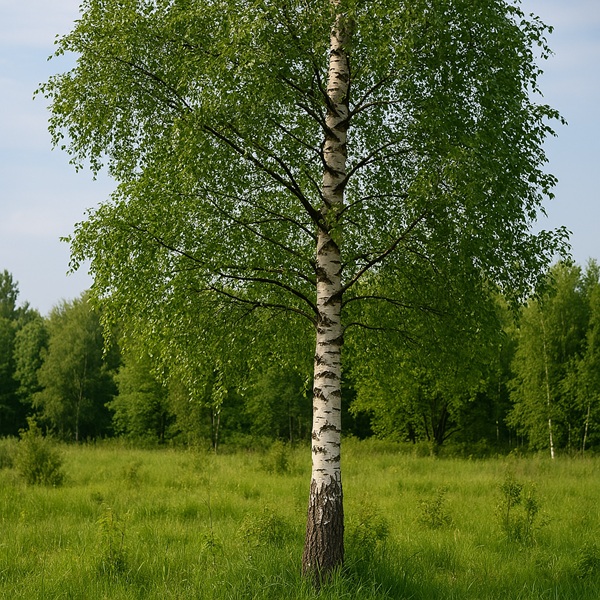
Birch is one of the most recognizable and beloved trees in the Ukrainian landscape. Its slender white trunk with black markings, graceful drooping branches, and light shimmering foliage create a unique image filled with poetry and harmony with nature. From a botanical point of view, birch belongs to the birch family (Betulaceae) and includes about 100 species, the most common in Ukraine being silver birch (Betula pendula) and downy birch (Betula pubescens). These trees are distinguished by high winter hardiness, rapid growth, and good adaptation to different conditions, which makes them ideal for landscaping both in cities and on private plots.
In the climatic conditions of Ukraine, birch feels comfortable in almost all regions, from Zakarpattia to Luhansk region. It withstands frosts down to -35°C, tolerates pruning well, and can even grow on poor sandy soils. However, despite such adaptability, the tree has certain requirements without which its growth and ornamental value will decline. The most important factors are sufficient moisture and a love of sunlight. In nature, birches often grow near bodies of water, along forest edges, and in areas with a moderately humid climate. In the southern regions of Ukraine, such as Mykolaiv and Kherson regions, the tree may experience stress during drought periods, especially when young.
Advantages of growing birch:
decorative throughout the year: in spring — bright green foliage, in summer — airy shade, in autumn — golden coloring, in winter — a contrasting trunk;
fast growth: up to 1 meter per year under favorable conditions;
environmental benefits: air purification, increased humidity, and phytomeliorative effects;
resistance to pests: damage is rare, especially in trees with dense bark;
undemanding in regard to soil: it can grow on sand, loam, and stony sites.
When choosing a birch for planting, it is worth considering its active root system. Horizontal roots can spread 5–7 meters from the trunk, which should be taken into account when placing other crops or structures nearby. It is also important to know that in mass plantings, birch may suppress neighboring plants because of its intensive use of moisture, especially during hot weather.
To grow birch successfully in a garden or park, it is important to choose the right place, taking the tree’s natural preferences into account. Birch prefers well-lit sites with moist but not waterlogged soils. It can grow in shade, but the crown will be loose and stretched, and its overall ornamental appearance will decline. The best options for planting are open lawns, forest edges, plots along fences, or areas away from buildings to avoid problems caused by the root system. Birch also looks excellent as a specimen tree or in row plantings, with the potential to reach 20–25 meters in height.
Birch is generally undemanding in regard to soil, but it grows best on light loams and sandy loam substrates with a neutral or slightly acidic reaction (pH 5.5–6.5). In heavy, clayey, or stagnant soils, the tree develops poorly: growth slows, fungal infections appear, and cracks form in the bark. Before planting, it is recommended to:
dig the site to a depth of at least 30–40 cm;
remove large roots and weeds;
add humus or compost, up to 10 kg per planting hole;
add sand to heavy soils, up to 30% of the volume;
lime the soil if acidity is elevated.
The planting hole should be 60–70 cm deep and wide. A drainage layer of gravel or expanded clay, 10–15 cm thick, is placed at the bottom, especially in dense soils. Then a fertile mixture is added, and the sapling is set vertically, with the root collar buried 2–3 cm. After planting, a trunk circle with a rim is formed and watered generously, up to 20 liters per tree. Mulching with peat, bark, or pine needles helps retain moisture and reduces weed growth.
It is important to consider the future size of the tree. In group plantings, at least 3–4 meters should be left between birches so the crowns do not intertwine and compete for resources. Near buildings and utilities, a minimum distance of 5–6 meters should be maintained, especially when planting a mature tree with a developed root system.
Birch can be propagated in different ways — by seed, green cuttings, and root suckers — but in Ukrainian gardening, the most convenient method is using saplings in containers or with an open root system. They are easy to buy from nurseries and root well if basic rules are followed. The best planting period is spring, from April to early May, or autumn, from September to October, with spring planting being preferable in regions with early frosts.
Basic planting rules:
use saplings up to 2–3 years old, as they adapt better;
if using an open root system, soak the roots in water for 6–12 hours;
plant in cloudy weather or in the evening;
after planting, always tie the sapling to a support to protect it from wind;
during the first month, water 1–2 times a week with 10–15 liters of water.
Transplanting mature trees is possible by transferring them with a soil ball, especially if the tree is over 2 meters tall. This is a difficult but feasible procedure. It is best carried out in autumn or early spring before bud break. The site is prepared in advance to reduce stress on the tree. With proper transplanting, mature birches recover quickly, especially if partial crown pruning is done to reduce moisture evaporation.
In modern landscaping, container planting of young birches is also popular for temporary decorative arrangements on terraces, rooftops, and balconies. However, such trees require intensive care: frequent watering, regular feeding, protection from overheating, and winter insulation.
Birch is a relatively undemanding tree, especially after it has rooted, but for full development and to preserve its ornamental value, it needs basic care. The main aspects are watering and protection from overheating, especially when young. In the conditions of Ukraine, particularly in the central and southern regions, hot summers and droughts can become a serious challenge. During the first two years after planting, birch is watered once a week with 15–20 liters per tree, and during drought periods up to twice a week. Mature trees need watering only when rain has been absent for a long time, more than 2–3 weeks, especially on sandy soils.
Mulching the trunk circle with peat, wood chips, or pine bark not only helps retain moisture but also protects the roots from overheating. It is advisable to renew the mulch layer annually. Another important element of care is feeding. In spring, March to April, nitrogen fertilizers such as urea or ammonium nitrate are applied to support active growth. In summer and early autumn, phosphorus-potassium complexes are used to strengthen the wood and prepare it for winter. If growth is slow and the leaves are pale, chelated micronutrient fertilizers with iron, magnesium, and boron are appropriate.
Birch pruning in Ukraine is performed rarely, since the tree naturally forms a beautiful crown on its own. However, in some cases it is necessary:
sanitary pruning of dry, broken, or diseased branches in winter or early spring;
thinning when the crown becomes too dense, especially in group plantings;
shaping decorative forms or trees planted along alleys;
limiting height if needed, for example near power lines.
It should be remembered that pruning is best done before sap flow begins, because birch has strong spring sap movement and the wounds may “bleed” for a long time. Only sharp, sterile tools should be used, and the cut surfaces should be treated with garden pitch or biological antiseptics.
Despite its high resilience, birch can suffer from a number of diseases and pests, especially under unfavorable conditions or sharp weather changes. Among diseases, the most common are fungal infections that cause branch dieback, spots on leaves, cracks in the bark, and root rot. There are also viral and bacterial infections that are difficult to treat, which is why timely prevention is important.
The most common diseases:
powdery mildew — a white coating on the leaves, more common in shaded places with high humidity;
birch rust — small reddish spots on the leaves, typical of humid summers;
bracket fungi and other wood-decaying fungi — affect weakened trees with damaged bark.
Control measures: spraying with fungicides such as Fundazol, Topaz, and Skor, sanitary pruning, wound disinfection, mulching, and avoiding overcrowding.
Pests:
aphids — especially in spring, causing leaf curling and discoloration;
leafrollers and caterpillars — feed on the leaves;
birch clearwing moth — damages the trunk and branches, especially in mature trees;
bronze birch borer — larvae tunnel under the bark, weakening the tree.
Prevention:
keep proper spacing when planting;
inspect trees regularly;
carry out timely sanitary pruning;
apply insecticides at the first signs of infestation, such as Aktara, Confidor, or Fufanon.
Birch is not just a tree but a true symbol of nature, widely used in landscape architecture and traditional Ukrainian gardening. Its light, elegant form adds vertical structure and depth to a site, while its white trunk contrasts beautifully with lawns and shrubs. It combines wonderfully with deciduous and coniferous species, especially in compositions with linden, rowan, maple, thuja, and juniper.
Main placement options:
alleys and group plantings along paths and driveways;
specimen trees on lawns as a focal point in a composition;
woodland-style plantings together with other trees;
landscape gardens with natural curves in paths and changes in elevation.
Birch is also widely used in folk medicine. Its buds, bark, and leaves are used in herbal therapy for infusions, decoctions, and ointments. Birch sap, collected in spring, contains vitamins, minerals, and organic acids and is considered a valuable preventive drink. In villages, birches were often planted near homes not only for aesthetic reasons but also as a symbol of purification and protection.
For those who value tradition and natural beauty, birch is an ideal choice. It creates shade, purifies the air, does not require complicated care, and lives for decades. And thanks to its rapid growth, within just 5–7 years after planting you will have a full-grown tree that decorates the site throughout the year.