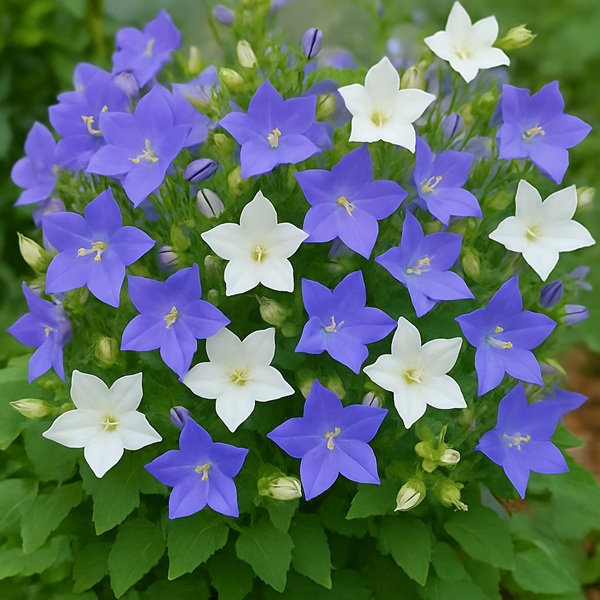
Bellflowers (Campanula) are ornamental plants capable of decorating both a garden plot and a windowsill in an apartment. The genus includes more than 300 species of herbaceous and semi-shrub forms distributed across the temperate climates of Europe, Asia, the Mediterranean, and the Caucasus. In Ukrainian flora, bellflowers are represented by both wild and cultivated species. They have long won popularity among gardeners thanks to their ease of cultivation and long flowering period.
The name comes from the Latin word campana, meaning “bell” — exactly the shape of the flower. Bellflowers bloom abundantly, and their flowers may be white, light blue, blue, lilac, and sometimes bicolored. They form on long shoots that are often trailing or slightly ascending. The leaves are usually rounded or heart-shaped, light green, and depending on the species may be smooth or slightly hairy.
In indoor floriculture, Campanula isophylla and Campanula portenschlagiana are especially popular. They are often called “the bride and groom”: the former has white flowers, while the latter has blue or lilac blooms. These species are not only decorative, but also very convenient for propagation — they root easily and quickly form dense cascading shoots. Bellflowers are perfect for hanging planters, balconies, verandas, and as an ampelous plant for south- and east-facing windows. Thanks to their easy care and lush flowering, they are an ideal plant for both beginners and experienced gardeners.
The choice of species depends on where you plan to grow bellflowers — indoors or in open ground. For Ukrainian conditions, quite a few varieties are suitable and perform well either in the garden or on a windowsill.
Campanula isophylla is an ampelous form, ideal for growing in hanging baskets. It has large flowers in white, blue, or violet. It features thin, trailing shoots and roots quickly. It prefers partial shade and moderate watering.
Campanula portenschlagiana is a low-growing ground-cover species. It blooms abundantly throughout the entire summer. It is frost-hardy and perfectly suited to rock gardens and borders.
Campanula carpatica (Carpathian bellflower) is the most popular garden species. It forms a compact mound up to 30 cm tall, with blue or white flowers. It tolerates the Ukrainian winter well.
Campanula medium (Canterbury bells) is a biennial with tall flowering stems. The flowers may be double or single and are excellent for cut arrangements. It requires reseeding or transplanting every two years.
Campanula lactiflora is a tall-growing species with slender shoots reaching up to 1.2 m. It forms large flowering clusters and is ideal for mixed borders.
Campanula punctata stands out for its spotted, drooping flowers. It requires fertile soil and regular watering.
For gardens in Ukraine, the best choices are C. carpatica, C. portenschlagiana, C. punctata, and C. medium — they are frost-hardy, drought-tolerant, and undemanding. For indoor cultivation, it is best to choose C. isophylla or hybrid ampelous forms. With proper care, bellflowers establish well both in flower beds and on windowsills.
Campanula can be propagated in several ways: by seed, cuttings, division of the rhizome, or layering. The most convenient time for planting is spring (April–May), when the threat of late frosts has passed. Some species can also be planted in autumn, but spring planting is more reliable under Ukrainian conditions.
Growing from seed:
The seeds are very small and are sown on the surface without being covered.
Sowing is done in March, in a loose substrate of peat and sand.
Cover with film, mist, and place in a warm bright spot at +18 to +22°C.
Seedlings appear in 10–14 days. After 2–3 leaves appear, they are pricked out.
They are planted into open ground in May.
For cuttings, use shoots 8–10 cm long, which root easily in water or moist sand. Mature plants can be divided in spring or autumn: the rhizome is cut, and the rosettes are planted separately.
The planting site should be bright or lightly shaded. The soil should be loose, well-drained, and neutral in reaction. Acidic soil should be limed. If the soil is clay-heavy, add sand. In containers, provide drainage such as expanded clay or gravel. The spacing between plants should be 20–30 cm, depending on the variety.
Properly organized care is the key to long and abundant flowering. Bellflowers are not overly demanding, but they respond sensitively to a lack of moisture and light. In Ukrainian conditions, especially in summer, it is important to provide regular watering, particularly during bud formation.
Recommendations:
In open ground, water 2–3 times a week; during dry periods, more often.
In pots and hanging baskets, watering may be needed up to 4 times a week. It is important to make sure there is no stagnant water.
Water at the base of the plant, avoiding wetting the flowers and leaves.
In winter, for indoor species, reduce watering to once every 10 days.
Feed every two weeks from March to August. Fertilizers for flowering plants with a high phosphorus and potassium content are preferred. Excess nitrogen promotes leaf growth but suppresses flowering. In autumn and winter, feeding is stopped.
Care also includes:
removing faded flowers, which prolongs blooming;
loosening the soil after rain or watering;
formative pruning for ampelous forms;
support for tall varieties;
misting the air around indoor forms when the air is dry.
If you follow these simple rules, bellflowers will bloom for a long time and actively maintain their ornamental appearance throughout the entire season.
Despite their hardiness, bellflowers can suffer from fungal diseases and pests, especially with excessive watering or poor ventilation. The main preventive measures are maintaining proper moisture levels and keeping the foliage clean.
Common diseases:
Gray mold (Botrytis) affects leaves and flower stalks, appearing as brown spots and a gray fluffy coating. The cause is excessive humidity. Solution: remove affected parts and treat with Fundazol or Bordeaux mixture.
Powdery mildew appears as a white coating, usually in warm, humid weather. Preparations such as Topaz and Skor help.
Root rot is often observed in potted plants and with stagnant water. Control method: repot into fresh substrate and use fungicides.
Pests:
Spider mites create a fine webbing, and the leaves lose their brightness. Use Fitoverm or Actellic.
Aphids settle on buds and young shoots. Spray with soapy water or Aktara.
Whiteflies are tiny white insects that weaken the plant. They are controlled with insecticides such as Confidor or Aktara.
Preventive measures:
moderate watering;
ventilation, especially for indoor bellflowers;
sanitary pruning;
regular inspection for pests;
repotting every 2–3 years.
Most garden bellflower species are perennial and overwinter well in open ground even without special covering. However, in regions with severe winters, it is worth taking extra precautions, especially for new or not yet well-established plantings.
For garden forms:
in autumn, cut them back to ground level;
mulch with dry leaves, peat, or spruce branches;
in spring, remove the cover, fertilize, and loosen the soil.
For indoor forms:
lower the temperature to +10 to +15°C;
reduce watering to 1–2 times a month;
stop feeding completely;
provide a bright but not hot place, such as a loggia or veranda.
In spring, during March–April, campanula is repotted, rejuvenated, and returned to active care. Cuttings are a quick way to renew the plant.
In design, bellflowers look wonderful:
along borders;
in flower beds and rock gardens;
as ground cover;
in combinations with lavender, hostas, and geraniums;
in cachepots, balcony boxes, and hanging pots.
Thanks to their unpretentious nature, frost resistance, and long flowering period, bellflowers remain one of the most beloved flowering crops for Ukrainian gardens and windowsills.