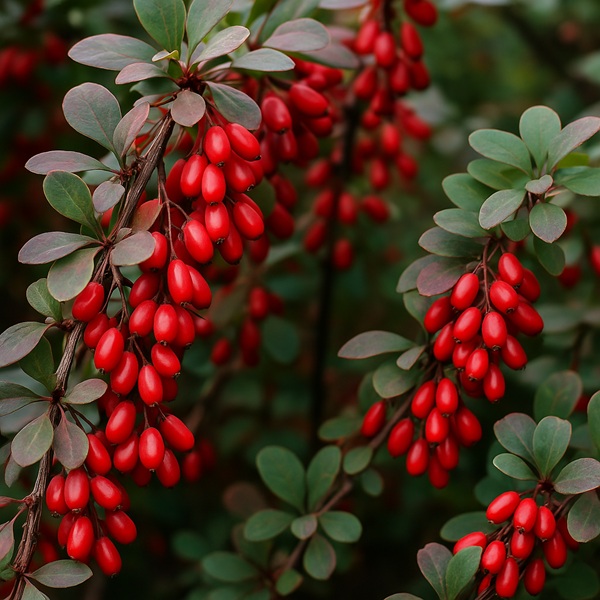
Barberry (Berberis) is an ornamental shrub known not only for its striking foliage and fruits, but also for its high resistance to unfavorable conditions. It belongs to the barberry family and includes more than 500 species, the most widespread in Ukraine being common barberry (Berberis vulgaris), Thunberg barberry (Berberis thunbergii), and numerous ornamental cultivars. The shrub is valued for its visual appeal, its ability to form hedges, its low maintenance requirements, and its drought tolerance, which is especially important during hot Ukrainian summers.
Barberry is well adapted to the climate of most regions of Ukraine. It tolerates frosts down to -30 °C without shelter and is resistant to heat and short-term drought. Because of this, it can be grown both in the southern regions (Odesa, Kherson, Mykolaiv) and in the northern and western parts of the country (Lviv, Chernihiv, Volyn). The main requirement is the right choice of site and minimal but proper care. Deciduous forms are more frost-resistant, while evergreen ones (Darwin’s barberry and others) require winter protection in colder regions.
Among the main advantages of barberry are its high ornamental value thanks to its bright leaves, flowers, and fruits; excellent resistance to urban conditions and air pollution; low demands on soil and strong drought tolerance; a wide variety of forms — from dwarf types (30–50 cm) to tall shrubs (up to 2.5 m); and the ability to be used either as a hedge or as a specimen plant in the landscape.
In addition to its ornamental qualities, many barberry species produce edible fruits. The berries contain organic acids, vitamin C, and pectins, and are used in folk medicine and cooking, especially in the Caucasus and Central Asia, as well as for making sauces and jam. In Ukraine, ornamental cultivars are grown most often. They may also bear fruit, but the berries are not always suitable for consumption because of their high acidity or bitterness.
One of the key factors in successful barberry cultivation is choosing the planting site wisely, because the shape of the shrub, the intensity of the leaf color, and the abundance of flowering all depend on light and soil quality. Barberry prefers sunny locations: with good light, its foliage develops especially vivid shades, from yellow to purple, and the crown remains dense and even. It will also grow in partial shade, but its ornamental quality decreases: the foliage turns greener, the shoots stretch out, and flowering and fruiting become weaker.
Barberry is undemanding when it comes to soil, but it grows best in light, well-drained substrates with a neutral or slightly alkaline reaction (pH 6.5–7.5). In acidic soils, the plant develops more slowly, becomes more susceptible to disease, and produces weaker growth. Before planting, it is recommended to lime the soil or add wood ash, especially if the soil is acidic. Sites with stagnant water and a high groundwater level are unsuitable, as they may lead to root rot.
Site and soil preparation:
dig the soil to a depth of 25–30 cm;
add humus or compost — 5–6 kg per 1 m²;
add wood ash (200 g/m²) or dolomite flour;
if needed, add sand to improve drainage;
1–2 weeks before planting, water the soil with a weak potassium permanganate solution or a biofungicide.
Barberry works well both in single plantings and in group compositions. When creating a hedge, the spacing between plants should be 0.4–0.5 m; for low-growing cultivars, 0.3 m is enough. In mixed plantings with other ornamental crops such as spirea, cinquefoil, and hydrangea, barberry does not suppress neighboring plants. On the contrary, it highlights them beautifully through the contrast of its foliage. It is worth remembering that some cultivars have thorns, so they should not be planted near children’s areas or pathways.
Barberry can be planted either in spring or in autumn, depending on the region and weather conditions. Spring planting is better suited to the northern and central regions of Ukraine, where winter is long and autumn is short. Autumn planting is recommended in the southern regions, and it should be done no later than late September or early October so that the shrub has time to root before frost. Plants with an open root system are planted while dormant — before bud break or after leaf fall.
Planting sequence:
dig a hole 40–50 cm deep and up to 50 cm in diameter;
place drainage at the bottom (crushed stone, gravel) — 10–15 cm;
fill with a mixture of garden soil, humus, and sand (2:1:1) with the addition of 100 g of superphosphate;
position the sapling so that the root collar is level with the soil surface;
firm the soil, water with 10–15 liters of water, and mulch with peat or bark.
During the first 2–3 weeks after planting, it is important to moisten the soil regularly, especially in dry weather. This helps the plant root quickly. After each watering, it is advisable to loosen the soil, remove weeds, and maintain the mulch layer. If planting is done in spring, the first feeding can be applied after 2–3 weeks using a nitrogen-containing compound fertilizer such as nitroammophoska. In autumn, no feeding is applied, since the plant should enter dormancy.
Barberry is an undemanding plant, but to preserve its decorative appearance and stimulate active growth, several key rules should be followed. In the first years after planting, timely watering is especially important: young plants are sensitive to soil drying out. Watering is done 1–2 times a week depending on the weather and rainfall. Mature shrubs need much less moisture — usually 1–2 times a month is enough if there are no long rains. It is important not to overwater, especially in heavy soils, to avoid root rot.
Starting from the second year after planting, barberry requires regular feeding. In spring (April–May), nitrogen fertilizers are applied to stimulate shoot growth — urea, ammonium nitrate, or compound mixes such as Kemira-Lux. In June–July, phosphorus-potassium fertilizers are used to support the formation of flower buds and strengthen the plant’s immunity. In autumn (late August to early September), ash or nitrogen-free autumn blends are applied. Foliar feeding with micronutrients such as boron, magnesium, and iron is used to prevent chlorosis and strengthen the foliage.
Barberry is pruned for two main reasons: sanitary pruning — removing dry, diseased, or damaged shoots — and formative pruning, used to create the desired shape, especially in hedges. Formative pruning is done in spring before sap flow begins. Thunberg barberry tolerates even deep pruning well. In autumn, light thinning or removal of individual branches is carried out. Dwarf cultivars usually do not need frequent intervention, while tall hedges are trimmed 2–3 times per season.
Barberry is generally resistant to disease, but on damp or overcrowded sites fungal infections may appear. The most common are powdery mildew, rust, and leaf spots. Aphids, barberry fly, sawflies, and spider mites may also occasionally cause damage. To prevent disease, it is important to avoid excessive watering and overcrowding and to maintain good air circulation.
Main diseases:
Powdery mildew — a white coating on leaves and shoots that leads to curling and leaf drop. Treatment: fungicides such as Topaz, Skor, and Raek.
Rust — bright orange spots on the leaves, especially on common barberry. Treatment: Bordeaux mixture, HOM.
Leaf spots — gray, brown, or black spots on the foliage, appearing under high humidity. Preparations: Fundazol, Previcur.
Pests:
Aphids — cluster on the shoot tips and cause leaf curling. Control: soap solution, Aktara, Confidor.
Barberry fly — damages the ovaries and causes them to drop. It is treated with insecticides before flowering.
Spider mite — especially dangerous in hot weather. Control: Actellic, Fitoverm.
Prevention includes timely pruning, good ventilation of the shrubs, moderate watering, mulching, and treatment with biofungicides twice a season.
Barberry can be propagated in several ways: by seed, cuttings, layering, and division of the bush. Under Ukrainian conditions, vegetative methods are the most convenient because they preserve varietal characteristics.
Main methods:
Cuttings — in spring or summer, green cuttings 10–15 cm long are taken and rooted in a greenhouse in a peat-sand substrate.
Layering — in spring, lower branches are pinned to the ground; by autumn they root, and the following year they are separated.
Division of the bush — used when transplanting a mature plant in spring or autumn.
Seeds — require stratification and are rarely used in amateur gardening.
In landscape design, barberry is truly versatile. It is excellent for hedges, borders, rock gardens, mixed borders, and alpine slides. Dwarf cultivars such as ‘Bagatelle’ and ‘Atropurpurea Nana’ are ideal for edging paths and for the front of flowerbeds. Taller ones such as ‘Red Rocket’ and ‘Golden Ring’ look beautiful as bold color accents. Barberry combines well with conifers, ornamental grasses, and perennials. Thanks to its resistance to unfavorable conditions, it is suitable both for private gardens and for urban squares.